Why your birth time still matters—long after the cake is gone
This is a practical field guide for anyone who only knows their birth date: how birth time—the hour and minute written on a chart or certificate—gets recorded, where it is lost or rounded, how families and archives still leave recoverable clues in plain sight, and how to treat that clock time like evidence when a form, a database, or a family dispute stops letting the day stay comfortably vague.
Published on

Most people can recite their birth date from muscle memory. Far fewer can say, without hesitation, the birth time down to the minute. That gap is so common it feels normal—until you need precision for genealogy, amended identity documents, twins order, legal affidavits, or even a high-precision age model that cares about the exact instant you began. This article explains what that minute represents in the real world, why it disappears from family memory faster than the date, and how to recover it like a researcher instead of guessing like a game show contestant.
Nothing here is legal or medical advice. Rules for vital records differ by country, state, and era; always follow the issuing authority's process when ordering or correcting documents.
Plain reasons the birth minute can matter
A birth date answers the dinner-party question, "what year were you born?" A birth minute answers a narrower one: "where on that day did the world flip from before-you to after-you?" Everyday life usually runs on the date. The minute tends to surface when two stories would collide without it, or when a form, chart, or timer insists on milliseconds from an instant rather than a civil day.
Think about when you have reached for a birth time even casually: filling out international residency or visa applications, comparing two relatives born the same day in the same city, settling which twin is "older" for a ceremony, reconciling a hospital bracelet photo with a certificate time, or watching a live counter that ticks elapsed time from a starting instant you typed in as noon because no one remembered. Those are all different doorways into the same idea: the minute is how the paperwork and the math stop blurring everyone who shares your birthday into one generic slot.
- Genealogy and family matching. A tighter clock window shrinks the haystack when you are deciding whether two index entries could plausibly belong to the same newborn.
- Same-day stories that would otherwise tie. Two siblings, cousins, or hospital neighbors born on the same calendar date need more than the date to keep timelines honest in a written narrative.
- Digital tools that measure from birth. When software asks for a clock time and you leave the default, you are signing a quiet contract about which version of your origin story the dashboard is allowed to tell.
- Heirlooms and memory objects. A nursery log or a film receipt stamped near discharge can still be emotionally important even when no law requires the minute—because precision is one way respect shows up in the archive you leave behind.
Why governments and hospitals started writing the clock, not just the calendar
For most of history, "born on Tuesday" was enough for parish registers. As births moved into hospitals in the 20th century, staff began noting the time of delivery for clinical documentation: labor progression, medication timing, newborn screening sequences, and discharge paperwork. That clinical habit leaked into civil registration. In the United States today, many (not all) state-issued certificates expose a time field—but older certificates, home births, or delayed filings may list only a date, or a rounded time supplied from memory days later.
The takeaway is simple and genuinely useful: your certificate is a snapshot of what the filing system knew at the time, not a metaphysical measurement of the universe. When the time is missing, it usually reflects workflow—not a conspiracy.
In many modern clinical settings, the recorded minute of birth is synchronized with the Apgar Timer. This is a standard evaluation of a newborn's health conducted at exactly one minute and five minutes after delivery. Because medical staff must be precise for this clinical assessment, the "birth time" on your record is often the most accurate timestamp in the entire hospital building—tied to a life-saving countdown, not just a casual glance at a wall clock.
| Source | What you often get | How to use it |
|---|---|---|
| Hospital labor & delivery / newborn records | Physician or nurse charted time of birth; may appear on discharge summaries | Request records through the hospital's health information office; retention varies by facility policy. |
| State or territorial vital record (birth certificate) | Time printed or blank depending on year and jurisdiction | Order a certified copy from the vital records office that holds the register—not a souvenir hospital certificate. |
| County or city register (older U.S. registrations) | Handwritten ledgers; quality varies | County clerk archives sometimes preserve registers even when later state abstracts dropped fields. |
| Delayed certificate of birth (filed years later) | Time may reflect affidavit memory, not contemporaneous charting | Treat time as provisional unless corroborated; prioritize primary clinical contemporaneous notes. |
| Family memory ("sometime after dinner") | Low precision, high emotional value | Interview relatives separately; compare stories; look for contradictions that suggest rounding. |
| Photographs with camera timestamps | EXIF may show "hospital day" timing clues | Clocks can be wrong; timezone settings matter—use as supporting evidence, not sole proof. |
A quick self-check: is the birth minute your problem this week?
You do not owe the universe a perfect timestamp. This page is for the stretch of life where the minute becomes load-bearing: when you are about to swear something in writing, stitch two archives together, or trust a counter that cannot read your intentions—only the fields you typed.
- You are about to file or amend a record. If a clerk asks for time-of-birth and you shrug, you are not being rude; you are deciding which placeholder the file will carry forward.
- You are comparing two people born the same day. Without a clock, the story compresses into a tie that real life may not have tied.
- You are using a tool that counts from birth. The tool will pick a time if you do not; knowing whether you agree with that pick is the whole point of caring.
- You are writing family history for someone else to inherit. Future readers cannot interview your sources; they inherit whatever specificity you bothered to freeze.
Why "12:00" keeps showing up when nobody remembers noon
Databases, forms, and calculators hate incomplete timestamps. If a system requires a full instant but only a date was collected, engineers often insert a neutral default—frequently 12:00 (noon) or midnight—so the program can run. That choice is invisible on paper until someone runs elapsed-time math and discovers their "precise" age shifts by hours. The informational win is blunt: a default time is a silent assumption, not a recovered fact.
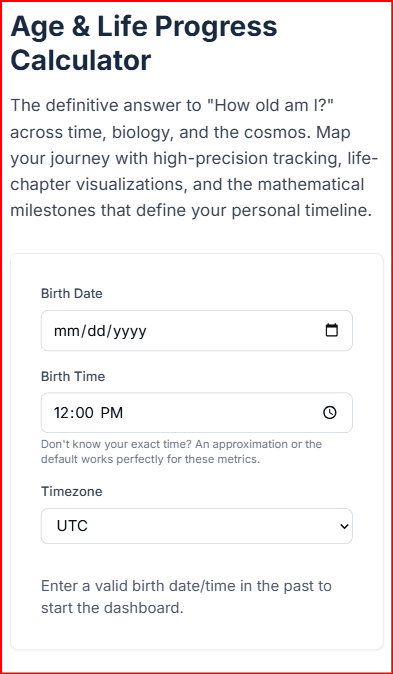
We see this pattern play out everywhere—even in the calculators we build to track life progress, where we have to balance that need for technical precision with the reality of human memory.
Swipe horizontally or scroll to the right to view the full screenshot.
The same logic applies when a parent tells a school office "we don't know" and the office types noon. If you later learn a closer window—say, between morning rounds and lunch—you can update your personal model even if you never amend the certificate. What matters is knowing which parts of your timeline are anchored in evidence vs. filler.
When you want to see how sensitive your age-in-seconds story is to that assumption, try our Age & Life Progress Calculator with two different plausible birth times on the same date: the ticker moves because time is continuous, even when memory is not.
How to investigate like a genealogist (without turning into one)
You do not need a subscription archive habit to make progress. Work outward in rings: closest contemporaneous sources first, then family ephemera, then newsprint. Write down every version of the story you hear, including who told it and when—contradictions are data.
- Order the long-form record if available. Some jurisdictions issue abstracts that omit fields present on the image filed with the state.
- Ask for newborn nursery paperwork or immunization booklets. Parents sometimes kept booklets with date-time stamps even when the fancy certificate frame stayed empty.
- Search local newspapers for birth announcements. Families paid for lines that could include morning or evening language—even if not atomic-clock precise.
- Religious records. Baptism entries sometimes include date and celebrant notes; compare to civil dates for consistency.
- Immigration and naturalization files. Passenger manifests and later petitions sometimes repeat or "correct" birth facts; treat them as corroboration, not automatic truth.
If you amend a record, keep copies of both versions. Genealogists call that trail a "proof standard" for a reason: future-you will forget which PDF was which.
When the date alone is usually enough—and when the minute earns a closer look
Plenty of errands never ask for a minute. If your week is running on rough age bands, school enrollment by birth year, or a cake with the right number of candles, the calendar is doing the heavy lifting and that is normal.
The minute earns attention when ambiguity would quietly rewrite something you care about: which record is the one you mean to stand behind, which sibling story is literally first, which database row is supposed to represent you, or which anniversary of an instant you are actually celebrating when the clock is fuzzy.
If none of that is on your desk right now, you can still skim the rest as reference for the week when it is—without owing anyone a crisis about precision.
Edge cases worth knowing before you argue with a cousin in the group chat
Twins. Order of birth can matter for identity and inheritance stories; times should be minutes apart on a well-charted delivery. If times match exactly on an old abstract, suspect transcription limits—not telepathy.
Midnight boundaries. A birth one minute after midnight belongs to the next calendar day. Family lore that compresses "born right at midnight" often smooths a messy clock into a story.
Time zones and travel. A birth in one zone recorded later in another can create apparent conflicts. When in doubt, anchor to the hospital location's local civil time as recorded, then map forward—not the other way around.
The 'Fall Back' Hour (Daylight Saving Ambiguity)
The 'fall back' hour. If you were born during the early morning hours of an autumn 'clock change' Sunday, your birth time might exist in a temporal loop. When clocks 'fall back' from 2:00 AM to 1:00 AM, the hour between 1:00 and 2:00 occurs twice. Unless your birth record explicitly notes 'DT' (Daylight Time) or 'ST' (Standard Time), there is a 60-minute margin of error that is mathematically impossible to resolve without clinical notes. This is a rare but 'definitive' edge case for anyone born in jurisdictions that observe DST.
If you want to see everyone in your household on the same future date, try our Future Age & Milestones Calculator.
If the point still feels abstract, here is the through-line
Birth time matters because civil life is mostly built on dates, while evidence, software, and some family stories are built on instants. When those two layers disagree, the date wins at the party and the instant wins in the footnote—unless you go looking for the footnote on purpose.
Recovering a minute is not superstition and not vanity. It is hygiene for any future you who will have to answer a sharper question than "what day?" with something sturdier than a shrug.
- Records layer: what did the filing system actually capture when someone could still remember?
- Math layer: what instant is a machine counting from when it says "you"?
- Story layer: what detail keeps two living memories from collapsing into one sentence?
In short
- Birth time is primarily a modern clinical and civil-registration artifact; absence on older documents usually reflects era and place, not a personal slight.
- Your strongest minute-level evidence is typically closest to the delivery record, not the family group text thread.
- Software defaults like noon are completeness strategies; label them mentally so they don't masquerade as memory.
- Investigate in rings—vital image, hospital PDFs, announcements, religious entries—keeping contradictory versions because they help you spot rounding.
- When precision matters for modeling, re-run the math after you tighten the window; hours matter to a second counter even when they don't matter to a cake candle.
- Beware the DST loop—births during the 'fall back' hour require a 'Daylight' or 'Standard' notation to resolve a 60-minute mathematical ambiguity.
- Recognize the Apgar link—modern birth times are often high-precision because they anchor the clinical evaluation timers used by neonatal staff.
- Name whether your open question is legal, genealogical, mathematical, or sentimental—that tells you if the minute is load-bearing this month or merely nice to have.
- The same calendar day can hide multiple true stories until someone writes down or recovers the clock.
- Recovering time is optional; knowing when you are guessing usually is not—especially before a form, database, or affidavit freezes a default for you.