The Silent Ingredients: A Guide to Hidden Gluten and Safe Eating
Stop guessing at the grocery store. We break down the science of Celiac safety, expose hidden additives, and give you the tools to verify your food with confidence.
Published on

The Science of Safety: Beyond the Bread Basket
For decades, the gluten-free diet was viewed as a niche medical necessity. Today, it is a global phenomenon. However, as the market expands, so does the confusion. For the estimated 1% of the population with Celiac Disease, and the millions more with Non-Celiac Gluten Sensitivity (NCGS), accuracy isn't a lifestyle choice—it is a health requirement.
This guide moves beyond the basics of "avoiding bread" to serve as a definitive reference on what gluten is, where it hides, and how to verify the safety of your food.
Defining the Enemy: What is Gluten?
Gluten is a general name for the proteins found in wheat (gliadin and glutenin), rye (secalin), and barley (hordein). It acts as a glue that helps food maintain its shape.
According to the Celiac Disease Foundation, gluten triggers an immune reaction in people with Celiac Disease that damages the villi in the small intestine. This damage prevents nutrient absorption. For those with NCGS, the reaction may not damage the intestine but causes systemic inflammation, brain fog, and abdominal pain.
The "Big Three" and Their Derivatives
The foundation of a gluten-free diet is the strict elimination of three primary grains. While this seems straightforward, these grains appear on ingredient labels under various names.
Wheat: The most common offender. It hides in:
- Semolina
- Spelt
- Farro
- Durum
- Bulgur
- Graham
Barley: Frequently overlooked because it is often used for flavoring rather than structure.
Watch out for: Malt, Malt Flavoring, Malt Vinegar, Brewer's Yeast.
Rye: Common in cereals, breads, and beers.
Watch out for: Triticale (a hybrid of wheat and rye).
The "Hidden" Gluten: Additives and Stabilizers
The greatest challenge in gluten-free living is not the bread aisle, but the condiment and processed food aisles. Manufacturing processes often use gluten-derived ingredients as thickeners or stabilizers.
The Malt Trap
According to the Mayo Clinic, malt flavoring can be made from barley. This makes many corn flakes, rice crisps, and barbecue sauces unsafe, even if the primary grain is corn or rice.
Modified Food Starch
In the United States, if "Modified Food Starch" is made from wheat, it must be labeled as such (e.g., "Modified Wheat Starch"). This is mandated by the Food Allergen Labeling and Consumer Protection Act (FALCPA), which requires the declaration of any ingredient derived from the eight major allergens, including wheat. However, in imported goods or vague labeling, this can be a risk factor.
Hydrolyzed Vegetable Protein (HVP)
Often found in soy sauce and imitation meats, HVP is frequently derived from wheat. Unless the product is explicitly labeled "Tamari" (which is traditionally wheat-free) or certified gluten-free, soy sauce is generally unsafe.
Tip: If you encounter an ingredient list with ambiguous terms like "Natural Flavors" or "Dextrin," it is safer to verify them. You can check specific additives using our Gluten-Free Checker Tool to ensure they don't contain hidden derivatives.
The 20ppm Standard: Why "Gluten-Free" Isn't "Zero"
In the United States and much of Europe, the legal definition of "Gluten-Free" allows for up to 20 parts per million (ppm) of gluten. For most people with Celiac disease, this is a safe threshold that doesn't trigger a reaction. However, it is a reminder that "Gluten-Free" on a processed package is a measurement of safety, not a claim of absolute absence. If you find you are still experiencing symptoms while eating "certified" processed foods, you may be among the small percentage highly sensitive to even these trace amounts.
The Oats Controversy
Oats are technically gluten-free. However, they are historically grown in fields adjacent to wheat or processed in the same facilities, leading to high risks of cross-contamination.
The FDA (U.S. Food & Drug Administration) allows oats to be labeled gluten-free only if the final product contains less than 20 parts per million (ppm) of gluten. If you have Celiac Disease, you should only consume oats that are specifically labeled "Certified Gluten-Free." However, keep in mind that this goes back to the section above where 20 ppm is not the absence of gluten, but a measurement of safety.
Swipe horizontally or scroll to the right to see the full-width screenshot.
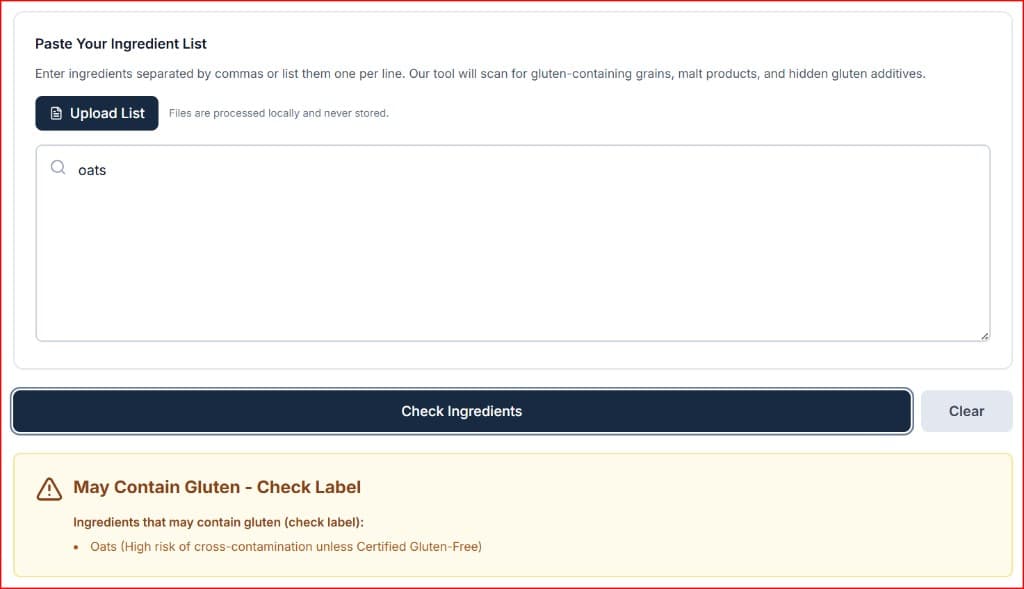
Functional Audit: A simulation run via our Gluten-Free Checker Calculator. When "oats" are analyzed, the system triggers a warning regarding cross-contamination risk. This logic ensures users are prompted to verify "Certified Gluten-Free" labeling, accounting for the frequent agricultural and manufacturing contact with wheat and barley.
The Distillation Rule: Alcohol and Vinegars
One of the most common points of confusion is whether grain-based alcohol is safe. The science of distillation is simple: gluten is a heavy protein that does not evaporate. When alcohol or vinegar is distilled, the liquid is turned into steam and then condensed back into liquid, leaving the gluten protein behind in the boiling vat. This is why distilled white vinegar and distilled spirits (like Vodka made from wheat) are scientifically gluten-free. Note: This does NOT apply to non-distilled items like malt vinegar or beer.
*Labels, additives, and individual sensitivity still matter — when stakes are high, verify the specific product and your clinician's guidance.
Safe Grains and Substitutes
Removing gluten does not mean removing carbohydrates or grains. There is a wide spectrum of naturally gluten-free ancient grains that offer superior nutritional profiles:
Pseudocereals: Quinoa, Buckwheat, Amaranth.
(Note: Buckwheat is related to rhubarb, not wheat, and is completely safe).
Cereals: Rice (Brown, White, Wild), Corn (Maize), Sorghum, Teff, Millet.
Beyond the Plate: The Medicine Cabinet and Makeup Bag
True safety requires looking beyond what you eat. Prescription medications often use starches as binders, and unless they are specified as corn or potato-based, they can contain gluten. Similarly, lip balms and lipsticks often use Vitamin E (Tocopherol) derived from wheat germ. Since these products are applied to the mouth, they can lead to accidental ingestion. If you have chronic, unexplained symptoms, your next step should be a full audit of your toiletries and medications.
Cross-Contamination: The Invisible Threat
For those with high sensitivity, ingredients are only half the battle. Cross-contact occurs when a gluten-free food comes into contact with gluten. Common vectors include:
Toasters:
Shared toasters are a major source of crumb contamination.
Deep Fryers:
French fries are naturally gluten-free, but if they are fried in oil used for breaded onion rings, they become unsafe.
Condiment Jars:
"Double dipping" a knife into a jar of mayo or peanut butter after spreading it on wheat toast contaminates the entire jar.
| Ingredient signal | Risk level (conceptual) | Practical action |
|---|---|---|
| Wheat, barley, rye, or obvious flour called out | High for gluten avoidance | Treat as gluten-containing unless a certified gluten-free process is documented. |
| Malt, malt extract, malt vinegar (non-distilled) | High—often barley-derived | Avoid unless the label clearly states a gluten-free claim you trust. |
| Unspecified “starch” or “modified food starch” | Variable—source matters | Prefer products that name the source; when unclear, choose verified gluten-free brands. |
| “Natural flavors” or vague flavorings | Variable—sometimes a hiding place | Use brands with transparent labeling or contact the manufacturer when stakes are high. |
| “May contain wheat” or shared equipment | Elevated cross-contact risk | Decide based on your sensitivity; many celiac protocols avoid these lines entirely. |
The Cross-Contact Cheat Sheet
| Location/Tool | Contamination risk | Safe habit |
|---|---|---|
| Toasters | Crumbs from previous wheat bread | Use reusable toaster bags or a dedicated GF toaster. |
| Wooden Utensils | Porous wood traps microscopic gluten particles | Switch to metal or silicone tools for GF cooking. |
| Condiment Jars | "Double-dipping" knives from wheat bread | Use squeeze bottles or label jars as "GF Only." |
| Shared Sponges | Sponges hold gluten residue from pasta pots, as an example | Use a separate color-coded sponge for GF items. |
Summary
Navigating a gluten-free lifestyle requires vigilance and education. While the elimination of Wheat, Barley, and Rye is the foundational step, true safety lies in understanding ingredient labels and manufacturing processes.
Medical Necessity
For Celiac patients, gluten causes physical damage. For NCGS, it causes systemic symptoms. Both require strict adherence.
Ingredient Awareness
Look beyond the obvious grains. Malt, modified starches, and natural flavorings can harbor gluten.
Cross-Contamination
Your kitchen practices are just as important as your grocery shopping.
Verification
When in doubt about a specific additive or food product, utilize verification tools to prevent accidental ingestion.