Understanding BMI: What It Is, How It Works, and When to Use It
A screening tool for body weight categories—and how to interpret it correctly.
Published on

If you have ever visited a doctor's office, filled out a health questionnaire, or researched weight management online, you have likely encountered Body Mass Index (BMI). It is one of the most widely used screening tools in healthcare, recognized by the World Health Organization (WHO) and the Centers for Disease Control and Prevention (CDC).
But what exactly is BMI? How is it calculated, and what do the categories mean? More importantly, when is it useful versus misleading?
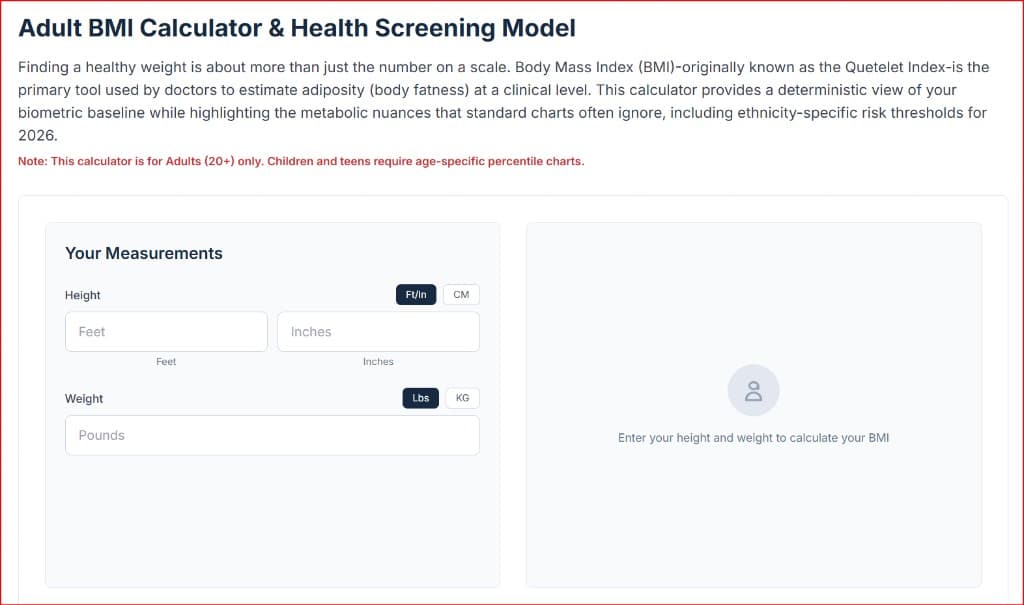
If you want to check your BMI quickly, you can use our BMI Calculator. The sections below explain what it measures, how it works, and when to use it as part of a broader health assessment.
Swipe horizontally or scroll to the right to view the full screenshot.
What BMI Is (and What It Isn't)
BMI is a mathematical ratio of weight to height squared. It provides a quick, standardized way to categorize body weight relative to height. The key thing to understand: it is not a direct measure of body fat, and it does not account for muscle mass, bone density, or fat distribution.
BMI is a screening tool, not a diagnostic one. It is designed to identify potential weight-related health risks at a population level, not to determine an individual's body composition or health status.
For a deeper understanding of how weight is distributed in the body, our article on understanding body composition explains why the number on the scale is less informative than how that weight is distributed.
The Statistical Origin: The "Average Man"
BMI was not created by a physician or a nutritionist, but by a Belgian mathematician named Adolphe Quetelet in the mid-19th century. He was not looking for a way to diagnose health, but rather to define "L'homme moyen" (the average man) through statistics. This is why BMI remains a powerful tool for population-level data but often fails to capture the physiological nuances of a single individual.
How BMI Is Calculated (The Formula)
BMI is calculated by dividing weight in kilograms by height in meters squared. In practice, you will see it expressed in either metric or imperial units:
Metric Formula
BMI = weight (kg) ÷ height (m)²
Example: A person who weighs 70 kg and is 1.75 m tall has a BMI of 70 ÷ (1.75)² = 22.9
Imperial Formula
BMI = [weight (lbs) ÷ height (inches)²] × 703
Example: A person who weighs 154 lbs and is 69 inches tall has a BMI of [154 ÷ (69)²] × 703 = 22.7
The multiplication factor of 703 is a conversion constant required to align imperial units (pounds and inches) with the standard metric BMI scale (kg/m²).
The Mathematical Scaling Flaw: Square vs. Cube
A technical criticism of the BMI formula is that it uses a square exponent (height²) while humans are three-dimensional objects. Mathematically, as an object grows in size, its volume (and weight) increases at a faster rate than its surface area. This "scaling bias" often penalizes taller individuals by flagging them as overweight simply because the formula doesn't account for the cubic nature of human volume. Some mathematicians suggest that an exponent of 2.5 would provide a more accurate representation for taller frames.
BMI Categories: What They Mean
According to the WHO and CDC, BMI is categorized into the following ranges for adults:
Adult BMI Categories
These categories are based on epidemiological studies that link BMI ranges to health outcomes. However, they are general guidelines, not absolute rules. Individual factors like age, muscle mass, and body composition can significantly affect what BMI means for a specific person.
When BMI Is Useful (Screening Tool)
BMI is most effective as a population-level screening tool. Healthcare providers use it to:
1. Identify Potential Health Risks
BMI can help identify individuals who may be at increased risk for conditions like type 2 diabetes, cardiovascular disease, and certain cancers.
2. Track Trends Over Time
Monitoring BMI changes can help track weight trends and evaluate the effectiveness of lifestyle interventions.
3. Guide Clinical Decisions
For medication dosing, surgical planning, and other clinical purposes, BMI provides a quick reference point.
When BMI Is Misleading (Limitations)
BMI has significant limitations because it doesn't differentiate between muscle and fat. This means it can misclassify certain populations:
Athletes and Highly Muscular Individuals
Athletes with high muscle mass may have a BMI in the "overweight" or even "obese" range despite having very low body fat percentages. Muscle is denser than fat, so a muscular person can weigh more than their BMI category suggests is healthy.
Older Adults
As people age, they tend to lose muscle mass and gain fat, even if their weight stays the same. BMI doesn't capture this shift in body composition. However, research suggests that for adults over 65, a slightly higher BMI (e.g., 25–27) can sometimes be protective against frailty and mortality, meaning the standard "Normal" range (18.5–24.9) isn't always the optimal target for geriatric populations.
Ethnicity & Race
Standard BMI cutoffs do not apply universally across all populations. The World Health Organization recognizes that for Asian populations (South and East Asian), health risks often begin at lower BMI levels compared to the general population. For example, a BMI of 23 or higher may be considered overweight for Asian individuals, rather than the standard cutoff of 25. This reflects differences in body composition, fat distribution, and metabolic risk profiles across ethnic groups.
Normal Weight Obesity (The "TOFI" Profile)
A significant limitation of BMI is its inability to flag "Normal Weight Obesity," often referred to as TOFI (Thin Outside, Fat Inside). A person can land in the 18.5–24.9 "Normal" range but still possess high levels of visceral fat around their organs, which carries the same metabolic risks as high-BMI obesity. This is why a "Normal" result should never be used as a free pass to ignore metabolic health markers like blood glucose or waist-to-hip ratio.
Fat Distribution Matters More Than Total Weight
Two people with the same BMI can have vastly different health risks based on where their fat is stored. Visceral fat (around the organs) is more metabolically active than subcutaneous fat (under the skin), but BMI doesn't distinguish between them.
For a more comprehensive view, BMI is best used alongside other metrics. Our Ideal Weight Calculator uses the Devine Formula to provide another reference point. Learn more about how ideal body weight is calculated in our article on the Devine Formula for ideal body weight.
How to Use BMI Responsibly
BMI is a starting point, not a destination. Here's how to use it effectively:
1. Use It as One Data Point
Don't rely solely on BMI. Combine it with other indicators like waist circumference, body composition measurements, blood pressure, cholesterol levels, and lifestyle factors.
2. Consider Your Individual Context
If you're an athlete, have a muscular build, or are over 65, your BMI may not accurately reflect your health status. Discuss your results with a healthcare provider who can interpret them in context.
3. Focus on Trends, Not Just Numbers
Rather than fixating on a specific BMI number, pay attention to trends over time. Are you maintaining a stable BMI, or is it changing? What lifestyle factors might be contributing to those changes?
4. Pair It with Body Composition Awareness
Understanding your body composition—the ratio of muscle to fat—provides context that BMI alone cannot. This is why tools like our BMI Calculator and Ideal Weight Calculator are most useful when used together with professional health assessments.
| BMI range (adult screening) | Category (typical WHO cut points) | Limitation to remember |
|---|---|---|
| Under 18.5 | Underweight band | Does not flag low lean mass vs. naturally slight build; clinical context matters. |
| 18.5 – 24.9 | Normal-weight band | Still misses visceral fat risk in some people; not ethnicity-specific on its own (e.g., fails to flag higher metabolic risk at lower BMI in South/East Asian populations). |
| 25.0 – 29.9 | Overweight band | Muscular athletes can land here without excess adiposity. |
| 30.0 and above | Obesity classes | Useful for screening trends, not a diagnosis; does not show fat location. |
Summary: Understanding BMI
BMI is a screening tool that categorizes body weight relative to height. It is calculated by dividing weight in kilograms by height in meters squared (or using the imperial formula with pounds and inches).
BMI categories range from underweight (less than 18.5) to obesity (30.0 or higher). While useful for population-level screening, BMI has limitations—it doesn't account for muscle mass, bone density, or fat distribution, making it potentially misleading for athletes, older adults, and individuals with unique body compositions. Note that these health risk thresholds can vary by ethnicity (often lower for Asian populations) and age (often higher for older adults).
Use BMI as one data point alongside other health metrics, professional guidance, and awareness of your individual context for a more complete picture of your health.
- The Scaling Bias: The formula's use of a square exponent (height²) can mathematically penalize taller individuals due to the "Square-Cube Law" of volume.
- TOFI Risk: A "Normal" BMI does not rule out "Normal Weight Obesity," where high visceral fat exists despite a healthy-looking scale weight.