Understanding Body Composition
Why the number on the scale doesn't tell the whole story.
Published on

The Limitation of Total Weight
In health and clinical settings, "weight" is often treated as a singular metric. However, weight alone does not differentiate between the various tissues that make up the human body. Two individuals can weigh exactly the same yet have entirely different health profiles based on their Body Composition—the proportion of fat, muscle, bone, and water in the body.
The Role of Body Mass Index (BMI)
The most common screening tool used by the World Health Organization (WHO) and the CDC is the Body Mass Index (BMI). It is a mathematical ratio of weight to height that provides a quick assessment of whether an individual falls within a "healthy" range for their stature.
While BMI is an excellent population-level metric for identifying potential health risks, it is a screening tool, not a diagnostic one. For instance, athletes with high muscle density may be categorized as "overweight" by BMI standards, even with very low body fat percentages. To get a clearer picture of your standing, you can use our BMI Calculator as a starting point for further health discussions.
Swipe horizontally or scroll to the right to see the full-width screenshot.
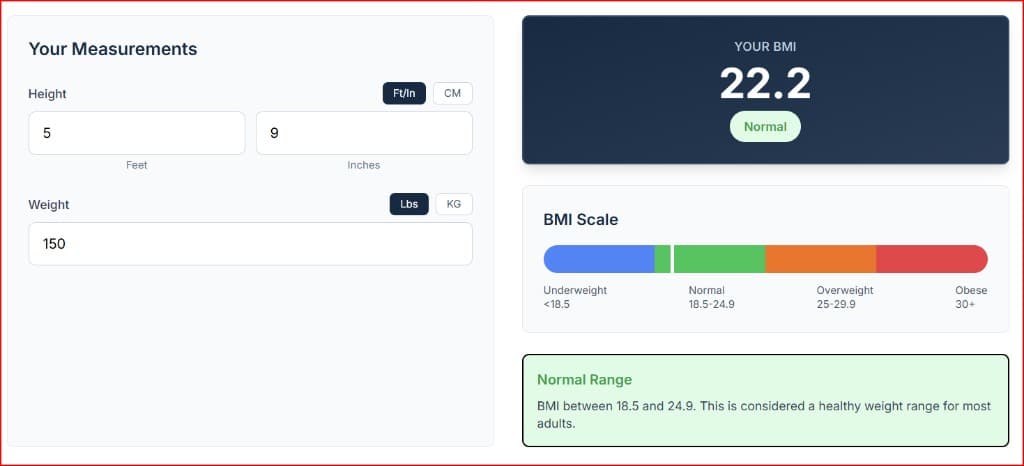
Functional Audit: A simulation run via our BMI Calculator. While BMI is a high-level mathematical screening tool rather than a diagnostic one, it remains the global standard for identifying potential weight-related health risks. We utilize high-precision metric conversions to ensure our outputs align with clinical WHO and CDC standards.
Essential Fat vs. Storage Fat
From a biological perspective, not all body fat is the same. According to the National Institutes of Health (NIH), the body requires a specific amount of Essential Fat to function.
Essential Fat
Necessary for hormone regulation, vitamin absorption, and temperature control.
Storage Fat
Accumulated energy reserves that protect internal organs.
Body Composition Breakdown (Average Adult)
Figure 1: Typical body composition breakdown for an average adult.
Inspired From: National Institutes of Health (NIH) - 4-Compartment Model of Body Composition.
The "Ideal Weight" Concept
Medical professionals often discuss "Ideal Body Weight" (IBW) based on clinical formulas like the Devine or Miller equations. These formulas attempt to determine a weight range where an individual typically experiences the lowest risk for chronic conditions. Understanding where you sit relative to these clinical benchmarks can be modeled using our Ideal Weight Calculator.
Clinical Benchmarks for Health
Research published in the Journal of Clinical Medicine indicates that where fat is stored matters more than the total amount. Visceral fat (the internal abdominal fat that surrounds organs) is more metabolically active and more closely linked to cardiovascular risks than subcutaneous fat.
Why You Can't Always Trust the Mirror (The "Skinny Fat" Reality)
Looking "thin" is not a mathematical guarantee of health. There is a specific body composition profile known as TOFI—"Thin Outside, Fat Inside." This occurs when an individual has a low Body Mass Index (BMI) and looks lean, but carries a high percentage of internal visceral fat. Because this fat is hidden around the organs rather than under the skin, it can go unnoticed while still increasing the risk for metabolic issues. Understanding your composition reminds us that health is about what's happening inside the body, not just how we look in the mirror.
The "Muscle vs. Fat" Space Race
One of the biggest frustrations in fitness is the "Scale Plateau," where your weight stays the same despite weeks of hard work. The math explains why: muscle is much denser than fat. Think of a pound of muscle as a small, heavy brick and a pound of fat as a large, fluffy pillow. They weigh the same, but the brick takes up much less space. If you are losing fat and gaining muscle at the same time, your weight might stay frozen, but your body is actually shrinking. This is why measuring your waistline often tells a more accurate story than the scale.
Same weight on the scale — very different room in your clothes
Figure 2: Conceptual sketch—tissue shapes are simplified. The point is density: equal weight does not mean equal size on your frame.
Aging Math: Why Muscle is Your "Health Pension"
As we age, our body composition naturally wants to shift toward higher fat and lower muscle—a process that can slow down your metabolism. Think of muscle as a "metabolic engine" that burns calories even while you sleep. By prioritizing muscle maintenance through activity, you aren't just "working out"; you are paying into a health pension. The more muscle you keep as you age, the higher your resting metabolic rate remains, making it mathematically easier to maintain a healthy weight long-term.
Why Your "Water Weight" is a Liar
Your total weight can fluctuate by three to five pounds in a single day, but it is almost impossible to gain or lose that much actual body fat in 24 hours. These spikes are usually just temporary shifts in the "Water" category of your composition. High-salt meals, stress, or even a tough workout can cause your body to hold onto extra fluid. When you see a sudden jump on the scale, remember the math: it's likely just a temporary water spike, not a permanent change in your body composition.
| Measure | What it tells you | What it leaves out |
|---|---|---|
| Weight on a scale | Your total body weight in pounds or kilograms. | It does not say how much of that weight is fat, muscle, bone, or water—two people can weigh the same and look very different inside. |
| BMI (body mass index) | A quick screening score from height and weight used by groups like the WHO and CDC. | It cannot see muscle vs. fat, so some athletes are labeled overweight even with low body fat—it is a screen, not a full diagnosis. |
| Body fat percentage (if you measure it) | A rough idea of what share of your weight is fat rather than other tissues. | The number depends on the method (scale, calipers, scan, etc.); use it as context with a professional, not as the only truth. |
Summary: Why Body Composition Matters
Composition vs. Scale
Total weight is less informative than the ratio of muscle to fat.
Health Risks
Fat distribution (visceral vs. subcutaneous) is a primary predictor of metabolic health.
Tool Utility
BMI and Ideal Weight formulas are best used as screening baselines for professional consultation.