Adjusted Body Weight (AdjBW): A Clinical Tool for Personalized Health Targets
Why standard weight metrics sometimes miss the mark, and how clinical teams calculate a more personalized baseline for health needs.
Published on

Navigating health metrics can be confusing. While broad measures like Body Mass Index (BMI) offer a useful starting point for screening, the number on the scale doesn't always tell the whole story of your body's metabolic needs.
In clinical settings—such as hospitals, pharmacies, and dietitian offices—healthcare providers often face a challenge when determining the best nutritional or medication plan for individuals with obesity.
If they calculate needs based on your Actual Body Weight (ABW), they might overestimate what your body truly requires, potentially leading to over-medication or overfeeding. Conversely, if they use a standardized "ideal" weight, they might underestimate your needs, failing to support your current body mass adequately.
To solve this dilemma, clinicians use a calculation known as Adjusted Body Weight (AdjBW).
It is important to understand that AdjBW is not a "goal weight" for you to achieve. It is a mathematical calculation used by professionals to ensure your care is tailored to your unique body composition.
The Science: Why Not Just Use Current Weight?
Your body is made up of different types of tissue—lean mass (muscle, organs, bone) and adipose tissue (fat).
Metabolically speaking, lean mass is "expensive" to run; it requires a lot of energy (calories) and metabolic support. Adipose tissue is less metabolically active, though it still plays a role in how drugs distribute throughout the body.
When a person carries a significant amount of additional weight, assuming that all of that weight has the same high metabolic demands as muscle can lead to inaccurate clinical decisions.
The Risk of Using Actual Weight: Calculating high-risk medications based solely on a higher total body weight can result in toxicity. The drug accumulates because adipose tissue does not absorb it as readily as lean tissue.
The Risk of Using "Ideal" Weight: Ignoring the additional weight entirely is also incorrect, as adipose tissue still contributes to the "Volume of Distribution" (Vd).
Adjusted Body Weight acts as the mathematical compromise designed to provide the safest, most accurate baseline for specific clinical calculations.
The Calculation: How AdjBW Works
The concept behind Adjusted Body Weight is to start with a standardized baseline and then account for a portion—but not all—of the additional weight.
The most common clinical standard uses a 0.4 adjustment factor (40%).
Therefore, the formula adds 40% of the difference between actual and ideal weight back onto the baseline.
The 3-Step Process
To calculate AdjBW, you must follow these steps in order.
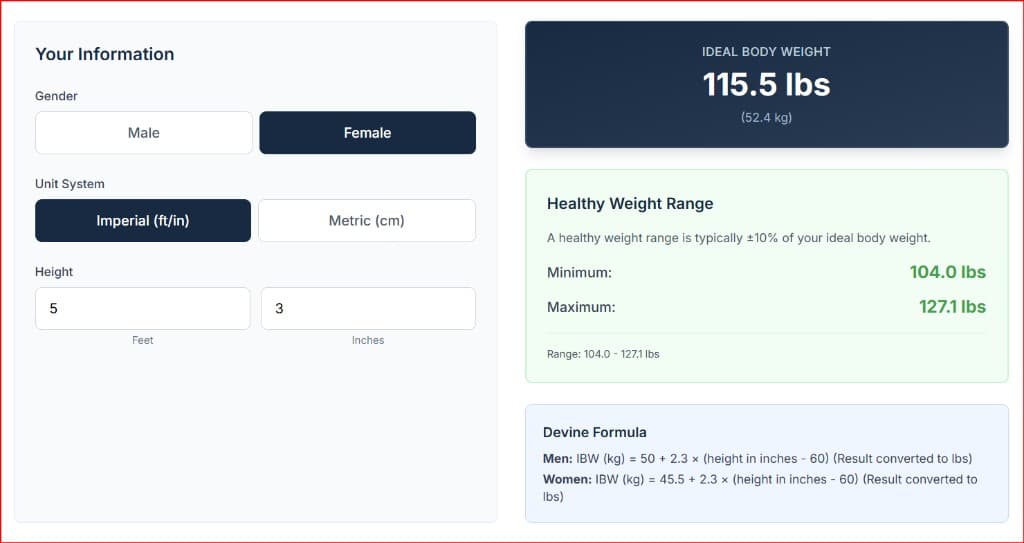
Step 1: Determine the Baseline
Before you can find the adjustment, you need a reference point. In clinical pharmacology guidelines (such as those used by Stanford Health Care), this baseline is typically the Ideal Body Weight (IBW) using the Devine Formula.
Swipe horizontally or scroll to the right to view the full screenshot.
Step 2: Find the Difference
Subtract the IBW from the current Actual Body Weight (ABW). This gives you the amount of "additional" weight. Math: ABW - IBW = Difference
Step 3: Apply the Adjustment Factor
Multiply that difference by 0.4 (representing the 40% factor) and add that result back to the IBW.
🧪 Clinical Deep Dive: Hydrophilic vs. Lipophilic Dosing
Why exactly is the adjustment factor set at 40% (0.4) instead of a different number? The answer comes down to pharmacokinetics—specifically, how a drug moves through water versus fat tissue.
- ■Hydrophilic Drugs (Water-Soluble): Medications like the antibiotic Gentamicin dissolve primarily in water and lean tissue. Because adipose (fat) tissue has very little water content, these drugs don't travel into fat well. If a clinician doses based purely on actual weight, the drug concentration in the bloodstream would skyrocket to dangerous, toxic levels.
- ■The Metabolic Scaling Exception: However, a person with obesity doesn't just gain adipose tissue. The body naturally scales up lean mass support organs (like the kidneys, liver, and heart) to help manage and pump blood through the extra physical weight.
The 0.4 multiplier is the hard-won clinical compromise. It mathematically honors the fact that while excess fat tissue doesn't actively absorb water-soluble drugs, the overall metabolic capacity and blood volume of the body have expanded by roughly 40% of that extra weight.
Visualizing the "Middle Ground"
It can be helpful to visualize where AdjBW lands. It will always be higher than the theoretical "ideal" weight, but lower than the current actual weight.
Below is a visual example of a person whose actual weight is 100kg, but whose theoretical baseline IBW is 60kg.
When Is This Used in Healthcare?
You generally do not need to worry about calculating this for yourself unless instructed by a professional. It is primarily a clinical tool used in:
Medication Dosing:
For antibiotics with narrow safety margins (like aminoglycosides), guidelines from the American Journal of Health-System Pharmacy recommend Adjusted Body Weight to prevent overdose in patients with obesity.
Nutritional Support:
Registered Dietitians often use this metric to calculate protein needs, ensuring they support your lean mass without overestimating calories.
| Clinical situation | Why raw scale weight misleads | What adjustment aims to fix |
|---|---|---|
| Significant obesity in dosing or nutrition planning | Body fat handles medications and food differently than muscle does. Relying strictly on the raw scale number can trick calculations into overestimating your needs. | It blends your ideal weight with a small, safe portion of the extra weight so your health plan matches how your body actually processes things. |
| Amputation or limb absence | The scale still reads your physical weight, but a missing limb means there is less active tissue for the body to support and power. | Clinicians adjust the baseline number down so your protein targets and medication amounts perfectly match your actual living tissue. |
| Fluid overload or edema | Severe swelling or extra fluid completely inflates the number on the scale without adding real muscle mass or nutritional needs. | Doctors estimate your 'dry weight' (your true weight without the extra water trapped in your body) to keep your feeding and medication plans safe. |
Summary
Adjusted Body Weight (AdjBW) is a clinical calculation, not a judgment on body size. It is used by healthcare providers to ensure nutritional and medical precision for individuals with obesity.
The Goal: To provide a safer, more accurate baseline for dosing and nutrition than Actual Body Weight alone.
The Prerequisite: You must first calculate Ideal Body Weight to use the formula.
The Math: It typically adds 40% of the excess weight onto the IBW baseline, based on pharmacokinetic distribution studies.
The Use Case: Primarily used by dietitians and pharmacists for specific clinical needs like protein intake or medication dosing.