Understanding the Devine Formula: How to Calculate Ideal Body Weight (IBW)
A clinical benchmark for ideal body weight (IBW)—and how to interpret it responsibly.
Published on

If you have ever searched for an "ideal weight" number, you have probably found a formula-based estimate called Ideal Body Weight (IBW). One of the most widely referenced IBW methods in clinical settings is the Devine Formula.
It can be useful as a screening benchmark—especially when paired with other context like body composition, waist measurements, and clinical history. But it is not a diagnosis, and it is not a one-size-fits-all target.
If you want to see your estimate quickly, you can use our Ideal Weight Calculator. The sections below explain what it is doing (and what it is not doing).
Swipe horizontally or scroll to the right to view the full screenshot.
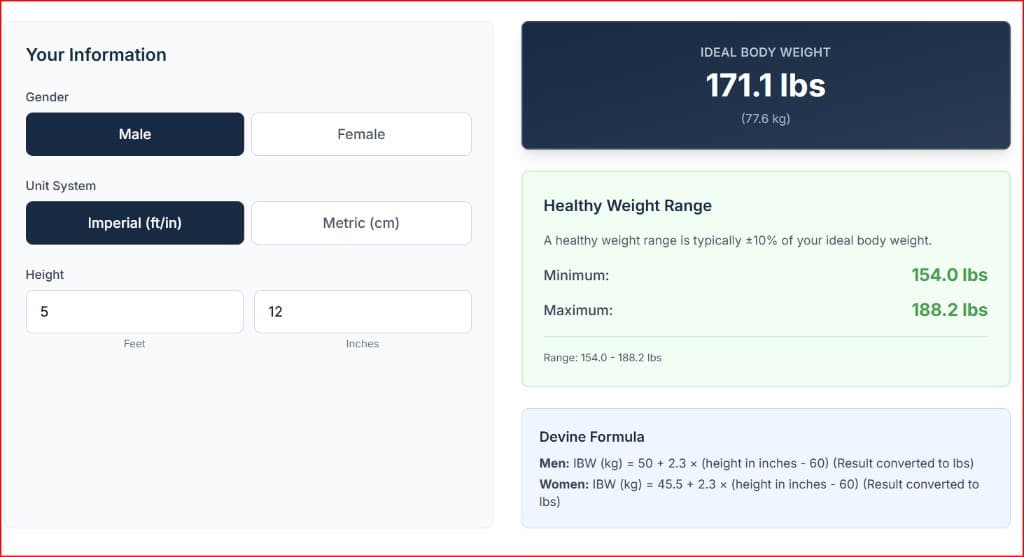
What the Devine Formula Is (and Why It Exists)
The Devine Formula is a simple linear equation that estimates IBW based on height and sex. It was originally developed by Dr. B.J. Devine in 1974 for clinical medication dosing purposes and has since been used as a reference point in healthcare settings.
The key thing to understand: it is not estimating your current body fat percentage, and it does not account for muscle mass, bone density, or body composition. It is an estimate of a reference weight given a height.
The Pharmacokinetic Origin: Medication Dosing
Dr. Devine did not develop this formula for weight loss tracking. Its primary purpose was to help pharmacists calculate the "clearance" of certain high-risk medications (like Theophylline or Digoxin). Because these drugs do not distribute well into adipose (fat) tissue, using a person's actual weight could lead to dangerous over-dosing. The Devine Formula provides a mathematical proxy for lean body mass to ensure clinical safety.
The Actual Formula (Inches vs. Centimeters)
The Devine Formula uses a 5-foot baseline and adjusts up or down depending on how far your height is from that point. In practice, you will see it expressed in either inches or centimeters:
Imperial (inches)
Men: IBW (kg) = 50 + 2.3 × (height in inches - 60)
Women: IBW (kg) = 45.5 + 2.3 × (height in inches - 60)
Metric (centimeters)
Men: IBW (kg) = 50 + 0.91 × (height in cm - 152)
Women: IBW (kg) = 45.5 + 0.91 × (height in cm - 152)
Deconstructing the "Base Weight" Constants
The 50 kg (men) and 45.5 kg (women) baselines represent the estimated weight of a person who is exactly 5 feet tall with a "healthy" amount of lean mass. The 2.3 kg (roughly 5 lbs) added for every inch above 5 feet is a linear approximation of how much structural mass (bone, muscle, and organ weight) the human frame typically gains per inch of height.
What Happens Under 5 Feet? (Yes, It Subtracts)
A common implementation mistake is to clamp the adjustment at zero—treating anyone under 5 feet as the baseline weight. But mathematically, the Devine Formula allows subtraction for heights under 60 inches (152 cm).
That is why our calculator now allows the "height minus baseline" portion of the equation to go negative for users between 4'0" (122 cm) and 5'0" (152 cm).
Practical Limits: Why We Enforce a Minimum Height
For extremely short heights, the formula can produce values that are not physiologically plausible. Rather than showing negative (or near-zero) results, our calculator asks for a minimum height of 4 feet (122 cm) to keep outputs meaningful.
How to Use IBW Alongside Other Health Metrics
IBW is best viewed as one data point. For a broader baseline, you can also use our BMI Calculator, keeping in mind BMI is also a screening tool with important limitations.
Research indicates that body composition (muscle vs. fat distribution) may be more predictive of health outcomes than total weight alone.
If you want deeper context, our article on understanding body composition explains why the number on the scale is less informative than how that weight is distributed.
The "20% Rule" for Clinical Significance
In many medical frameworks, a person is considered to be at a significantly increased health risk when their actual body weight exceeds their Devine IBW by 20% or more. If your current weight is significantly above this 120% threshold, clinicians often pivot to using "Adjusted Body Weight" (AdjBW) to find a metabolic middle ground for nutritional planning.
| Role | What you supply | What the formula returns |
|---|---|---|
| Height | Your height, compared to 5 feet (60 inches). | Calculates the height differential (ΔH) by comparing total inches against the 60-inch (5') clinical baseline. |
| Sex / gender | Whether the formula uses the male or female version. | Determines which "Base Weight" constant is applied (50 kg for men or 45.5 kg for women) before adding the per-inch adjustment. |
| Output: ideal weight | Nothing else is needed beyond height and sex/gender. | A discrete Ideal Body Weight (IBW) value. Professional results are typically expressed in kg, then converted to lbs (1 kg = 2.204 lb) for patient-facing reports. |
Note: While the Devine formula is the clinical standard for IBW calculation in adults, its accuracy is mathematically optimized for individuals 5 feet (60 inches) or taller. For pediatric use or individuals under 5 feet, alternative clinical adjustments (such as the Miller or Hamwi variants) are typically consulted.
Summary
The Devine Formula estimates Ideal Body Weight (IBW) using a height baseline of 5 feet (152 cm) and a linear adjustment above or below that point.
It should be treated as a screening benchmark, not a definitive health target. Use it alongside other metrics (and professional guidance) for real decisions.
- Pharmacokinetic Roots: Originally engineered for precision medication dosing to avoid toxic levels in patients.
- The 120% Threshold: Exceeding your IBW by more than 20% is a common clinical marker for evaluating metabolic risk and obesity.