Mastering Concrete Slab Calculations: Formulas, Yields & Planning
A professional guide to estimating cubic yards, determining bag counts, and accounting for subgrade variance on your rectangular projects.
Published on

At its most basic level, concrete is sold by volume, not weight. In the United States, the construction standard for ordering ready-mix concrete is the Cubic Yard.
To find this, you must convert all your dimensions (Length, Width, and Thickness) into feet, multiply them to get Cubic Feet, and then divide by 27 (since there are 27 cubic feet in one cubic yard).
You can skip the manual math and conversions by using our Concrete Calculator, or you can use the formula below to understand exactly how the numbers work.
The Formula:
Volume (yd³) = (Length (ft) × Width (ft) × Thickness (ft)) / 27
⚠️ The "Inches" Trap
The most common error we see in the field is mixing units. If you are pouring a standard patio slab that is 4 inches thick, you cannot enter "4" into the formula. You must convert it to feet first (4 ÷ 12 ≈ 0.33 feet).
Failure to convert thickness correctly will result in an estimate that is massive and incorrect.
While the basic formula covers a uniform pour, most structural slabs—like those for garages or heavy sheds—require an additional calculation for perimeter support to prevent cracking and frost heave.
The "Thickened Edge" Variable
If you are pouring a slab for a structural building like a garage or a heavy shed, a standard flat-slab calculation will leave you short. You must account for "thickened edges" or monolithic footings. These are typically 12 inches deep and 12 inches wide around the entire perimeter to support the structure's weight and prevent frost heave.
Premix Bag Yields: 80lb vs. 60lb
For smaller projects (typically under 1 or 2 cubic yards), buying premixed bags from a home center is often more economical than paying the "short load" fees charged by ready-mix trucks.
However, a bag of concrete is not 100% solid volume; it is a mix of aggregate, sand, and cement that consolidates when water is added. Professional estimators use specific Yield Constants to determine how many bags are required.
According to manufacturer specifications compliant with ASTM C387 (such as this Quikrete Technical Data Sheet), the typical yields for standard weight concrete are:
- 80lb Bag: Yields approximately 0.60 cubic feet.
- 60lb Bag: Yields approximately 0.45 cubic feet.
- 50lb Bag: Yields approximately 0.375 cubic feet.
To find the number of bags needed, you divide your project's total Cubic Feet by the yield of the bag you intend to buy.
Pro Tip:
Always check the specific bag label. High-strength mixes or lightweight concrete mixes may have slightly different yields than standard general-purpose concrete.
The "Hidden" Variable: Why You Need a Waste Factor
If you calculate the exact mathematical volume of a 10x10 slab and order exactly that amount of concrete, you will run short.
In the real world, "perfect" dimensions do not exist. Professional contractors and engineers always add a Waste Factor (typically 5% to 10%) to account for three variables:
- Subgrade Unevenness: The ground beneath your slab is rarely perfectly flat. A dip of just ½ inch across a large patio can absorb several cubic feet of concrete.
- Form Deflection: Wooden forms often bow slightly outward under the immense pressure of wet concrete (which weighs ~145 lbs per cubic foot).
- Spillage: Some material is inevitably lost during mixing, transport, or screeding.
For most residential slab projects, a 10% safety margin is the industry standard to ensure you don't run out halfway through the pour.
Calculating Sub-Base: From Yards to Tonnage
A professional pour is only as stable as its base. Industry standards (ACI 302.1R) recommend a 4-inch layer of compactible material, such as ¾-inch crushed stone. While the volume math is the same as concrete, stone is sold by weight. To convert your required cubic yards to tonnage, use a multiplier of 1.5 (e.g., 2 cubic yards ≈ 3 tons). This accounts for a typical density of 110 lbs per cubic foot when compacted.
When to Switch from Bags to a Truck
A common question for DIYers is: "Should I mix this by hand or call a truck?"
The threshold for most professionals is 1.5 to 2 Cubic Yards.
1 Cubic Yard requires roughly 45 bags (80lb). Mixing 45 bags by hand is physically demanding and time-sensitive; you must mix the last bag before the first bag begins to set.
Short Load Fees: Ready-mix suppliers often charge extra fees for orders under 4 cubic yards. However, for projects over 2 yards, the cost of a truck is often comparable to buying 90+ bags, with significantly less labor and a more consistent structural result.
For detailed standards on ready-mix specifications, you can also refer to the National Ready Mixed Concrete Association (NRMCA).
The Strength Variable: Water-Cement Ratio
When mixing bags by hand, there is a high temptation to add extra water for workability. Mathematically, this is the most expensive mistake you can make. Increasing the water-to-cement ratio from 0.45 to 0.60 can reduce the compressive strength (PSI) by as much as 40%. For a durable finish that resists scaling and cracking, maintain a stiff 'slump'-if the mix flows like soup, you have compromised the structural integrity of the entire slab.
Precision in Practice: Solving a Complex 4-Slab Project
Swipe horizontally or scroll to the right to view the full screenshot.
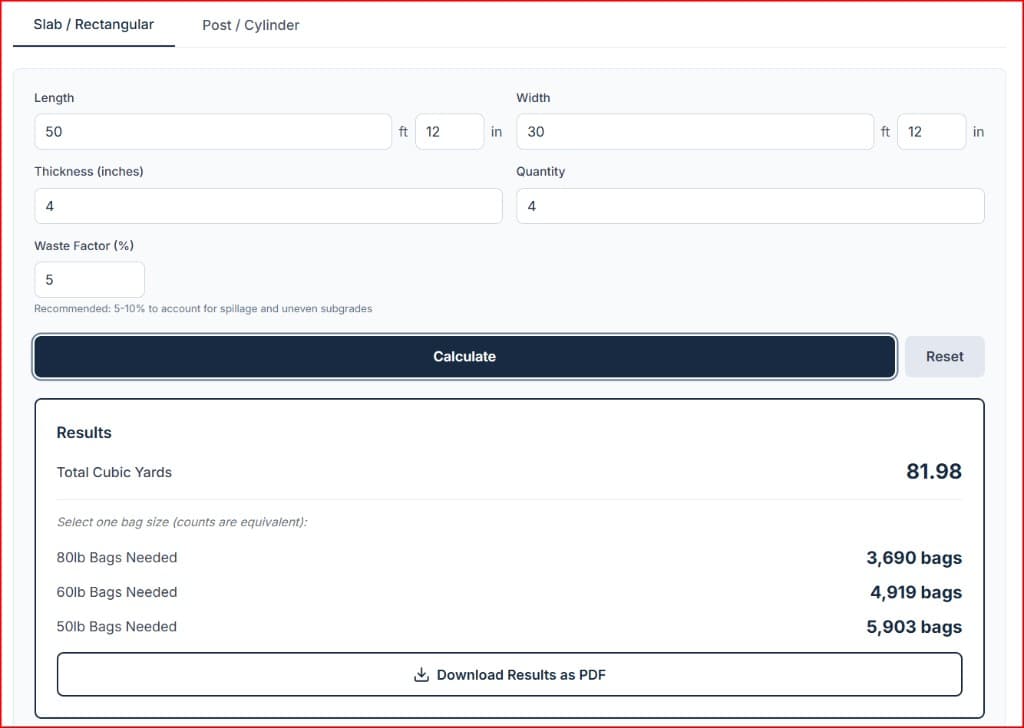
| Variable | Unit consistency | Common pitfall |
|---|---|---|
| Length (L) | Use the same system as width—usually feet (or meters) end-to-end. | Mixing inches on one edge and feet on another without converting. |
| Width (W) | Match L; multiply L × W only after both are in identical units. | Measuring the tapering form at the widest point vs. narrowest and getting the wrong area. |
| Depth / thickness (D) | Convert inches to feet (e.g., 4" → 0.333… ft) before multiplying into volume. | Treating the inch measurement as if it were already feet—orders of magnitude wrong. |
| Volume → cubic yards | Cubic feet = L × W × D (all in feet); divide ft³ by 27 for yd³. | Forgetting the 5-10% waste factor for uneven subgrade or form flex—resulting in under-ordering on tight schedules. |
Summary: Calculating Concrete for Slabs
To calculate concrete for a slab, convert your length, width, and thickness into feet, multiply them to find cubic feet, and divide by 27 to determine Cubic Yards. For example, a 10x10 slab that is 4 inches thick requires approximately 1.23 cubic yards before adding waste.
Always include a 5-10% waste factor to account for uneven subgrades and form deflection. When purchasing premix, use standard yields: an 80lb bag typically provides 0.60 cubic feet, while a 60lb bag provides 0.45 cubic feet. For projects exceeding 2 cubic yards, ordering a ready-mix truck is often more practical than mixing over 90 bags by hand.