How to Calculate Framing Lumber: A Step-by-Step Guide
Stop guessing at the lumber yard. Here is the professional formula for estimating studs, plates, and blocking.
Published on

There is a distinct difference between a "napkin sketch" estimate and a professional lumber takeoff. The napkin sketch assumes a wall is just a straight line of vertical boards. The professional takeoff knows that walls have corners, structural loads require overlapping plates, and tall walls are fire hazards if not blocked correctly.
If you calculate your framing lumber based on simple length and width, you will inevitably end up back at the store buying the 15% of material you forgot.
Below is the breakdown of the "Contractor Math" we use in our Lumber & Decking Calculator, helping you turn a floor plan into an accurate shopping list based on International Residential Code (IRC) standards.
Step 1: Calculate Lumber for Plates (The "Double Top" Rule)
A common amateur mistake is calculating Wall Length x 2 for the horizontal plates (one for the bottom, one for the top). In almost all residential construction, this is insufficient.
The Professional Reality:
To meet structural standards, walls typically require a Double Top Plate.
- Cap Plate (Top): Used to overlap corners and tie intersecting walls together, providing structural rigidity.
- Top Plate: Nailing surface for the studs.
- Bottom Plate (Sole Plate): Anchors the wall to the floor.
According to IRC Section R602.3.2, top plates must be doubled and overlapped at corners and intersections. If you only estimate for a single top plate, your wall lacks the required structural continuity.
The Estimator's Formula:
Total Plate Linear Ft = Wall Length × 3
Step 2: Calculate Stud Counts (Don't Forget Corners)
If you simply divide your wall length by 16 inches, you are calculating for a wall floating in empty space. Real walls connect to other walls, and those connections require extra lumber for drywall backing.
The "Three-Stud" Rule:
Whether you are framing a "Solid Corner" (older style) or a "California Corner" (O.V.E. Corner), you generally need three studs to form the corner.
- Two studs create the corner structure itself.
- One extra stud acts as the "nailer" for the interior drywall.
The "Crown" Factor: Framing for Straightness
Professional framers don't just count studs; they grade them. When estimating, it is standard practice to order an extra 5% specifically for "Field Studs" vs. "Critical Studs" (corners and openings). Every piece of dimensional lumber has a "crown"-a slight hump along the narrow edge. For field studs, the crown always faces the same direction (usually out). For corners, you must select the straightest possible lumber to ensure drywall doesn't "wave" at the intersections.
To properly calculate framing lumber, you must add 3 extra studs for every corner in the project. If you have a room with 4 corners, that is 12 extra studs—a significant amount of lumber to overlook.
The Hidden Variable: Rough Openings (RO)
Windows and doors are not "voids" in your lumber count-they actually consume more lumber than a solid wall. Every opening requires a structural header and a specific set of support studs:
- King Studs: Full-height studs on both sides of the opening.
- Jack Studs (Trimmers): Shortened studs that support the header.
- Cripple Studs: Short studs above the header or below a window sill.
The Math: For every window or door under 6 feet wide, add a minimum of 4 extra studs to your count to account for the King/Jack combo. For wider openings requiring double trimmers, add 6 studs.
Step 3: Account for Height (Fire Blocking)
Standard walls (8ft or 9ft) allow studs to run continuously from bottom to top. However, once you enter the territory of "Tall Walls" (foyers, vaulted ceilings, or garage walls), the lumber requirements change.
IRC Section R302.11 (Fireblocking):
The code dictates that in concealed spaces of stud walls, fireblocking must be provided vertically at the ceiling and floor levels and horizontally at intervals not exceeding 10 feet.
Why? It prevents the wall cavity from acting like a chimney flue during a fire, slowing the spread of flames.
The Math: If your wall is 12 feet high, you must calculate lumber for a horizontal row of blocking roughly halfway up the wall.
Step 4: Add Waste Factors
Lumber is an imperfect organic material. Even "Premium" or "No. 2" grade lumber will have culled boards—warped, twisted, or split.
- 10% Waste: The bare minimum for simple, straight runs.
- 15% Waste: Recommended for projects with many short cripple studs or complex corners where off-cuts cannot be reused easily.
Code Requirement: Pressure-Treated (PT) Bottom Plates
Per IRC Section R317.1, any wood member in direct contact with concrete or masonry must be naturally durable or pressure-treated. When calculating your "Plate Linear Footage," ensure your order separates the Bottom Plate from the Top Plates. You cannot use standard KD (Kiln-Dried) studs for the bottom plate if you are framing on a slab or foundation wall. This is the most common reason DIY projects fail initial framing inspections.
Automating the Calculation
You can perform these calculations manually, or you can use a calculator that has these code requirements built into its algorithm.
Swipe horizontally or scroll to the right to view the full screenshot.
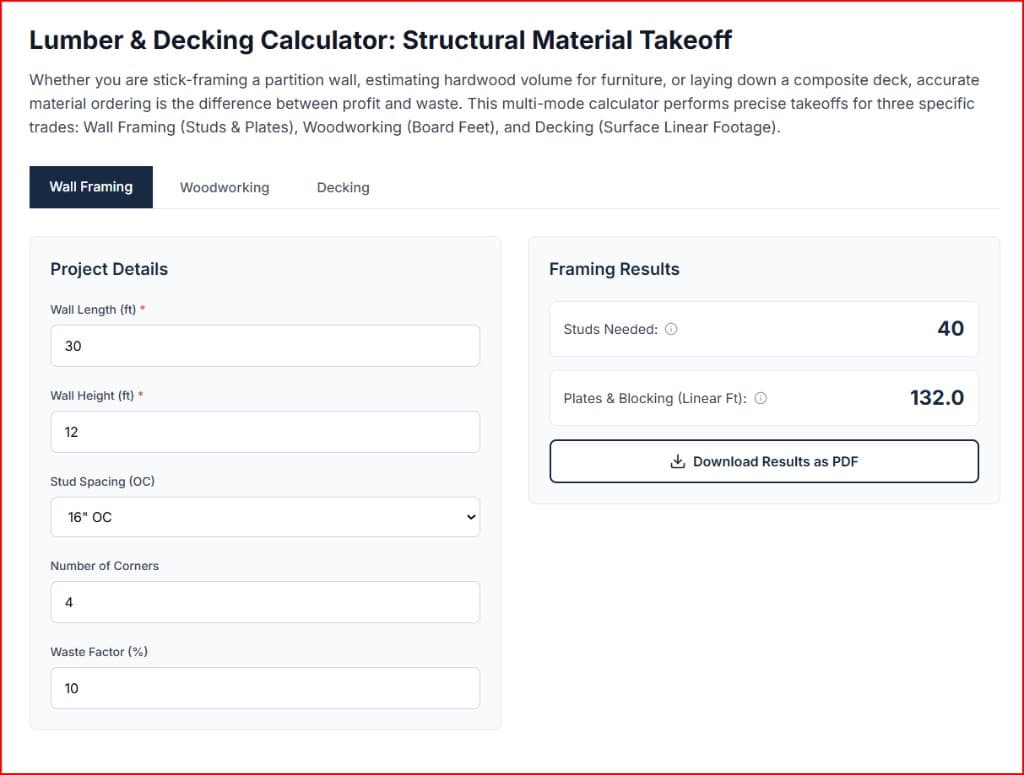
We designed the Definitive Calc Lumber & Decking Calculator to respect the "lingo" and logic of the job site.
- Input: Length, Height, Spacing, and Corner Count.
- Output: It separates "Stud Counts" (pieces) from "Plate Linear Footage" (length), so you know exactly what to order.
- Intelligence: It automatically triggers the fire blocking math for walls over 10 feet.
Calculate Your Framing Lumber Here
Stop guessing. Build it right, and build it once.
Summary: Professional Framing Lumber Calculation
| Framing Component | Common Mistake | Professional Standard | Code Reference |
|---|---|---|---|
| Plates | Calculating 2 plates (Top/Bottom). | 3 Plates (1 Bottom + Double Top) to tie corners. | IRC R602.3.2 |
| Corners | Ignoring corners in stud counts. | Add 3 extra studs per corner for drywall backing. | IRC R602.3 |
| Tall Walls | Ignoring height > 10ft. | Add Fire Blocking (horizontal row) at intervals not exceeding 10ft. | IRC R302.11 |
| Bottom Plate | Using standard lumber on concrete. | Must be Pressure-Treated (PT) lumber. | IRC R317.1 |