The "Gap Trap": Why Nominal Math Ruins Deck Estimates
A contractor's guide to nominal vs. actual widths, gap spacing, and calculating the exact linear footage for your surface boards.
Published on

There is a specific mistake that separates a first-time DIYer from a seasoned deck builder. It usually happens when you reach the very end of the deck.
You calculated that your 10-foot wide deck needed exactly 20 boards (because 10 feet ÷ 6 inches = 20). But when you lay the last board, you are short by nearly 10 inches. You have to stop work, drive back to the store, and buy two more rows of lumber.
Why did the math fail? Because a "6-inch" deck board is not 6 inches wide.
Below is the "Contractor Math" used in our Decking Calculator, ensuring your material list accounts for the reality of the lumber yard, not just the label on the shelf.
1. Nominal vs. Actual: The 0.5" Discrepancy
In the US and Canada, softwood lumber is sold by "Nominal Dimensions" (the size of the wood before it was dried and planed smooth).
The Label: "5/4 x 6" or "2 x 6" decking.
The Reality: The board you actually buy is 5.5 inches wide.
The Label: "2 x 4" decking.
The Reality: The board is 3.5 inches wide.
If you calculate your coverage based on 6 inches, you will underestimate your row count by nearly 10%. On a large deck, that is a significant shortage.
The Moisture Variable: Wet vs. Dry Width
Technical accuracy requires knowing the 'state' of the lumber at the time of purchase. Pressure-treated (PT) lumber is often sold 'wet' because it is infused with liquid preservative. A wet 5/4 x 6 board may actually measure 5-5/8" wide at the yard. As it dries in the sun and acclimates, it will shrink toward 5-1/2" or even 5-3/8".
Note: If 'wet' boards are installed with a full 1/4" gap, that gap may expand to 1/2" once the wood dries, creating a safety hazard and an eyesore. Conversely, kiln-dried cedar or composite boards are dimensionally stable and should be gapped precisely to manufacturer specs immediately.
2. The Gap Factor
Deck boards cannot be jammed together tight. They need a "gap" (typically 1/8" to 1/4") to allow for water drainage and seasonal expansion.
When calculating how many rows of boards you need, you must add this gap to the board width to determine your true "Coverage Width."
The Formula:
Rows = Deck Width (inches) / (Actual Board Width + Gap)
Example: For a standard 5.5" board with a 1/8" (0.125") gap:
5.5 + 0.125 = 5.625 inches of coverage per row.
It seems small, but over a 20-foot wide deck, properly accounting for the gap might save you from buying 2 extra rows of expensive composite or cedar.
The Nosing Factor: Calculating for Overhang
A frequent oversight in deck estimation is calculating material needs based strictly on the frame dimensions. Professional deck designs feature a 'nosing'-the board edge that overhangs the rim joist to allow for water runoff and a finished aesthetic.
The Math: A standard nosing extends 1" to 1-1/2" past the frame. If a deck frame is exactly 120" wide and requires a 1" overhang on both sides, the 'Calculation Width' for the board count is actually 122". Accounting for this 2-inch difference ensures the final board is a full-width piece rather than a narrow, structurally weak 'sliver.'
3. Calculating Total Linear Feet
Once you know your row count, you can determine the Total Linear Feet of material required. This is the "God Number" for ordering.
The Formula:
Total Linear Feet = Rows × Deck Length × (1 + Waste%)
Why focus on Linear Feet?
Because you rarely buy one length of board. You might buy a mix of 12', 16', and 20' boards to stagger your joints and minimize waste. Knowing your total linear footage allows you to mix and match board lengths to fit your framing layout.
4. Substructure vs. Surface
It is vital to distinguish between Decking (the surface you walk on) and Framing (the structure underneath).
- Decking: 5/4" or 2" thick boards. Calculated by surface area.
- Framing: Pressure-treated 2x8, 2x10, or 2x12 joists. Calculated by span tables.
Important Note: Surface calculations do not account for joists, beams, or ledger boards. For the structural frame, you must consult specific span tables provided by the American Wood Council (AWC) DCA 6 Guide. This is the industry standard for residential deck codes.
Material Choice vs. Joist Spacing
The choice of surface material dictates the framing math.
Standard Rule: Standard 5/4" wood decking and most composites require joists spaced at 16" on-center. However, if the design calls for boards laid diagonally (a 45-degree pattern), the joist spacing must be decreased to 12" on-center to prevent the boards from feeling 'spongy' underfoot. If an existing frame is 24" on-center, surface options are typically restricted to 2x6 (1.5" thick) boards for safety.
Automating the Math
You can do the "5.5 inch" math manually, or you can use a calculator that has these industry standards built-in.
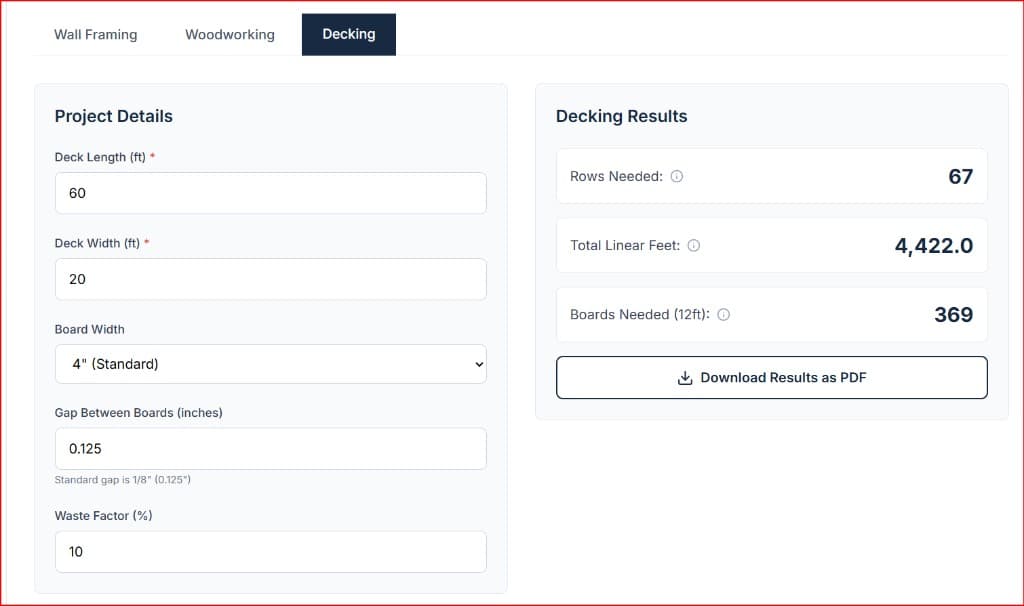
We designed the Definitive Calc Decking Tool to handle the nuances of contractor math automatically:
- Actual Width Logic: You select "6 inch nominal," and we calculate using 5.5 inches automatically.
- Gap Control: We default to the standard 1/8", but you can adjust it for composites or tight fits.
- Waste Factors: Quickly add 10-15% for bad cuts and ends.
- Board Count: We convert your linear footage into an estimated count of 12-foot boards to help you visualize the order size.
Practical Application: Estimating a 10' x 12' Deck
Swipe horizontally or scroll to the right to view the full screenshot.
Calculate Your Decking Material Here
Stop guessing at the lumber yard. Input your actual dimensions, and get the exact row count you need to finish the job.
For detailed requirements on fastening these boards (screws vs. nails) and joist spacing limits (16" vs. 24" on-center), always refer to the International Residential Code (IRC) - Section R507. This code dictates the maximum distance your joists can be spaced based on the decking material you choose.
Summary: Professional Decking Material Calculation
| Measurement | Nominal (Label) | Actual (Math) | Why it Matters |
|---|---|---|---|
| Standard Board | 6 inches | 5.5 inches | Using 6" will result in being short 10% of material. |
| Narrow Board | 4 inches | 3.5 inches | Common for cedar or intricate patterns; same 0.5" loss applies. |
| Gap Spacing | N/A | +0.125" (1/8") | Must be added to the board width to get true "Coverage." |
| Total Boards | "Pieces" | Linear Feet | Calculate total length first, then divide by the board lengths available (12', 16') to minimize waste. |