The Hardwood Hustle: Why You Always Run Out of Lumber
A professional guide to mastering "Board Feet" and calculating waste so you buy the right amount the first time.
Published on

There is a painful moment in every woodworker's journey: You are building a dining table out of expensive Black Walnut. You carefully measured every finished part. You bought exactly that amount of wood.
And now, halfway through the build, you are staring at a pile of off-cuts, sawdust, and a knot right where a table leg needs to be. You are short, and the lumber yard is closed.
Your measurements were likely perfect, but there is a disconnect between how furniture is built and how lumber is sold. Hardwood isn't sold by linear length like a 2x4; it's sold by volume according to standards set by the National Hardwood Lumber Association (NHLA).
Swipe horizontally or scroll to the right to view the full screenshot.
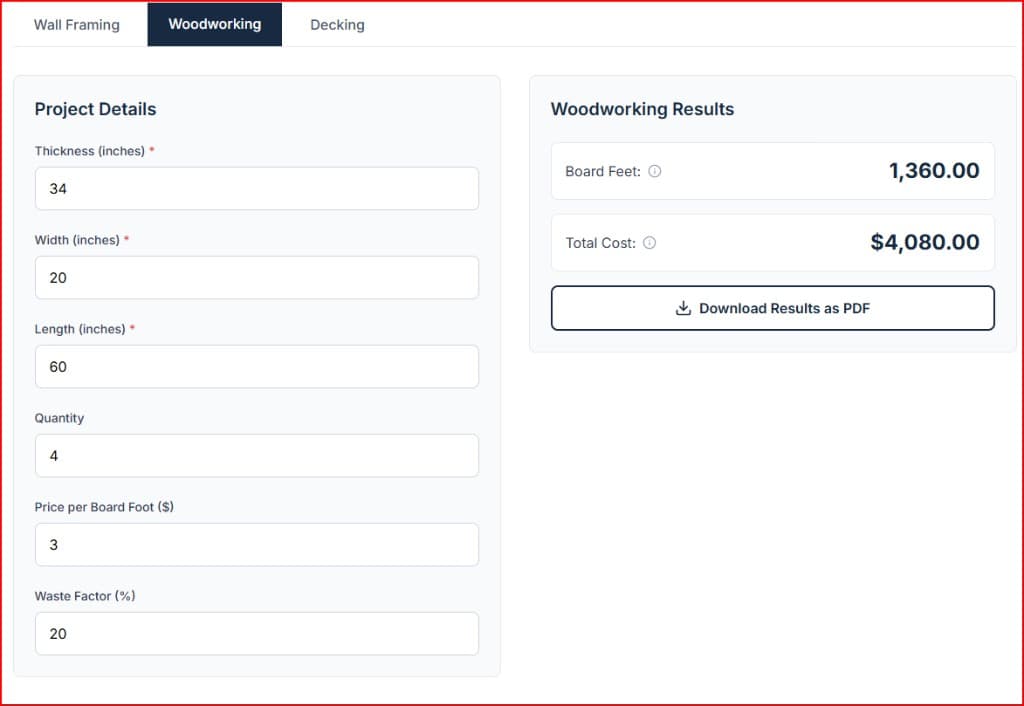
Below is the breakdown of the "Industry Math" used in our Woodworking Lumber Calculator, helping you translate finished furniture parts into an accurate rough lumber order.
1. The Standard: Understanding the "Board Foot"
If you walk into a professional hardwood dealer and ask for "10 feet of 6-inch wide maple," they will look at you confused. They price their inventory by the Board Foot (BF).
The Definition:
A single Board Foot is a volume measurement equal to 144 cubic inches of wood. The standard visualization is a board that is 12 inches wide, 12 inches long, and nominally 1 inch thick.
12" (W) × 12" (L) × 1" (T) = 144 cubic inches = 1 Board Foot
The Estimator's Formula:
Because most furniture parts are measured in inches, you need a formula to convert those dimensions into that 144-cubic-inch standard volume.
Board Feet = (Thickness (in) × Width (in) × Length (in)) / 144
The Professional's "2-Inch Rule" for Length
Beyond volume math, professional woodworkers always add a minimum of 2 inches to the length of every finished part before calculating board footage. This accounts for 'end checking'-small cracks that form at the ends of boards during the kiln-drying process as moisture escapes the end grain faster than the faces. These cracks are often invisible until you begin milling, and having that 2-inch buffer ensures you can cross-cut away unstable wood without coming up short on your final project dimensions.
If your calculator doesn't do this math automatically, you are likely buying the wrong amount of wood. For a deeper dive into measuring hardwood, Purdue University provides a comprehensive guide on lumber grading and measurement.
2. The Silent Killer: Milling Waste Factors
Calculating the board footage of your finished parts is known as "Net Board Feet." But you can't buy net footage; you have to buy "Gross Board Feet" (rough lumber) and mill it down to size.
If your finished table top needs 100 BF of wood, buying exactly 100 BF of rough lumber guarantees you won't have enough.
Where does the wood go?
Every step in the milling process turns expensive wood into worthless sawdust:
- Saw Kerf: The width of the saw blade that turns to dust with every rip and crosscut.
- Jointing & Planing: Taking a rough, warped board and flattening it removes significant thickness and width.
- Defects: Knots, sapwood, checks (cracks) at the end of boards, and ugly grain patterns must be cut around.
Professional Standards for Waste:
A professional cabinet maker never orders exact amounts. They apply a percentage multiplier based on the project complexity and wood species.
- 20% Waste: The bare minimum for standard projects using high-quality ("Select & Better") lumber.
- 30-40% Waste: Required for complex projects with curved parts, or when using "rustic" grade lumber that requires cutting around many knots.
3. A Note on Thickness: The Quarter System
When buying rough lumber, thickness is rarely measured in even inches. It is measured in "quarters."
- 4/4 (Four-Quarter): Nominally 1" thick rough. Will surface down to ~3/4" finished thickness.
- 8/4 (Eight-Quarter): Nominally 2" thick rough. Will surface down to ~1 3/4" finished thickness.
When using a calculator, always input the thickness you are buying (e.g., 1 inch for 4/4 stock), not the final thickness of your furniture part.
Reference Guide: Rough Stock vs. Finished Thickness
To ensure a board finishes at your desired thickness without 'skipping' (when the planer misses low spots), use the following industry-standard mappings.
| Desired Finish | Required Rough Stock (Quarters) | The Reasoning |
|---|---|---|
| 3/4" Finish | Buy 4/4 (1" Nominal) | Allows for 1/8" removal per face to reach perfect flatness. |
| 7/8" to 1" Finish | Buy 5/4 (1.25" Nominal) | Critical for heavy table tops. |
| 1 1/4" Finish | Buy 6/4 (1.5" Nominal) | Standard for 1 1/4" finish. Note: For a full 1 1/2" finish, professional makers step up to 8/4 to allow for flattening. |
| 1 3/4" Finish | Buy 8/4 (2" Nominal) | The professional standard for heavy furniture legs. |
Automating the Estimate
You can do the math manually for every single piece of your project, or you can use a tool designed for the job.
We updated the Definitive Calc Woodworking Estimator to handle both the required math and the reality of the shop floor.
- Input in Inches: Enter your parts list in standard Thickness x Width x Length.
- Automatic Conversion: The tool instantly converts your inches into industry-standard Board Feet.
- Crucial Feature - Waste Factor: A dedicated input lets you add your 20% or 30% waste buffer, ensuring the final shopping list reflects Gross Board Feet—the amount you actually need to buy.
Calculate Your Hardwood Needs Here
Don't get caught short. Calculate for waste, and build with confidence.
For a better understanding of how lumber grades like FAS and Common relate to your project, you can watch this explanation of American hardwood lumber grades. This video breaks down the grading rules visually, helping you decide which grade to buy for your specific furniture needs.
Yard Shortcuts: Converting Linear Feet to Board Feet (4/4 Stock)
Use these multipliers to quickly estimate volume while at the lumber yard for 1-inch thick (4/4) boards:
- 4" Wide: Multiply Linear Feet by 0.33
- 6" Wide: Multiply Linear Feet by 0.50 (The 1:2 ratio)
- 8" Wide: Multiply Linear Feet by 0.67
- 12" Wide: 1:1 Ratio (1 Linear Foot = 1 Board Foot)
Summary: Professional Woodworking Lumber Calculation
| Concept | Common Mistake | Professional Standard | Why it Matters |
|---|---|---|---|
| Buying Units | Buying by linear foot. | Buy by the Board Foot (BF). | Industry standard pricing per NHLA Rules. |
| The Formula | Guessing at volume. | Use (T" × W" × L") / 144 to get BF. | Converts your inch measurements into purchasing units. |
| Milling Waste | Buying exact "Net" amounts. | Add 20-30% Waste Factor to get "Gross" BF. | Accounts for saw kerf, planing, jointing, and knots. |
| Estimating | Using napkin math. | Use the Definitive Calc Tool. | Ensures you buy enough wood in one trip. |