The Math We All Forgot: Why a Mixed Fraction Calculator is an Everyday Essential
Let's be honest: when was the last time you enjoyed finding a common denominator?
Published on

For most of us, fraction math is a distant memory from middle school. We understand the concepts, but the actual mechanics—converting mixed numbers to improper fractions, finding the least common multiple, and simplifying the result—is mental friction we don't need in our busy lives.
Yet, the real world doesn't run on clean, whole numbers. It runs on measurements, recipes, and materials that rarely fit into tidy integers.
Trying to do mixed fraction math in your head, or scribbling it on the back of an envelope under pressure, is a recipe for costly mistakes. This is where a robust Mixed Fraction Calculator transforms from a homework aid into a practical, everyday necessity.
Here are three scenarios where having precision in your pocket saves time, money, and sanity.
Swipe horizontally or scroll to the right to view the full screenshot.
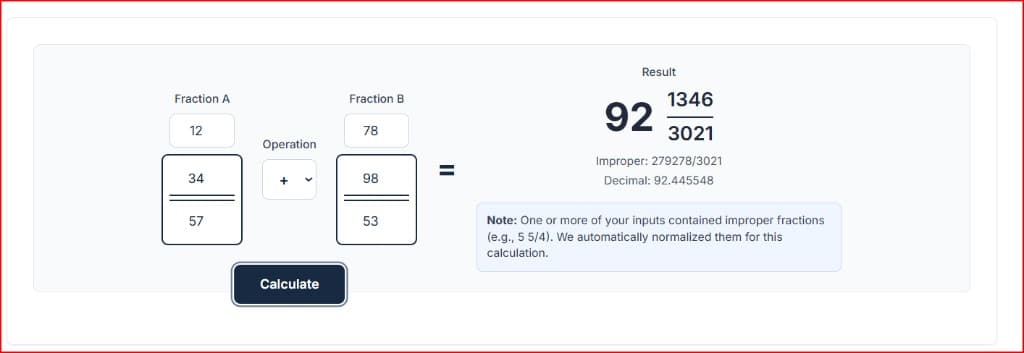
Use Case 1: The Weekend Warrior (Home Improvement & DIY)
The highest stakes for fraction math usually happen in the garage or at the hardware store. When you are dealing with lumber, piping, or crown molding, "close enough" isn't good enough. A miscalculation here means wasted materials and another expensive trip to the store.
The Scenario: You are installing baseboards in a hallway. You have two sections of wall to cover before hitting a doorway.
- Wall A measures 458 feet.
- Wall B measures 312 feet.
You need to know the exact total length to buy.
The Manual Headache: You have to remember that 12 is the same as 48. Then you add the whole numbers (4+3=7). Then add the fractions (58 + 48 = 98). Then convert the improper fraction (98 = 1 18). Finally, add that back to the whole number to get 818.
The Calculator Solution: You punch in 458 + 312. The calculator instantly handles the common denominator conversion and spits out the exact answer: 818. It gives you the confidence to make the cut once.
Use Case 2: The Kitchen Chemist (Scaling Recipes)
Cooking and baking are sciences based on precise ratios. But recipes rarely serve the exact number of people you are cooking for. Doubling a recipe is usually easy, but what about halving it? Or scaling it down by a third?
The Scenario: You have a fantastic cookie recipe that calls for 234 cups of flour, but you only want to make half a batch.
The Manual Headache: You need to calculate 234 ÷ 2. To do this manually, you first convert 234 to an improper fraction (114). Then you remember that dividing by 2 is the same as multiplying by 12. So, 114 × 12 = 118. Finally, you convert that back to a mixed number to find out how much to scoop: 138 cups. By the time you figure that out, the oven has preheated and you're frustrated.
The Calculator Solution: Enter 234 ÷ 2. The result is instant: 138. No flour wasted, no dense cookies.
Use Case 3: The Precision Crafter (Woodworking & Sewing)
For hobbies that require precision, like quilting, sewing, or detailed woodworking, multiplying fractions is a constant requirement. You are often dealing with small, varying units that need to be repeated multiple times.
The Scenario: You are building a custom shelving unit and need to cut 6 identical support brackets. Each bracket needs to be exactly 5316 inches long. How much total wood stock do you need?
The Manual Headache: You need to calculate 5316 × 6.
Converting 5316 to an improper fraction gives you 8316. Multiplying 8316 by 61 equals 49816. Now you have to simplify that massive improper fraction through long division to get back to a usable measurement.
The Calculator Solution: Input 5316 × 6.
The calculator provides the exact mixed number: 3118 inches. Furthermore, a good calculator will also provide the decimal equivalent (31.125), which is often easier to read on modern digital tape measures or calipers.
🪚 Pro-Tip: The "Hidden Fraction" Builders Always Add (The Saw Kerf)
If you take the precision craft scenario above and buy a board that is exactly 3118 inches long, your project will fail. Why? Because pure math doesn't account for sawdust.
In the real world, every time a saw blade cuts through material, the width of the blade itself destroys a small sliver of wood. This thickness is known as the saw kerf, and on a standard circular saw or miter saw, it measures exactly 116 to 18 of an inch.
📐 The Real-World Formula: To get 6 identical brackets, you have to make 5 total cuts. If your blade has a 18-inch kerf, you will lose a total of 58 of an inch to waste stock.
Using your mixed fraction calculator, you must add that hidden fractional loss back into your raw math: 3118" + 58" = 3168" → Simplified to 3134"Your actual minimum required raw material length is 3134 inches.
Always use your calculator to layer your tool's blade dimensions over your raw math requirements before buying stock or pulling your measuring tape.
| Context | Why mixed numbers win | Typical situation |
|---|---|---|
| Cooking & baking | Recipes and scoops are written in halves, thirds, and quarters—easy to scale and read at a glance. | Doubling a recipe, splitting a dish, or measuring with cup lines marked in fractions. |
| Construction & woodworking | Tape measures are marked exclusively in fractions, not decimals. Trying to find a number like 0.125 or 0.3125 on a physical tape measure introduces constant conversion confusion and cutting mistakes. | Marking studs, trim, or pipe lengths where “a little long” wastes material. |
| Teaching & mental math | Shows whole units plus a remainder; helps compare sizes and explain division cleanly. | Explaining “3 pies and a slice” vs. a long decimal that obscures the whole part. |
The Bottom Line
We live in a digital world, yet we still rely on analog measurements. You shouldn't have to rely on mental gymnastics to bridge that gap. A specialized tool allows you to:
- Eliminate Errors: Avoid the "off-by-an-inch" mistakes that ruin materials.
- Save Time: Skip the manual conversion to improper fractions and back.
- Handle Precision: Effortlessly switch between mixed numbers, improper fractions, and decimals depending on your tape measure or scale.
The next time you are faced with a tricky fraction, don't guess. Use the Mixed Fraction Calculator to get the exact number you need in seconds.