Percent Change vs. Percentage Difference: Knowing Which Formula to Use
They sound the same, but they calculate completely different things. Learn the distinct rules for each formula to ensure your analysis is mathematically sound.
Published on

In everyday conversation, we often use the words "change" and "difference" interchangeably. If two numbers aren't the same, they are "different," and if a number moves, it has "changed."
However, in data analysis, these are two separate mathematical concepts. Using the wrong one can lead to significantly skewed results.
The choice comes down to one simple question: Is there a clear "start" and "finish"?
1. Percent Change: The Directional Formula
Use this when: You have a clear timeline or a baseline. Order matters.
Percent Change tracks the movement of a value over time. It assumes that Value A happened before Value B.
Example: A stock price moving from $100 to $150.
The Logic: We compare the gap to the starting number. Since we started at $100, a $50 jump is a massive 50% increase.
2. Percentage Difference: The Relational Formula
Use this when: You are comparing two simultaneous values. Order does not matter.
Percentage Difference compares two values where neither is the "original" or "standard."
Example: Thermometer A reads 98°F and Thermometer B reads 100°F.
The Logic: Which thermometer is correct? Neither. They are just two different readings. If we used the "Percent Change" formula here, calculating "98 to 100" gives +2.04%, but "100 to 98" gives -2.00%. This discrepancy exists because the formula is looking for a "start" that doesn't exist.
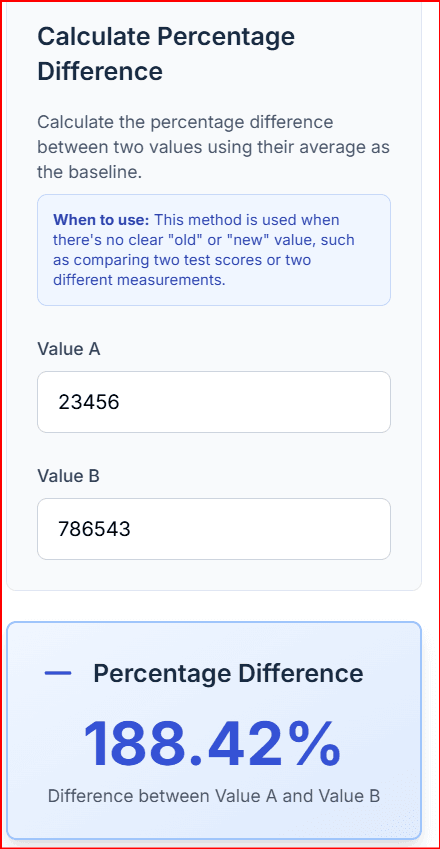
We built the Percentage Difference mode of our calculator specifically to solve this ambiguity.
The Solution: The "Difference" Formula
To remove the directional bias, the Percentage Difference formula doesn't divide by an "old" value. Instead, it divides the gap between the values by their average.
The formula is:
(|Value A - Value B| / Average) × 100
By using the average in the denominator, this method ensures that:
- Neutrality: Comparing A to B yields the exact same percentage as B to A.
- Balance: The result is relative to the scale of the values themselves, rather than being skewed by the smaller or larger number.
Here is how to apply this distinction in the real world.
Science and Calibration
Scenario: A lab technician has two sensors measuring the same liquid. Sensor A says 5.00 pH, Sensor B says 5.05 pH.
The Verdict: Use Percentage Difference.
Why: There is no "before" and "after." The technician needs to know the degree of variance between two equal instruments to determine if they are within the margin of error.
Manufacturing Consistency
Scenario: A factory produces steel beams. Batch 101 has a tensile strength of 450 MPa. Batch 102 has 440 MPa.
The Verdict: Use Percentage Difference.
Why: The goal is uniformity, not growth. The engineer uses this formula to ensure the variance between batches stays below a strict tolerance threshold (e.g., 1%).
Financial Growth
Scenario: A company had $1 million in revenue in 2024 and $1.5 million in 2025.
The Verdict: Use Percent Change.
Why: There is a clear timeline. The 2024 number is the "anchor." Investors want to see the specific directional growth (+50%) relative to where the company started.
A Note on Mathematical Edges
The Percentage Difference formula works in almost all comparison cases, with one rare exception: if the average of the two numbers is zero.
This occurs if you compare a number to its negative equivalent (e.g., 5 and -5). In this specific instance, the denominator becomes zero, rendering the result undefined. For all other comparison scenarios, the formula remains valid.
When the Starting Value is Zero
While the Percentage Difference formula struggles with an average of zero, the Percent Change formula has a different nemesis: a starting value of zero. If your baseline (Old Value) is 0 and your new value is 100, you cannot divide by zero. Mathematically, this creates an undefined result (or infinity). In business, this often happens when launching a new product or a brand-new revenue stream. If you encounter this, don't force a percentage. Simply report the absolute growth (e.g., "From $0 to $100") rather than a percent change. Claiming "Infinite % growth" is mathematically defensible but practically meaningless.
The Significance Filter: When to Ignore the Percentage
Not every calculated percent change deserves to be reported. In statistical analysis, we look for 'significance.' If you are measuring a change in a dataset with a very low volume, a massive percentage change might simply be 'noise.'
For example, if your website conversion increases from 1 visitor to 2 visitors, that is a 100% change. However, because the sample size is so small, that data point is statistically insignificant and shouldn't drive a business decision. Before you share a high percentage change with a client or manager, always ask: Is the sample size large enough for this percentage to represent a repeatable trend? If the answer is no, report the raw numbers and add a note about the low sample size.
Expert analysis isn't about using the calculator; it's about knowing when the output is actually meaningful.
Conclusion: Selecting the Right Tool
Applying "Percent Change" in situations better suited for "Percentage Difference" introduces invisible bias into your data.
Always ask yourself: Is there a clear start and finish?
If yes (Old vs. New), use Percent Change. If no (Item A vs. Item B), use Percentage Difference mode of the Calculator to get the unbiased precision you need.
| Measure | Denominator in the formula | Question you are answering |
|---|---|---|
| Percent change | The starting (old) value. | How far did we move from a fixed baseline over time? |
| Percentage difference | The average of the two values. | How far apart are two peers, treating A and B symmetrically? |
Percentage Difference Calculator Interface
Swipe horizontally or scroll to the right to view the full screenshot.
Summary: The Cheat Sheet
- Percent Change: Measures growth or decline over time. Requires a clear starting point. (Formula divides by the Start Value).
- Percentage Difference: Measures the gap between two equal values. No starting point needed. (Formula divides by the Average).
- Key Trigger: If switching the numbers (A to B vs. B to A) shouldn't change the result, you must use Percentage Difference.
- Real World Use: As examples, use "Difference" for quality control, instrument calibration, and comparing peer items. Use "Change" for stock prices, weight loss, and revenue growth.