The Architecture of Accumulation: Geometric Growth, Frequency, and Yield
Why wealth generation is a function of time and frequency, not just principal.
Published on

Compound interest is a geometric progression, not magic. We analyze the mathematical mechanics of accumulation, the impact of compounding frequency (), and the critical difference between nominal and real returns.
In institutional finance, capital growth is classified into two distinct mechanics: linear progression (Simple Interest) and geometric progression (Compound Interest). Linear growth is arithmetic; it requires constant additive input to sustain upward momentum. Geometric growth is exponential; it creates a feedback loop where the asset's yield generates its own subsequent yield, detaching the outcome from the initial principal.
For the quantitative analyst or the long-term investor, understanding this mechanism is not about optimism—it is about mathematical determinism. This article deconstructs the compound interest formula to isolate the variables that engineer wealth, moving beyond basic definitions into the structural mechanics of accumulation.
The Formula: Deconstructing the Equation
To control your fiscal trajectory, you must master the governing equation. The standard governing equation for compound interest is:
Where:
- = Future Value (The Output)
- = Principal (The Capital Input)
- = Annual Interest Rate (The Velocity)
- = Compounding Frequency (The Multiplier)
- = Time (The Exponent)
While retail marketing focuses on and , the institutional eye focuses on and . These are the levers of exponential acceleration discussed in our broader Triple-Lever Framework.
Visualizing the "Detachment Point"
The most critical phase in compounding is the Detachment Point—the mathematical moment when the interest generated in a single period exceeds the recurring principal contribution of that period.
Prior to this point, the curve appears linear (the "Accumulation Phase"). Once the detachment occurs, the curve goes vertical. This is not speculative; it is the inevitable result of the exponent increasing.
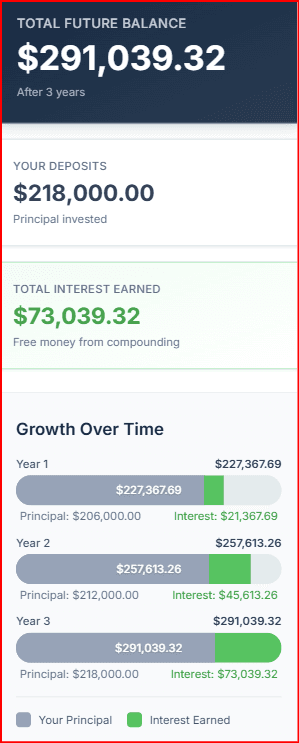
Compound Interest Projections
Swipe horizontally or scroll to the right to view the full screenshot.
Fueling the Engine: Why Adding Money Regularly Changes the Math
The compound interest formula often looks at a static, one-time investment (). In the real world, you are likely adding money to your account on a regular schedule. Think of compound interest as the engine of your wealth, and your monthly contributions as the fuel.
When you add money regularly, you aren't just saving more—you are constantly increasing the "Principal" () that the formula uses. By consistently feeding the engine, you aren't just letting your money grow; you are actively moving your portfolio's base to a higher level, allowing you to hit the "Detachment Point"—that vertical acceleration phase—years sooner than if you had just let a one-time sum sit idle.
The Variable "": The Frequency Delta
Novice investors assume a 10% return is static. It is not. The variable (compounding frequency) alters the Effective Annual Rate (EAR).
Consider a $10,000 capital allocation at 10% nominal yield:
- Annual Compounding (): End balance $11,000.
- Monthly Compounding (): End balance $11,047.
- Continuous Compounding (): End balance $11,051.
While the $51 delta appears negligible in year one, when extrapolated over a 30-year horizon, this variance compounds into a significant capital divergence. This is why you must verify the APY (Annual Percentage Yield), not just the APR. You can model this divergence precisely using our Compound Interest Calculator, which allows you to toggle between monthly and annual frequencies to see the exact impact on your ledger.
The Decay of "": Quantifying the Cost of Waiting
In the formula, time () acts as the exponent. This means its relationship to wealth is super-linear. A 10% reduction in time does not result in a 10% reduction in wealth; it can result in a 50% reduction in final outcome.
This phenomenon is what we call "Duration Risk" in reverse. The investor who starts later must contribute exponentially more capital to achieve the same result as the investor who started earlier. We have quantified this specific penalty in our analysis of the "Million Dollar Penalty" in The High Cost of Waiting.
The "Real" Rate: Adjusting for Inflation & Tax Drag
Institutional analysis never relies on the "Nominal" rate (the number on the screen). We solve for the Real Rate of Return.
There are two silent erosions to your compound curve:
Inflation:
Purchasing power decay effectively lowers your . If your portfolio grows by 8% but inflation is 3%, your geometric growth is only functioning at 5%. (Read more: How Inflation Impacts Purchasing Power).
Tax Drag:
Unless capital is sheltered (e.g., 401k/IRA), taxes are levied on the yield before it can compound. A 10% return taxed at 20% is mathematically an 8% compounding rate.
The Lesson: Maximizing is useless if you ignore the drag coefficients of taxes and inflation.
The Timing of Returns: Why the Order Matters
The compound interest formula assumes a steady, predictable return year after year. In reality, markets fluctuate. While the math of compounding works regardless of the order of your returns, your personal wealth does not. A major market drop early in your journey—when your balance is small—is a manageable bump in the road. However, that same market drop later in life, when your account balance is large, can be financially devastating. This is known as Sequence of Returns Risk. As your portfolio grows, your focus must shift from simply maximizing growth to managing volatility, ensuring that a market downturn doesn't permanently damage the compound curve you've spent decades building.
Heuristics: The Rule of 72
While algorithmic modeling is required for final projections, a quick mental heuristic is useful for strategy meetings. The Rule of 72 approximates the doubling time of an investment.
At a 10% return, capital doubles every 7.2 years. While mathematically an approximation of the logarithmic function , it remains a vital tool for quick estimation. For the full derivation and edge cases of this rule, see our dedicated guide on The Rule of 72.
Trust the Math, Not the Market
Markets fluctuate. Volatility is inevitable. But the mathematics of compounding remain constant. It is a deterministic force that rewards consistency and time over intensity and timing.
By understanding the variables (frequency) and (time), you move from being a passive saver to an active architect of your wealth.
| Compounding | Periods per year (m) | Effect on effective annual yield |
|---|---|---|
| Annual | 1 | Baseline: effective rate equals the stated nominal rate when quoted per year. |
| Semiannual | 2 | Interest credits twice; effective yield is higher than the nominal annual label. |
| Quarterly | 4 | More frequent credits; gap between nominal and effective widens slightly. |
| Monthly | 12 | Common on loans and savings; APY is noticeably above the nominal APR-style quote. |
| Daily (or continuous limit) | 365+ (or continuous) | Approaches the mathematical maximum effective yield for that nominal rate—small extra bump vs. monthly at typical rates. |
Executive Summary: The Mechanics of Wealth
- Geometric Dominance: Compounding is an exponential function. It always outperforms linear additive savings given sufficient time.
- The Frequency Multiplier: Higher compounding frequency () increases the Effective Annual Rate (EAR). Always calculate based on APY, not APR.
- The Exponent of Time: Time () is the most powerful variable in the formula. Delaying investment has a super-linear negative impact on final accumulation.
- Net vs. Gross: True geometric growth must be calculated net of inflation and tax drag. Use our Compound Interest Calculator to model these variables and verify your actual trajectory.