AFFO and the Quality of Income: How to Judge REIT Payout Strength with Precision
A practical framework for reading REIT cash flow with confidence, so you can tell whether a dividend is sturdy or stretched before the next market wobble.
Published on

Many investors buy REITs for one core reason: steady income. But a high yield by itself does not tell you whether that income is dependable. A dividend can look generous right up until the moment management cuts it. That is where AFFO becomes valuable. It helps you judge whether the cash engine underneath a REIT is actually supporting the payout, or whether the distribution is being stretched by timing quirks, one-time adjustments, or debt pressure.
Think of REIT analysis like evaluating a rental property you own with a partner. You would not decide how much cash you can safely withdraw each month by staring only at appraised building value. You would check rent collected, normal maintenance, leasing costs, and financing drag. AFFO brings that same real-world logic to public REITs.
If you are new to asset-value framing, this companion piece on what NAV says about underlying investment value is useful context. In this article, we focus on the income side: the durability of the dividend stream.
Why AFFO Matters More Than Yield Headlines
A headline yield is like a restaurant sign that says "Huge portions." It tells you something about quantity, but almost nothing about quality, consistency, or long-term viability. AFFO helps answer the better question: is the REIT producing enough recurring cash after normal operating friction to sustain what it pays shareholders?
In real estate, accounting earnings can be noisy. Buildings depreciate on accounting schedules, while actual property economics move based on lease terms, occupancy quality, rent growth, refinancing terms, and recurring capital requirements. AFFO attempts to clean that signal so investors can assess what portion of income is repeatable.
Net Income vs. FFO vs. AFFO: A Practical Comparison
Investors often see three numbers discussed together: net income, FFO, and AFFO. They are not competing scoreboards. They answer different questions. Net income is the formal accounting result. FFO (Funds From Operations) is designed to reduce some real-estate-specific accounting distortion, especially depreciation and property sale gains. AFFO then goes another step and aims to approximate recurring cash available for distributions after normal property upkeep and leasing friction.
Another analogy: if net income is the weather report, FFO is the radar image, and AFFO is the road-condition report for your actual trip. You need all three at times, but for dividend durability, AFFO often gets closest to ground truth.
| Metric | Best use | Blind spot if used alone |
|---|---|---|
| Net income | Formal accounting profitability and trend awareness. | Can understate property economics due to heavy depreciation treatment. |
| FFO | Improves comparability across REITs by neutralizing key accounting noise. | Still may not subtract enough recurring maintenance and leasing drag. |
| AFFO | Closer proxy for recurring distributable cash and payout resilience. | Not standardized perfectly across all REITs; adjustment quality matters. |
The AFFO Adjustment Stack Investors Should Inspect
AFFO is helpful, but it is not magic. You still need to inspect what management adds back and subtracts. A strong habit is to ask: "Would I count this as recurring if I personally owned these buildings?" If the answer is yes, it usually belongs in the recurring cash picture.
Adjustments that usually improve clarity
Depreciation normalization and one-time sale event removal can improve signal quality. These are often sensible steps because they remove accounting timing effects that do not represent ordinary cash generation from stabilized operations.
Adjustments that deserve extra scrutiny
Recurring tenant improvements, leasing commissions, and maintenance capital are real drags. If a REIT keeps classifying recurring expenses as "special" or "non-recurring," that can overstate AFFO quality. A useful check is consistency: if the same item appears every year, it is likely part of normal economics.
This is where comparison skills overlap with your broader investing toolkit. You can pair this with our framework on valuation expectations and narrative risk to avoid paying premium prices for fragile cash profiles.
Using AFFO Payout Ratio as a Dividend Stress Gauge
The AFFO payout ratio is one of the clearest practical checks in REIT analysis. It asks: what share of recurring cash is being distributed? Lower is not always better, and higher is not always a disaster. But extremely high ratios leave less room for tenant disruption, refinancing pressure, or unexpected major maintenance costs.
Think of the ratio like a bridge load limit. If daily traffic is already near maximum, a temporary shock can create trouble fast. If load is moderate, the structure has breathing room. For payout analysis, trend direction usually matters more than one quarter in isolation.
A Simple Stress Test: The Refinancing Ripple
A safe payout ratio today can become a 'trap' tomorrow if a REIT is staring at a large debt maturity. If 20% of a REIT's debt matures this year and is refinanced from a 4% rate to a 6.5% rate, that incremental interest expense flows directly out of AFFO.
| Variable | Current State | Post-Refinance (Simulation) |
|---|---|---|
| AFFO per Share | $1.00 | $0.85 |
| Dividend per Share | $0.75 | $0.75 |
| AFFO Payout Ratio | 75% (Safe) | 88% (Stretched) |
A practical interpretation range
Many investors view a moderate band as healthy for long-run resilience, but thresholds differ by property type and lease structure. Net-lease and multifamily REITs can behave differently from office or specialty segments. This is why you compare within peer sets, not across the whole REIT universe blindly.
Sector Nuance: Why Two REITs with the Same Yield Can Be Very Different
Imagine two REITs each yielding 6.5%. One has long contractual leases with stable tenants and moderate intensity of major maintenance costs. The other has shorter lease terms, weaker occupancy quality, and repeated refinancing over the next 24 months. On a watchlist, they look similar. Under AFFO analysis, they can look completely different.
This is also where macro interpretation matters. If inflation and financing conditions shift, cash resilience can diverge quickly. If you want a refresher on inflation pressure and purchasing power, this guide on inflation's impact on real value pairs naturally with AFFO-based income analysis.
Common red flags to watch
Repeatedly "adjusted" add-backs, weakening same-property performance, and rising payout ratio alongside weakening balance-sheet flexibility should trigger caution. A useful mental model: fresh paint does not repair structural beams. Attractive investor decks do not replace recurring cash discipline.
How to Calculate AFFO: Inputs, Formula, and a Worked Example
If you want a clean AFFO read, start with a repeatable process. In practical terms, AFFO is your REIT cash result after stripping out accounting noise and subtracting recurring property costs that are necessary to keep the portfolio producing rent.
Numbers you need first
To calculate AFFO itself, use the first six inputs below. The dividend input is only needed for the payout ratio step after AFFO per share is calculated.
- Net income from the reporting period.
- Where you will generally find it: Income statement (usually near the bottom, often labeled "Net Income" or "Net Income Attributable to Common Shareholders").
- Depreciation and amortization tied to real estate operations.
- Where you will generally find it: Cash flow statement (non-cash add-backs), plus footnotes or the supplemental REIT package for property-level detail.
- Any gains or losses from asset sales that are not part of recurring operations.
- Where you will generally find it: Income statement lines like "gain on sale" / "loss on disposition," with confirmation in notes and management discussion.
- Straight-line rent and other non-cash timing adjustments (meaning: reports may show rent as evenly spread month to month, even when tenants are actually paying less now and more later, so this line helps you separate reported rent from real cash received today).
- Where you will generally find it: REIT supplemental earnings package, notes to financial statements, and management reconciliation tables.
- Recurring maintenance and leasing costs (tenant improvements and leasing commissions where applicable).
- Where you will generally find it: Cash flow statement investing section, property supplement schedules, and AFFO/FFO reconciliation disclosures.
- Total diluted share count so you can compute AFFO per share (this is the full share base after including potential shares from items like stock compensation, options, and convertibles, not just basic shares outstanding).
- Where you will generally find it: Earnings release share table, income statement EPS footnote, or 10-Q / 10-K diluted weighted-average shares line.
- Annual dividend per share (or quarterly dividend per share annualized) only if you also want to compute AFFO payout ratio after calculating AFFO per share.
- Where you will generally find it: Dividend declaration press releases, earnings release summary tables, investor relations dividend history pages, or the statement of equity distributions.
Simple calculation flow
One practical template is:
AFFO = FFO
       - straight-line rent adjustment
       - recurring maintenance and leasing costs
       ± other recurring cash adjustments
Then divide by diluted shares to get AFFO per share.
Example (illustrative only)
Assume a REIT reports FFO of $120 million, straight-line rent adjustment of $8 million, recurring maintenance and leasing costs of $20 million, and no other material recurring adjustments. That gives AFFO of $92 million. If diluted shares are 100 million, AFFO per share is $0.92.
If the annual dividend per share is $0.74, payout ratio by AFFO is roughly 80.4% ($0.74 / $0.92). That is a much sharper decision signal than yield alone because it ties the payout directly to recurring cash generation.
Is a higher ratio good or bad? Usually, lower means more cushion and higher means less cushion. A practical rule of thumb is: below ~75% is often comfortable, ~75% to ~85% is watch-list territory, and above ~85% can be stretched unless the REIT has exceptionally stable cash flows. There is no universal "perfect" number, so always compare within the same REIT sector and lease profile.
A Repeatable AFFO Checklist for Real-World Decisions
You do not need a complex institutional model to improve decision quality. A repeatable checklist often beats ad-hoc judgment. When reviewing a REIT, run this quick pass:
Eight-question pass
- Is AFFO per share growing, flat, or slipping over multi-quarter windows?
- How much of AFFO is consumed by dividends now versus one year ago?
- Are management adjustments consistent year to year?
- What recurring maintenance and leasing costs are being taken out of the total?
- How exposed is the balance sheet to near-term refinancing?
- Are occupancy and rent collections stable in the core portfolio?
- Is current valuation demanding perfection for the payout story?
- Would the dividend still look safe under a mild operating slowdown?
Swipe horizontally or scroll to the right to view the full screenshot.
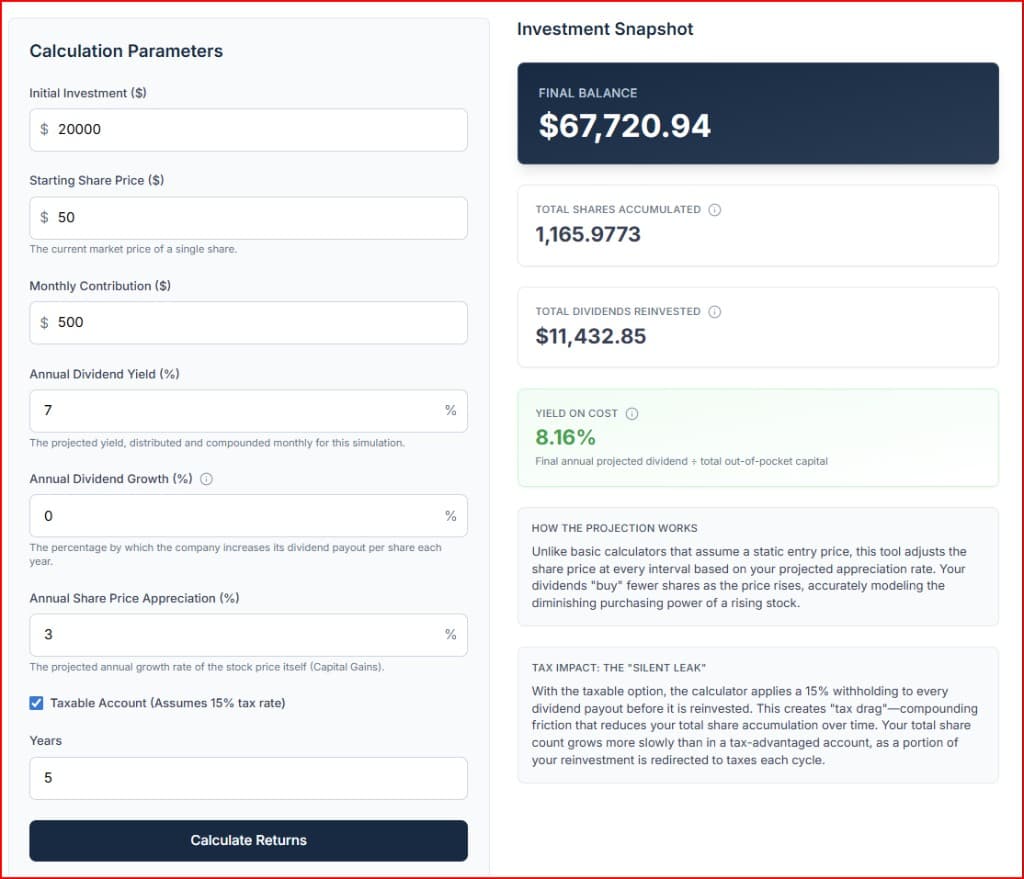
You can additionally model reinvested income scenarios with our Compound Interest Calculator and compare return paths with the ROI Calculator. For multi-period project-style return framing, this piece on IRR decision logic is a useful bridge.
Definitive Summary
- AFFO is a durability lens: It is often a stronger indicator of dividend resilience than yield headline alone.
- Check the math quality: A number is only as useful as the discipline behind its add-backs and subtractions.
- Run the calculation yourself: Build AFFO from FFO, subtract the standard recurring adjustments, apply other recurring cash adjustments as plus or minus where appropriate, convert to AFFO per share, then use dividend per share to compute payout ratio and judge cushion versus stress.
- Use payout ratio as a stress gauge: Rising payout load with weaker fundamentals deserves caution.
- Compare within peer context: Property type, lease profile, and financing structure can change interpretation.
- Keep it repeatable: A simple AFFO checklist improves decision quality more than one-off hot takes.