A Layperson's Guide to Margin Investing
Plain-language clarity on what margin is, how it works, and when the risks outweigh the rewards.
Published on

Margin is when your broker lends you money so you can buy more stocks or other securities than your cash alone would allow. In plain terms: you put in some of your own money, the broker adds a loan on top, and you control a larger position. That can mean bigger gains if the market goes up—and bigger losses if it goes down. This guide explains how it works, what the rules are, when it might (and usually doesn't) make sense, and how to stay safer if you use it.
What Is Margin, Really?
A margin account is a type of brokerage account that lets you borrow against the value of the investments you already hold. Think of it like a secured loan: the collateral is your portfolio. The broker sets a limit on how much you can borrow based on that collateral and on regulatory rules. You don't have to borrow; having a margin account just gives you the option. Many investors use a cash account instead, where you can only buy what you can pay for in full—no borrowing.
When you "buy on margin," you're using a mix of your own money and the broker's money. Your share is called your equity—the part of the account that would be left if you sold everything and repaid the loan. The broker's share is the margin debt. As prices move, your equity goes up or down. If it falls too far, the broker can require you to add cash or sell holdings to bring your equity back above a set threshold. That demand is called a margin call, and it can happen quickly in a sharp downturn.
The Rules: Reg T and Maintenance
In the U.S., federal rules limit how much you can borrow when you first open a margin position. The main one brokers follow is Reg T (short for Regulation T), which is set by the Federal Reserve. Reg T says that, in most cases, you can borrow up to 50% of the purchase price of eligible securities. So if you want to buy $10,000 of stock, you need to put in at least $5,000 of your own money; the broker can lend you the other $5,000. Individual brokers can require more than 50% of your own money (they call that "house margin" or stricter initial margin), but they can't allow less than Reg T for standard accounts.
After you're in the position, a different rule kicks in: maintenance margin. That's the minimum amount of equity you must keep in the account as a percentage of the total value of your margin positions. If the market drops and your equity falls below that percentage, the broker will issue a margin call. Maintenance requirements are set by the broker and by self-regulatory rules (like FINRA's); they're often in the 25–40% range for many stocks, meaning your equity must stay above that percentage of the total market value of your margined holdings. If you don't meet the call by adding funds or selling, the broker can close out your positions without your permission to bring the account back into compliance.
Broker discretion. The 25–40% maintenance rule is a floor, not a ceiling. In times of extreme volatility, brokers reserve the right to raise maintenance requirements to 100% on specific stocks instantly. This "margin expansion" is what triggers liquidations even when a stock hasn't hit your projected stop-loss. You may think you have cushion; a broker notice can remove it overnight.
The price at which a margin call is triggered (for a single stock) can be formalized. If we call the initial margin (e.g., 50%) and maintenance margin (e.g., 30%) as decimals, the critical price below which you get a call is:
So a stock bought at $100 with 50% initial margin and 30% maintenance has a margin-call price of about $71. Below that, your equity in that position fails the maintenance test—and the broker can act.
How Margin Magnifies Gains and Losses
The math is straightforward. Say you have $10,000 of your own money. In a cash account, you buy $10,000 of stock. If the stock goes up 10%, your holding is worth $11,000—a 10% gain on your money. If it goes down 10%, you have $9,000—a 10% loss.
In a margin account, you might put in the same $10,000 and borrow another $10,000 (assuming Reg T and your broker allow it), so you buy $20,000 of stock. Your equity is still $10,000—the part that's yours. If the stock goes up 10%, the position is worth $22,000. You owe $10,000 to the broker, so your equity is $12,000. That's a 20% gain on your $10,000. If the stock goes down 10%, the position is worth $18,000. After repaying the $10,000 loan, your equity is $8,000—a 20% loss on your money. So the same 10% market move becomes a 20% move for your equity. A 50% drop in the stock would wipe out half the position value; after repaying the loan, your equity could be gone or negative, and the broker would be protecting its loan by selling—a margin call in action.
That's why margin is often described as leverage: it multiplies your exposure. It doesn't change the direction of the market; it just makes your stake in the outcome bigger relative to the cash you put in. For more on how growth and compounding work over time, see our post on the mathematics of compound interest and the Rule of 72—and remember that on margin, the same math can work against you when the market falls.
The Cost of Borrowing
The broker doesn't lend for free. You pay interest on whatever you borrow—usually billed monthly, and it can add up the longer you carry the loan. So your investments don't only need to go up. They need to go up enough to cover that interest. Relative to investing the same cash with no loan, you also need the bigger position to outrun the loan cost—or you're behind.
Many brokers also use a rate ladder: borrow more, and the interest rate can tick a little lower. That can look like a deal. The screenshot below is a real broker screen showing how much one account could borrow and what rate applied at each borrowing level.
Real Broker Screen: Borrow Limit & Interest Rate Tiers
Swipe horizontally or scroll to the right to view the full screenshot.
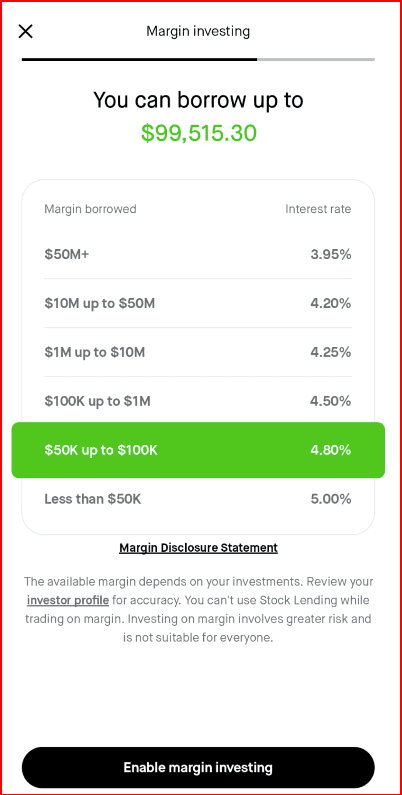
Here's the part most rate tables leave out: turn that percent into dollars on your money. Suppose you put in $10,000 of your own cash and borrow another $10,000 at 4.80%. The loan alone costs about $480 a year (before compounding)—whether the market is up, flat, or down. If the stocks go nowhere, you're still out roughly that $480. Margin only "helps" after the bigger position gains enough to cover that bill. The same stocks in a cash account don't owe the broker that fee.
A lower rate in a higher tier (for example, 4.50% once you're above $100K on this screen) can look attractive. It usually means you're carrying more debt, so a down day still hits harder. Cheaper rate is not the same as safer. And as the screen notes, you often can't earn stock-lending income on the same account while you're borrowing—another tradeoff, not free money.
Interest is typically charged periodically and can compound, so the longer you carry a balance, the more it costs. Our compound interest explainer and our Compound Interest Calculator can help you see how borrowing costs add up over time. For a portfolio-level check on how much room you have before a call, use our Margin Loan & Portfolio Risk Calculator.
Taxes add another wrinkle: margin interest may or may not be deductible depending on how you use the loan and current tax rules. Don't assume it's deductible; check with a tax professional.
Sometimes You Can Withdraw Margin as Cash
Margin isn't only for buying more securities. Many brokers let you take margin as cash—withdraw it to your linked bank account—as long as you have enough borrowing capacity and your account stays above the maintenance requirement. So you might use margin like a line of credit: you leave your investments in place and pull out cash for a short-term need (e.g., a large expense or a bridge until another payment lands) instead of selling and potentially triggering taxes.
The same rules and risks apply. You pay margin interest on the amount you withdraw. That balance counts as margin debt, so a drop in your portfolio still shrinks your equity and can still lead to a margin call. If you withdraw a lot relative to your equity, you have less cushion before a market dip pushes you below the maintenance level. So using margin for cash is still borrowing against your portfolio—treat it with the same caution, and only do it if you understand the cost and can afford the risk.
When Margin Makes Sense—and When It Doesn't
Margin can make sense in limited cases: short-term, tactical use by experienced investors who understand the risks and can afford to lose the money they've put in. Some use it to avoid selling a position (and triggering taxes) by borrowing for a short need instead. Others use it in strategies that have defined risk and short time horizons. Even then, the cost of interest and the risk of a margin call mean it's not "free leverage."
For most people, margin is a bad fit. If you don't have an emergency fund, or you'd be wiped out by a 30–50% drop in your portfolio, or you're investing for long-term goals like retirement, building wealth over time with a cash account (or no leverage) is usually safer. Starting early and staying invested with money you can afford to leave in the market often beats trying to amplify returns with margin. And if you're juggling other debt, getting that under control first—for example with a clear balance-transfer or payoff plan—is usually a better use of your attention than margin investing. You can model payoff timelines with our 0% APR Payoff Planner.
If you're weighing big life trade-offs—like how much to put in the market versus a down payment—running the numbers matters. Our rent vs. buy analysis and Mortgage Calculator can help you compare options with real numbers. For measuring returns on specific investments or projects, our ROI Calculator and our guides on CAGR and IRR are useful—and none of them require using margin.
If You Use Margin: Practical Safety
What happens when equity drops too low: The broker is not your partner; they are a senior creditor. If your equity fails, they will liquidate your most liquid assets—often your best stocks—at market prices to ensure their loan is covered. They will not wait for a recovery. That's why the "safe zone" vs. "danger zone" graphic below matters: stay well above the line.
If you do use margin, keep a buffer. Don't max out your borrowing. The closer your equity is to the maintenance requirement, the less room you have before a drop triggers a margin call. A sharp down day can push you below the threshold quickly, and you may get only a short time to meet the call (often one to a few days) before the broker liquidates positions. That can lock in losses and leave you with a tax bill and less portfolio than you started with.
Know your broker's maintenance level and how they notify you (email, phone, in-app). Keep enough cash or liquid assets that you could meet a call without being forced to sell in a panic. And if you're not sure you could stomach a 30–50% drop in the value of your margined position without distress, scale down the amount you borrow or avoid margin altogether. Understanding how inflation affects your purchasing power and real returns is also part of the picture: margin interest and inflation both eat into what your money is really worth over time.
| Topic | Cash account | Margin account |
|---|---|---|
| Borrowing | You buy only with available cash—no loan from the broker. | You can borrow against investments the broker accepts. Opening rules usually limit how much you can borrow at the start (often about half the purchase). |
| Who holds risk if values fall | For ordinary long stock, your loss is limited to what you paid for the position. | The broker gets paid back first. If your share of the account falls too low, they can demand cash or sell your investments. |
| Effect on returns | Your percentage gain or loss tracks the investment (before fees and taxes). | Borrowing makes gains and losses larger relative to the cash you put in. |
| Recurring cost | No loan interest from the broker just for holding the position. | You pay interest on borrowed money until you pay the loan back. |
| If the account gets too thin | No broker deadline to add cash because of a loan minimum. | Margin call: you may need to add cash quickly, or the broker may sell positions—sometimes without waiting—to bring the loan back into line. |
Definitive Summary
- What margin is: Leverage via a senior secured loan. Your portfolio is the collateral; the broker is the lender who gets paid first.
- The rules: Reg T limits how much you can borrow when you open a position (often 50% of the purchase). Maintenance margin is the minimum equity you must keep; below that, the broker can issue a margin call and sell your holdings if you don't add funds. Brokers can raise maintenance to 100% in volatile markets.
- Amplification: Margin multiplies both gains and losses on your equity. A 10% market move can be a 20% move (or more) on your money when you're leveraged.
- Cost: You pay interest on what you borrow (often lower rates at higher balances). Turn the rate into dollars—for example, $10,000 borrowed at 4.80% is about $480 a year before compounding. Stocks must cover that bill before margin helps vs. cash-only investing. A cheaper rate usually means more debt, not less risk.
- Margin as cash: Many brokers let you withdraw margin to your bank account (like a line of credit). You still pay interest and face the same margin-call risk—use the same caution.
- When to avoid it: Most investors are better off without margin—especially if you need stability, have other debt, or are investing for the long term. Building wealth over time with a cash account is usually safer.
- If you use it: Maintain a massive buffer. Professional traders rarely use more than 10–20% of their available margin to avoid "Gap Risk"—the danger of a stock opening significantly lower than it closed.