The Definitive Guide to IRR: Measuring True Investment Profitability
Move beyond simple growth rates. Discover how the Internal Rate of Return (IRR) accounts for regular contributions and complex cash flows to reveal the reality of your investments.
Published on

Plenty of guides focus on CAGR—the "what if I put in one lump sum and never touched it?" growth rate. Real life is messier: you add to your 401(k) every month, pull money out for a down payment, or put capital into a side business in chunks. A single "average return" number can hide what's really going on. The number that accounts for when money goes in and out is the Internal Rate of Return, or IRR.
In simple terms, IRR is the "true" annual return that makes everything you put in and everything you got out—and the timing of each—add up fairly in today's dollars. It's the go-to measure when your investment has multiple deposits or withdrawals: retirement savings, rental income, or a business you fund over time.
IRR at a Glance
- What IRR is: The yearly return that makes the value of everything you put in equal to the value of everything you got out, once you account for when each amount moved.
- Use it when: You add or take out money at different times—regular contributions, a few big deposits, or mixed withdrawals.
- IRR vs. CAGR: CAGR fits one lump sum in and one value out. IRR fits any pattern of money in and out over time.
- Keep in mind: IRR has some quirks (e.g., odd cash-flow patterns can give more than one answer). Use it together with common sense and other numbers that matter to you.
Why a Simple "Percent Return" Isn't Enough
Say you put $500 a month into a retirement account for 10 years, then stop and let it grow. Or you buy a rental for $20,000, spend $5,000 on repairs in year two, and collect rent every month. A single "we made X%" number that ignores when you added or took money out can make a strategy look better or worse than it really is. When you invest matters just as much as how much you invest. IRR wraps that timing into one number: the annual return that makes your whole story—every dollar in, every dollar out—"break even" in today's terms.
That's why analysts and investors use IRR for things like venture deals, real estate, and retirement plans with ongoing contributions. It answers the question you actually care about: "Given what I put in, what I got out, and when it all happened—what was my real yearly return?"
The Big Idea: Making In and Out "Break Even" in Today's Dollars
A dollar today is worth more than a dollar next year—you could invest it and earn something. So when we look at future money (rent you'll collect, or a lump sum you'll get when you sell), we "discount" it back to today's value using a rate . Money you put in counts as negative; money you get back counts as positive. The net present value (NPV) is just the total of all those adjusted amounts. When you find the rate that makes that total exactly zero, that rate is your IRR—the "break-even" return that makes the whole project fair in today's terms.
The math (for reference)
- — money in or out at each time (negative when you put in, positive when you get back).
- — the rate we use to bring future dollars to today; when the total equals zero, is the IRR.
You don't need to solve for IRR by hand. Spreadsheets and financial calculators do it for you. (Pro tip: Use the standard IRR function for perfectly equal, yearly intervals, but use the XIRR function if your deposits and withdrawals happen on exact, irregular calendar dates.) The takeaway: IRR is the yearly return that makes your entire cash-flow story "break even" when valued in today's dollars.
Two Examples: What IRR Means in Practice
Numbers help. Here are two simple scenarios that show what IRR is really telling you.
Example 1: One lump sum in, one payout out
You invest $10,000 today. Two years later, you have $12,100. The IRR is about 10%. That means: if we value everything in today's dollars, a 10% yearly return is the rate that makes your $10,000 "grow" to $12,100 over two years. In this case, IRR and CAGR are the same—because you had one deposit and one ending value.
Check: $10,000 × (1.10)² = $12,100.
Example 2: Multiple contributions over time
You put in $5,000 today (at the start) and another $5,000 one year later. At the end of year 3, your account is worth about $12,700. The IRR is roughly 10% again. But notice: you didn't put in $10,000 all at once—the second $5,000 was only invested for two years. A naive "I put in $10k and got $12.7k" would suggest a 27% total return, which ignores timing. IRR folds that timing in and says: "Your money effectively earned about 10% per year, given when each dollar went in."
Check at 10%: $5,000 × (1.10)³ + $5,000 × (1.10)² ≈ $12,705.
That's the power of IRR: it gives you a fair, annualized number even when your cash flows are spread out.
IRR vs. CAGR: When to Use Which
CAGR works when you put in one lump sum, never touch it, and look at your balance years later. It answers: "What steady yearly growth would turn my starting amount into my ending amount?" IRR does the same kind of thing but for any pattern of money in and out. If you truly have just one deposit at the start and one value at the end, IRR and CAGR will match. Once you add regular contributions, withdrawals in the middle, or several rounds of funding, you're in IRR territory—CAGR no longer tells the full story.
A 401(k) where you contribute every month (and maybe withdraw later) is a classic IRR situation. So is a business you fund in stages and then sell. For the simpler case—one deposit, one ending value—our guides on how compound interest works and the Rule of 72 are a great place to start. IRR is the next step when your money moves in and out at different times.
Limits of IRR—and How to Use It Well
IRR is useful but not magic. In rare cases, unusual patterns of money in and out can produce more than one "break-even" rate, so the number can be ambiguous. Experts sometimes use other variants (like modified IRR) or compare projects using a fixed hurdle rate instead. IRR also assumes that any money you get back is effectively reinvested at that same rate until the end—in real life you might spend it or invest it elsewhere. So treat IRR as "what this project is implying I earned per year," and use it together with other things you care about: risk, how soon you need the money, and whether the numbers make sense for your goals.
For your own finances, IRR is especially helpful when you're comparing strategies that involve different contribution or withdrawal schedules. In business and real estate, it's the standard way to compare projects that need different amounts of cash at different times. When you care about what your money will actually buy years from now, pair it with inflation-adjusted (real) returns. And always keep risk and liquidity in mind—a high IRR doesn't mean much if the ride was wild or you couldn't get your money out when you needed it.
The "Next Play" Trap: Why High Percentages Can Trick You
There is a sneaky hidden rule built into IRR that catches a lot of people off guard. The calculator automatically assumes that every single time an investment hands you cash—like a dividend payout or a monthly rent check—you instantly turn around and dump that exact cash into a brand-new project that makes that same exact high interest rate.
Think about a quick house flip. You invest some money, fix up the kitchen, sell it six months later, and make a great profit. Because you made your money so fast, your IRR might look like a breathtaking 40%.
But that 40% speed limit only worked while your money was trapped inside that specific house. Once the house sells, that cash lands right back in your everyday bank account making basically zero while you hunt for another deal. The formula pretends you found another identical 40% house flip that very same afternoon. Because of this, don't get blinded by huge short-term numbers—what really matters is how long you can keep your money actively working.
What Is a "Good" IRR for Everyday Investments?
Just like with regular returns, what counts as a "good" percentage depends entirely on where you put your money and how much risk you can sleep with at night. Here is a simple look at how different investments stack up:
- 🚀 8% to 10% (The Simple Route):If you just put your money into a basic stock market fund and leave it alone for years, this is what you usually get. It's your main baseline. If a complicated investment doesn't beat this number, it is probably not worth the extra stress and hassle.
- 🏠 12% to 15% (The Hands-On Route):This is the speed people look for when buying rental houses or fixed property deals. You want those extra percentage points because your cash is locked up tight (you can't just click a button and get it out tomorrow) and dealing with repairs takes actual work.
- ⚡ 20% or More (The Wild Side):This territory is for starting your own small business, funding a side hustle, or taking on big personal projects. You want a massive number here because the chance of losing your money is much higher, and your personal time spent running things isn't free.
The Spreadsheet Trap: Why Your Formula Is Giving You an Error
If Excel, Google Sheets, or another tool spits out #NUM!, #VALUE!, or a nonsense rate, the math engine usually isn't broken—the cash-flow list you fed it is. Two setup mistakes cause almost all of the pain:
Rule 1: Signs matter (money out vs. money in)
Spreadsheet IRR formulas need a clear story about cash direction. Treat money you put in as a negative number (cash leaving your wallet). Treat money you get back as a positive number (cash entering your account).
- Initial investment:
-5000(Cash out) - Mid-project payout:
+1200(Cash in) - Final sale or withdrawal:
+6800(Cash in)
If every number in your column is positive, the spreadsheet assumes you received free money repeatedly without spending anything. Because no "break-even" math is possible, it throws a #NUM! error. Think of negatives as "I funded this" and positives as "this paid me."
Rule 2: Regular IRR vs. XIRR (timing)
Classic IRR assumes perfectly equal gaps between cash flows—every month or every year, like clockwork (e.g., depositing $200 every January 1st).
Real life is messier. You might invest in March, add funds in November, and sell 14 months later on a random Tuesday. For those uneven calendar dates, always use XIRR instead of plain IRR.
- Why it matters:
XIRRuses exact calendar dates to weight early and late dollars correctly—and unlike regularIRR,XIRRalways outputs a true annualized percentage, saving you from manual compounding math.
The Hurdle Rate Reality Check: Factoring in Your Sweat Equity
A high IRR looks exciting on a screen. But before you call a project a win, compare it against what you could have earned with almost zero effort. That hands-off baseline is your hurdle rate—the minimum bar an active deal must clear to justify your time and stress.
Simple benchmarks work well as hurdle rates:
- High-Yield Savings Account / CDs: Your baseline for short-term, risk-free cash.
- Broad Stock Market Index Fund (e.g., S&P 500): Your baseline for long-term, hands-off growth.
A practical example
Say a hands-on side business or rental property calculates to a 12% IRR, but it demands 15 hours a week of evening work, repairs, or client drama. Meanwhile, a low-cost index fund historically yields around 10% with zero weekly effort.
On paper, 12% beats 10%. In real life, that tiny 2% difference is the only return you are making for hundreds of hours of manual labor. Divided by all those worked hours, your "sweat equity" might be paying you pennies per hour.
The IRR formula didn't lie—it just ignored your calendar. Always weigh three factors together: the percentage, the risk of loss, and the required labor. A slightly lower IRR with no work often beats a flashy IRR that acts like a second job.
Using IRR with Real Numbers and Our Calculators
You don't need to struggle with messy spreadsheets or guess your way through the math. You can plug your numbers directly into our True Annualized Return Calculator to handle the complex calculations instantly. Once you have your true annual return number, you can use our other calculators to test different scenarios and map out your next move:
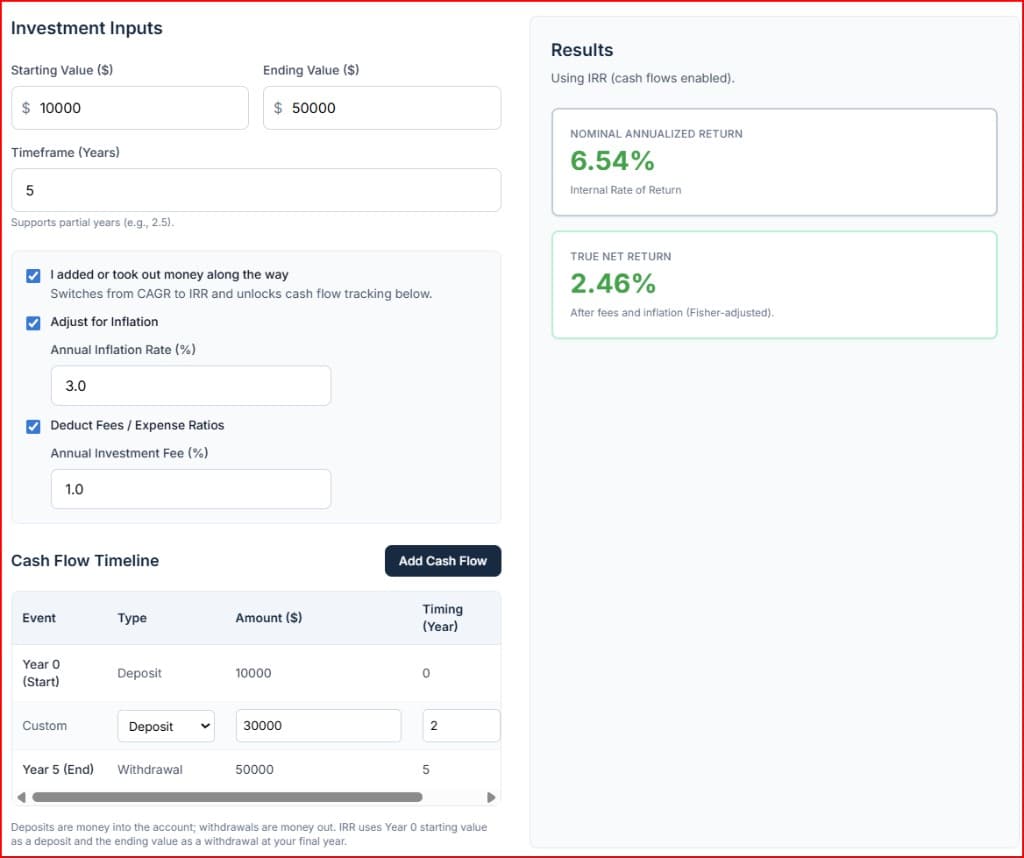
Visualizing an Irregular Cash Flow Timeline
Swipe horizontally or scroll to the right to view the full screenshot.
- Use the Compound Interest Calculator to see how that growth rate turns into future dollars with regular contributions over time.
- Use the ROI Calculator to get a quick snapshot of your total gains versus costs before factoring in the exact dates your money moved.
- For decisions that mix borrowing and investing—like "pay down the mortgage or invest?"—our Mortgage Calculator and rent vs. buy analysis help you lay out your cash baseline.
- If you're tackling credit card or balance-transfer debt, our 0% APR Payoff Planner models your payment strategy so you can compare saving on high-interest debt against investing.
When you pair IRR with a clear view of your actual money in and out—and use tools like these to test different scenarios—you go from "did I do okay?" to a concrete sense of true profitability, whether it's a retirement account, a rental, or a side business.
| Metric | Handles uneven cash flows? | What it tells you |
|---|---|---|
| NPV | Yes — it accounts for every single deposit and withdrawal, no matter how random the timing is. | The net dollar profit your project adds in today's terms (after accounting for a required baseline rate). It tells you total wealth added, but not your percentage return. |
| IRR | Yes — it untangles all your uneven deposits and payouts over the entire timeline. | Your true yearly growth speed. It squishes your entire messy timeline into a single "percent per year" number so you can compare it to other investment options fairly. |
| CAGR | No — it only looks at a single starting balance and a single ending balance. | A smooth growth percentage between two solid points. It works great for one lump sum, but it completely breaks and misleads you if you add or pull out cash along the way. |
Definitive Summary
- What IRR is: The yearly return that makes everything you put in and everything you got out—adjusted for when each happened—"break even" in today's dollars.
- When to use it: Whenever money goes in or out at different times: regular contributions, a few big deposits, withdrawals, or uneven payouts.
- IRR vs. CAGR: CAGR is for one lump sum in and one value out. IRR is for any pattern of money in and out over time.
- Keep in mind: IRR can be tricky in odd situations (e.g., more than one answer). Use it with other factors—risk, inflation, how soon you need the money—for the full picture.
- How to use it: Get IRR from a spreadsheet or calculator, then use our compound interest, ROI, mortgage, and payoff tools to test scenarios and compare strategies in real numbers.