The Strategic Balance Transfer: A Fiduciary's Guide to 0% APR Offers
Why "back of the napkin" math fails when you are fighting 25% APR.
Published on

Debt is not linear; it is exponential. When credit card interest rates hover near 25%, your debt is actively working against you, compounding daily.
Many consumers view a Balance Transfer (0% APR offer) as a "Get Out of Jail Free" card. It is not. It is a highly leveraged financial instrument. Used correctly, it can save you thousands of dollars and years of payments. Used incorrectly, it can be a delay tactic that may result in a deeper hole.
At Definitive Calc, we believe in math, not marketing. Before you sign up for a new card and pay a 3% to 5% transfer fee, you need to simulate the outcome.
The "Silent Tax" of High-Interest Debt
To understand why a balance transfer might be necessary, you must first respect the mathematics of high-interest debt.
Using the Rule of 72: How Fast Will Your Money Double?, we know that a debt with a 24% APR will double in size in just three years if left unchecked. This is the reverse of investment growth; it is wealth erosion.
Consider the "Debt Avalanche" method. Mathematically, paying off the debt with the highest interest rate first is usually the optimal strategy. A balance transfer is essentially a super-charged Avalanche: it artificially forces your highest interest rate down to 0%, stopping the interest accrual immediately.
The Trade-Off: Upfront Fee vs. Long-Term Savings
The catch with almost every balance transfer offer is the Transfer Fee. This is typically 3% to 5% of the amount you move.
The Skeptic's View: "Why would I pay $600 to move $20,000 of debt? That increases my balance to $20,600 immediately."
The Mathematician's View: You are paying a fixed, one-time fee to avoid a variable, recurring cost.
If your current APR is 25%, you are paying roughly 2% of your balance in interest every single month. In this scenario, the 3% transfer fee pays for itself in just 45 days. Every month of 0% interest after that is pure profit.
However, this math only works if you can pay off the debt before the promotional period ends.
Visualizing the trade-off: The fee (green) is a controlled cost. The interest (red) is a runaway cost.
The Importance of Precision in Debt Planning
Standard debt payoff calculators are excellent tools for general planning. They work well when you have a single debt with a fixed interest rate. However, balance transfers introduce dynamic variables—such as split interest rates, one-time fees, and promotional expiration dates—that require a more detailed approach.
A basic estimate often assumes a linear path to zero. In reality, balance transfers often involve complexities that can alter your timeline:
- Partial Transfers: It is common to be approved for a limit lower than your total debt (e.g., transferring $5,000 of a $20,000 balance). This leaves you managing two separate interest rates simultaneously.
- Split APRs: You may have one pool of debt at 0% and another remaining at 25%. A robust plan must determine which balance to prioritize to minimize total interest costs.
- The "Cliff" Effect: If the debt is not fully paid by the end of the promotional period (e.g., 24 months), the remaining balance is suddenly subject to the standard APR.
This is why we built the Strategic Balance Transfer Planner.
Swipe horizontally or scroll to the right to view the full screenshot.
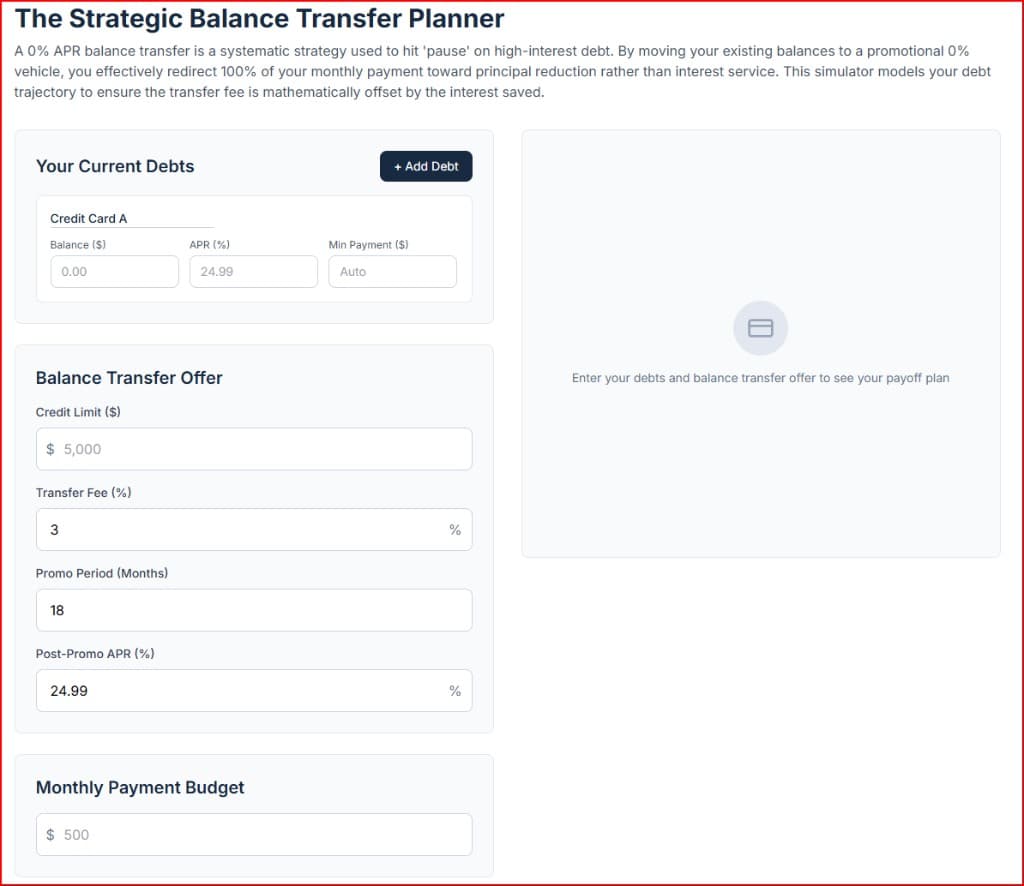
Rather than providing a static estimate, our tool runs a month-by-month simulation. It automatically accounts for these variables, applying payments strategically to help you visualize the most efficient path to becoming debt-free.
The Fiduciary Check: When NOT to Transfer
As advocates for financial literacy, we must offer a warning. The math only works if the behavior changes.
According to the Consumer Financial Protection Bureau (CFPB), many consumers fall into a deeper trap by clearing the balance on their old card and then spending on it again.
Do not attempt a balance transfer if:
- You have not fixed your cash flow: If you are spending more than you earn, a transfer only delays the inevitable. We recommend establishing a solid financial foundation and savings rate before attempting advanced debt strategies.
- You cannot afford the payoff plan: Use our calculator to see the monthly payment required to hit $0 balance before the promo expires. If that number is higher than your budget, you need to know before you apply.
- You treat credit as income: Remember, credit is simply borrowing from your future self at a premium.
⚠️ The "Mixed Balance" Trap: Losing Your Purchase Grace Period
A critical trap that basic credit card guides completely ignore is the unexpected loss of your purchase grace period. If you move a debt balance onto a card with a 0% intro APR offer, you must never swipe that card for everyday purchases like gas or groceries, unless the offer explicitly states 0% APR applies to both transfers and new purchases.
Normally, credit cards give you an interest-free grace period between the day you buy something and the day your bill is due. But the moment you carry a balance on that card (which a balance transfer inherently forces you to do), that safety net vanishes.
🛑 How the Banks Apply Your Money: Under federal law (the CARD Act), if you pay more than your minimum monthly payment, the bank must apply that extra cash to your highest-interest balance first.
So, if you swipe your new balance transfer card for a $100 grocery haul, that $100 will immediately start racking up interest at the card's standard ongoing purchase APR (which typically runs between 20% to 27% on modern rewards cards) from day one. While your extra monthly payments will go toward clearing that high-interest $100 first, managing separate balance tiers with completely different interest rates on a single statement makes it incredibly difficult to manually track your progress or accurately project your true debt-free timeline.
The Absolute Rule: Once a credit card becomes a balance transfer tool, lock it in a physical drawer and do not run a single new transaction through it until the transferred balance reads exactly $0.
Run the Simulation
A balance transfer is not magic; it is simply a mathematical restructure of your liabilities. It swaps a high variable rate for a low fixed fee.
In finance, the cost of Waiting is real. Every day you wait to optimize your debt is another day of compound interest working against you.
Don't guess. Run the numbers.
| Factor | Typical transfer path | Staying put on a high APR card |
|---|---|---|
| Up-front cost | You pay a one-time fee upfront (usually 3% to 5% of the total debt you move). | No fee upfront, but expensive interest charges get added to your card every single month. |
| Interest during the plan | You get a complete break from interest (0% APR) for a set number of months. | Your normal high interest rate keeps hitting your balance month after month. |
| Payoff horizon | You need to clear the debt before the special deal ends, or high interest kicks right back in on whatever is left. | Making only minimum payments drags out your timeline for years, making the total amount you owe grow bigger over time. |
Summary
- The Math: High-interest debt (20%+) compounds exponentially; a balance transfer stops this growth for a set period.
- The Fee: A 3-5% fee is often recouped in 2 months of interest savings.
- The Nuance: Variables like partial transfers and post-promo rates can complicate the payoff timeline.
- The Solution: Use a simulation tool to model Partial Transfers and Payoff Timelines accurately.
- The Rule: Only transfer if you have corrected the spending behavior that caused the debt.