Everyday Math That Actually Matters: When to Use the Right Calculator
Three everyday situations where the right calculator—and the right formula—can save you time, money, and avoid bad decisions.
Published on

Most of us don't think of ourselves as "math people." We get by with rough guesses and round numbers. But in a few everyday situations, the wrong number doesn't just mean a small mistake—it can mean wasted money, a bad decision, or results that don't add up.
This guide focuses on three of those situations: working with measurements and fractions, judging growth or decline over time, and comparing two values when neither is clearly "the start." In each case, people often rely on mental math or the wrong formula—and the outcome can be a botched project, a misread trend, or a comparison that changes depending on how you enter the numbers.
The good news: you don't need to love algebra. You just need to know when to reach for the right calculator and the right idea. Below we walk through each situation in plain language and point you to deeper guides so you can go from "close enough" to "got it right."
When measurements aren't whole numbers
Cutting lumber, scaling a recipe, or ordering materials often means working with halves, quarters, and eighths. You might need to add 4⅝ feet and 3½ feet for a trim run, or double a recipe that calls for 2⅓ cups of flour. Doing that in your head is error-prone—common denominators and mixed numbers are easy to fumble under pressure.
"Close enough" in these cases can mean a second trip to the store, a batch that doesn't turn out, or material left over (or short) when the job is done. The fix isn't to become a fractions expert; it's to use a tool that handles the arithmetic correctly every time.
Our mixed fraction calculator guide takes the guesswork out and walks through real scenarios—DIY, recipes, and materials—so you know when to reach for it and how it keeps small mistakes from becoming costly ones.
When you need to see growth or decline
Raw numbers don't always tell the story. A $500 price drop on a $5,000 item is a 10% drop; the same $500 off a $6,000 item is roughly 8.3%. The dollar change is the same, but the percentage change—how big the move was relative to your starting point—is what helps you judge whether a sale is strong, whether your savings rate is improving, or whether a business metric is trending up or down.
Percentage change is the right lens whenever you have a clear before and after: last month's revenue vs. this month's, last year's weight vs. today's, or a sticker price vs. a sale price. It answers one question: "By what percentage did this go up or down?" Relying only on the raw difference can make a small shift look huge or a big shift look minor, depending on the starting value.
A checkout receipt is a good everyday example. Many print dollars—shelf prices and discount lines—not percentages. Run percentage change on each pair and the same-looking "$ off" amounts stop being comparable at face value. The screenshot below is a real warehouse-club receipt; the caption turns two discount lines into percentages so you can see how the ranking can flip.
Real Warehouse Receipt: Discounts & Unit Pricing
Swipe horizontally or scroll to the right to view the full screenshot.
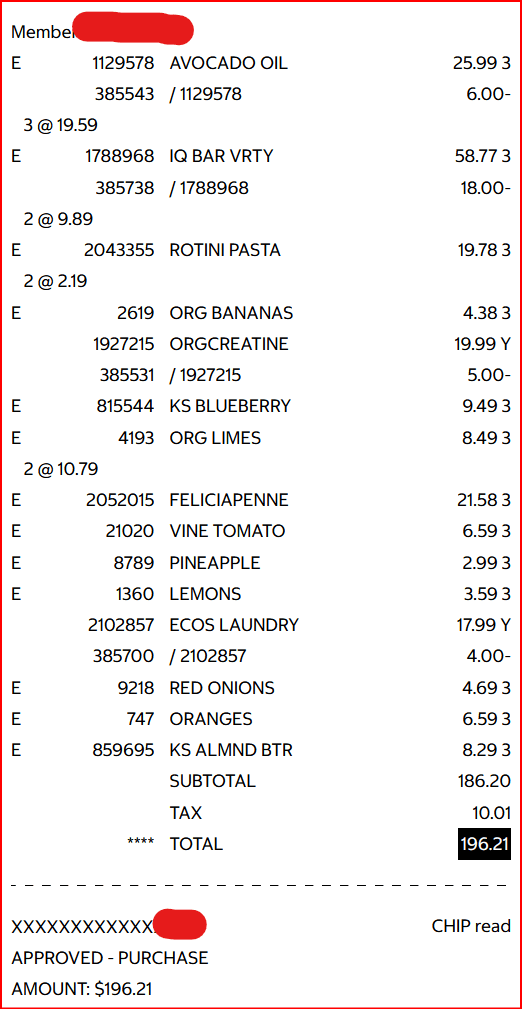
That's the point of percentage change on a receipt: once you divide each discount by its own starting price, two different "$ off" lines become comparable. One more caveat while you're thinking in percentages: drops and gains are not mirror images. A 50% drop from $100 leaves $50; getting back to $100 takes a 100% gain on that smaller base—not another 50%. The same trap shows up in stacked markdowns (50% off, then "extra 50% off" is 75% total off, not free) and in recoveries after a loss (a 20% drop needs a 25% rise to break even). You don't need a separate calculator for that—just remember the next percentage always applies to the new starting number.
Our real-world guide to percentage change walks through how to use it for sales, savings, and everyday decisions—with concrete examples and no jargon.
When you're comparing two things (and neither is "the start")
Sometimes you have two numbers—two thermometer readings, two vendor quotes, two product specs—and there's no clear "before" and "after." You just want to know how far apart they are in percentage terms. If you use the percentage-change formula anyway, you run into a problem: the answer changes depending on which number you treat as the starting point. Going from A to B gives one result; going from B to A gives another. That inconsistency is a sign you're using the wrong tool.
For those cases, you want percentage difference, not percentage change. Percentage difference treats both values equally by using their average as the starting point. This gives you a single, consistent measure of how much they differ—useful for quality checks, comparing options, or any time the order of the numbers shouldn't affect the result.
Our guide to percentage change vs. percentage difference spells out when to use which formula, with examples, so your comparison is fair and repeatable.
You don't have to be a numbers person to get these right. You just need to spot the situation: measurements and fractions, growth or decline over time, or a straight comparison of two values with no natural "start." In each case, using the right calculator and the right formula removes guesswork and avoids the kind of errors that cost time, money, or misleading conclusions.
The three guides linked above go deeper—with step-by-step examples and clear rules—so you can tackle each case with confidence. Bookmark them when you need a quick reference, and reach for the right tool when the stakes are real.
| Calculator / framework | Life decision it supports |
|---|---|
| Mixed fractions & measurements | DIY cuts, recipes, and material lists where small rounding errors become expensive mistakes. |
| Percent change (clear “before” and “after”) | Raises, sale prices, savings goals, or any trend where one number clearly came first. |
| Percent difference (no natural start point) | Comparing two options—quotes, bids, or products—where neither side is inherently the baseline. |
Definitive Summary
- Measurements and DIY: When lengths, recipes, or materials use fractions, use a mixed fraction calculator so small errors don't become costly ones.
- Growth or decline: When you have a clear before and after (prices, savings, performance), use percentage change to see the relative change—not just the raw difference.
- Comparing two things: When neither value is "the start," use percentage difference so your comparison is fair and doesn't depend on which number you put first.
- Bottom line: Match the situation to the right mathematical framework. No manual calculation required—just the right tool at the right time.