You Can Leave the HSA Money Invested and Pay Yourself Back Later
An HSA is a health savings account for medical bills, and the money in it can be invested so the balance can grow. You can pay a bill from the HSA on the day it arrives, or you can pay with other money, such as a checking account, and leave the HSA money invested. Taking the money out that day means it leaves the account and can no longer grow, so paying with other money leaves it invested, where the balance can keep growing until you pay yourself back. You keep the receipt from the bill, and years later that receipt lets you take out the same amount you paid. You do not owe federal income tax on that payback as long as the HSA is allowed to cover the bill, the bill came after you opened the HSA, you still have the receipt, nobody else has already paid you for it, and you did not already claim the bill as a tax write-off.
Published on

A medical bill often feels like something the HSA should pay the same day. You can use it that way. You can also pay the bill with other money, keep the receipt, and leave the HSA money invested, then take that same amount out years later and pay yourself back. There is no deadline on that wait, because the money left invested can grow. Growth inside the HSA is not included in your federal income while it stays there.
A note on these rules: This is general information about federal rules, not a reading of one job's plan. A flexible spending account follows a deadline that job sets. Medicare, including when contributions stop and which premiums the HSA can pay, depends on the coverage you have and on when it starts. The dentist bills and the extra 20% tax in this post are examples, and another bill or another health situation can come out differently. California and New Jersey do not follow the federal treatment of an HSA, so the state tax there can come out differently. Your HSA company can also set its own steps for investing and for taking money out.
Pay from the HSA today, or leave the money invested
You can pay the doctor, or the dentist, from the HSA on the day the bill arrives. Many accounts give you a card for that payment. The bill is then paid, and that amount has left the HSA, so it cannot stay invested and that piece of the balance cannot grow.
The other path is to pay with money that is not in the HSA. A checking account is one example, and a savings account is another. You could also put the bill on a card and pay that card from money outside the HSA. What matters is that the HSA itself stays untouched, so the money left there can be invested and the balance can grow. Your HSA company decides whether the money can be invested, and it may ask you to keep some of the balance in cash first. Cash may earn a little interest. Invested money is the part that can grow, and that growth is a possibility, not a promised result.
The screenshot below is from one HSA company. Some companies require a set amount of cash to stay uninvested before the rest can be invested. That amount is a rule the company sets. The tax rules do not set it, and some companies do not require that cash amount.
One HSA company: cash and invested money
Swipe horizontally or scroll to the right to view the full capture.
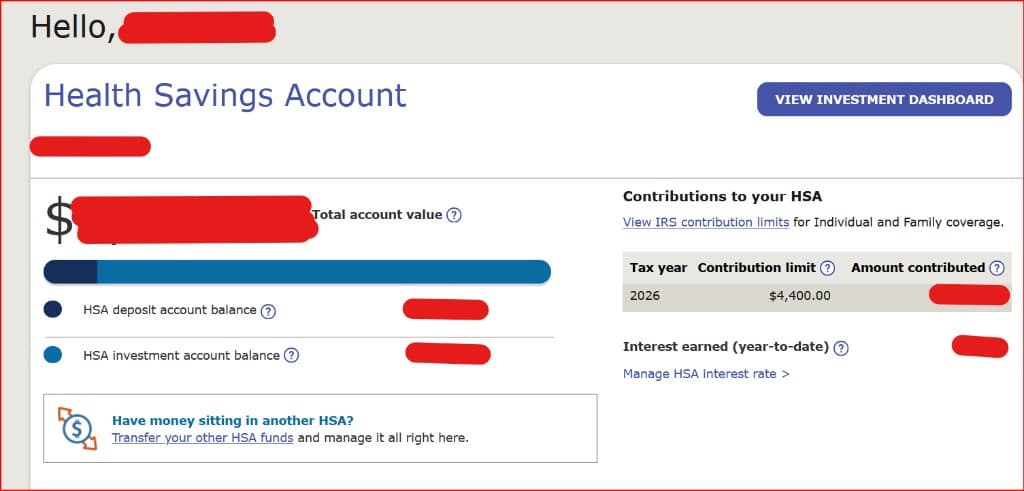
If the HSA card is what pays the bill, that swipe is already the withdrawal. The receipt from that visit does not let you take the same amount out again later, because the money left the account on the day the card was used.
The receipt lets you take out the same amount you paid
You do not have to take HSA money out every year. When you do take it out for a bill you already paid, the receipt is what ties the withdrawal to that bill. You do not send the receipt in with your tax return. You keep it with your tax papers, because those papers are what show the withdrawal was for that bill, that nobody else had already paid you for it, and that you had not already claimed it as a tax write-off. A useful receipt shows the date, who was paid, what was done, and the amount you paid.
A workplace flexible spending account is a different account. The money there is usually tied to a deadline the job sets. An HSA is not built that way. Money you do not spend stays in the HSA from one year to the next, which is why a receipt can still be used long after the visit. The HSA is also your account. Leaving the job does not close it, and it does not erase a receipt for a bill that came after the account was opened.
Say the bill was $400 and you paid it with other money. Years later, the receipt lets you take $400 out of the HSA and pay yourself back. If the invested balance has grown past $400, you still take $400 for that bill. The growth can stay in the account. If you take out more than $400, the extra is no longer a payback for that bill, and the extra is the part that can be taxed. The $400 is an example, so the match is easy to see. Your bill will be a different number.
The bill has to be one the HSA is allowed to pay
A doctor visit can be that kind of bill. A dentist bill can be too, when it is treatment, such as a cleaning, a filling, or braces, because those dental bills count as medical bills for an HSA. Teeth whitening does not, because it is not treatment for dental disease. A normal health insurance premium usually does not count either. The bill can be for you, your spouse, or a dependent you claim on your tax return.
The payback stays free of federal income tax when the records hold
You do not owe federal income tax on that payback when the HSA is allowed to cover the bill, the bill came after you opened the HSA, and you still have the receipt. Nobody else can have already paid you for that same bill, which includes insurance and any other account that already paid it. You also cannot have already claimed that bill as a tax write-off. If insurance paid part of the bill, you pay yourself back only for the share that was left for you. The share insurance already paid does not come out of the HSA. You still report the withdrawal on Form 8889, the HSA form that goes with your federal return, even when you do not owe federal income tax on it.
You can still pay yourself back in a year when you can no longer add money to the HSA. The bill only has to come after the account was opened. State rules can set the exact day that opening happens. A bill from before that day does not qualify. Enrolling in Medicare generally stops new contributions. It does not stop a payback for a bill that already qualifies. After you turn 65, a Medicare premium can be a bill the HSA is allowed to pay. A Medigap premium cannot.
| The bill | Can the HSA pay it |
|---|---|
| A doctor visit | Yes. A doctor visit counts as a medical bill. |
| A cleaning, a filling, or braces | Yes. Dental treatment counts as a medical bill. |
| Teeth whitening | No. Whitening is not treatment for dental disease. |
| A normal health insurance premium | Usually no. A normal premium is not a bill the HSA is allowed to pay. |
| A Medicare premium after you turn 65 | Yes. After 65, that premium can qualify. |
| A Medigap premium | No. A Medigap premium cannot, even after you turn 65. |
The table covers the bills named in this post. A yes is about the kind of bill. The payback stays free of federal income tax when the receipt rules above are met.
Money from a paycheck is a different step
Putting money into an HSA from a paycheck changes what actually hits your bank account. That is the contribution. Paying yourself back years later is the withdrawal. The receipt rules in this post are about the withdrawal, and they do not change how the paycheck deduction was figured in the year the money went in.
A withdrawal that is not for a medical bill can be taxed
You can take money out of an HSA at any time. If that money is not used for a medical bill the HSA is allowed to pay, that part is included in your federal income. There can also be an extra 20% tax on that same part. People sometimes call the extra 20% an early withdrawal penalty. There is no separate fee by that name. The charge is the extra 20% tax.
The extra 20% tax does not apply after you turn 65. It also does not apply if the tax rules treat you as disabled, which is a strict test and not every illness. After 65, or in that disability case, a withdrawal that is not for a covered medical bill can still be taxed as income. The age, or the disability, removes the extra 20%. It does not remove the income tax on a non-medical withdrawal.
A withdrawal can also be only partly for a bill. The part that matches a bill you already paid can stay free of federal income tax when the receipt rules are met. The extra dollars, beyond that bill, are the part that can be taxed, and the extra 20% tax can apply to those dollars when you are under 65 and the disability test does not fit.
The picture puts the two withdrawals side by side. On the left, you already paid a medical bill with other money, you kept the receipt, and later you take out that same amount. That payback can stay free of federal income tax when the receipt rules are met. On the right, the money was not for a bill the HSA is allowed to pay. Under 65, that part can be taxed as income, and it can also get the extra 20% tax.
So the reason to pay with other money is that the HSA can stay invested until you pay yourself back. The money you take out then is the amount you paid for the bill, not whatever the balance has grown to. If the balance has grown past that bill, the growth can stay in the account.
Before you pay yourself back
- You can pay a medical bill from the HSA the day it arrives, or pay with other money, such as a checking account, and leave the HSA money invested. Some companies require a set amount of cash to stay uninvested before the rest can be invested. That amount is a rule the company sets.
- The reason to wait is that money left invested can keep growing. Money you take out today has left the account. Growth inside the HSA is not included in your federal income while it stays there. California and New Jersey do not follow that federal treatment, so the state tax there can come out differently.
- Keep the receipt with your tax papers, and do not send it in with your tax return. A useful receipt shows the date, who was paid, what was done, and the amount you paid. Years later it lets you take out the same amount you paid, and the growth can stay in the account. There is no deadline on that wait.
- You do not owe federal income tax on that payback when the HSA is allowed to cover the bill, the bill came after you opened the HSA, you still have the receipt, nobody else already paid you, and you did not already claim the bill as a tax write-off. If insurance paid part of the bill, the payback is the part you paid. You still report the withdrawal on Form 8889 even when you do not owe federal income tax on it.
- If the HSA card already paid the bill, do not take that amount out again. An HSA is not a flexible spending account. Unused money stays, and the account stays yours if you leave the job.
- A dentist bill for treatment can count. Teeth whitening does not. A normal health insurance premium usually does not. After 65, a Medicare premium can. A Medigap premium cannot. The bill can be for you, your spouse, or a dependent you claim.
- You can still pay yourself back in a year when you can no longer add money to the HSA. Enrolling in Medicare generally stops new contributions. It does not stop a payback for a bill that already qualifies.
- The payback is the amount you paid for a bill the HSA is allowed to pay, and that amount can stay free of federal income tax when the receipt rules above are met. Money taken out for something else can be taxed as income, and under 65 an extra 20% tax can apply to that part. After 65, or if the tax rules treat you as disabled, the extra 20% stops. Income tax on that part can remain. The disability test is strict, and it is not every illness.