Escrow Shortage Explained: Why Your Mortgage Payment Went Up
When the escrow account runs short, the next analysis can lift your monthly bill—even if the loan rate never moved.
Published on

You open the mail from your loan servicer and the monthly amount went up. Your rate looks the same. You did not refinance. Nobody changed the term of the loan. So what moved?
Often the answer is not the loan interest itself. It is the escrow part of the payment—the side account that holds money for property taxes and homeowners insurance. When that account runs short of what was owed, the next review can raise what you pay each month. This guide walks through how that happens, shows a dollar example, and covers the repayment options servicers usually offer when there is a shortage.
Disclaimer: This is general education, not legal, tax, or lending advice. Escrow rules, cushions, and repayment plans vary by loan type, investor guidelines, and servicer. Your escrow analysis notice and loan documents control your situation. If numbers look wrong, contact your servicer and keep written records.
What Escrow Is (and What It Is Not)
Escrow, in the mortgage-payment sense, is a holding account your servicer manages for certain recurring home costs—most commonly property taxes and homeowners insurance. Each month, part of your total payment goes into that account. When the tax bill or insurance premium comes due, the servicer pays it from the account.
Analogy 1 — the shared jar for big bills: Picture a kitchen jar labeled “Tax Day & Insurance Day.” You drop money into the jar every payday so you are not hit with one giant bill twice a year. The jar is not your vacation fund. It is not extra principal. It exists so the big bills get paid on time. If the cost of those bills rises—or if last year’s deposits were too low—the jar runs short before the next bill is fully covered. That shortfall is the shortage.
Escrow is not the same thing as the interest rate on your loan. Interest is the cost of borrowing the principal. Escrow is a pass-through bucket for other obligations. Your fixed rate can stay put while the escrow piece climbs. For how fixed-rate payments interact with inflation over time, see why a fixed mortgage payment can feel cheaper as inflation rises—a different story from an escrow reset.
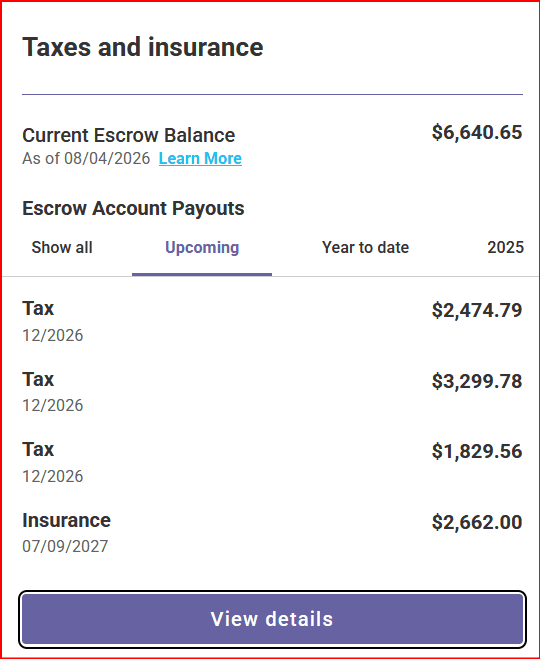
In a real loan portal, that jar usually shows up as a current escrow balance plus a list of upcoming tax and insurance payouts the servicer expects to pay from the account—like the screenshot below.
Real Loan Portal: Escrow Balance & Upcoming Payouts
Swipe horizontally or scroll to the right to view the full screenshot.
Your Monthly Payment Is a Stack, Not One Number
Many statements show one total. Under the hood, that total is usually built from pieces:
- Principal — pays down what you owe on the loan
- Interest — the finance charge on the balance
- Escrow / impounds — set-aside for taxes, insurance, and sometimes other items
People shorthand this as PITI (principal, interest, taxes, insurance). The first two follow the amortization schedule. The escrow portion is estimated, then checked against real bills. If you want the loan-side math (how early payments are mostly interest), start with amortization on mortgages and auto loans or run numbers in the Mortgage Calculator.
Figure: The escrow band can move even when the interest band does not.
How an Escrow Shortage Forms
At the start of an escrow year (or after closing), the servicer estimates what taxes and insurance will cost, then divides that estimate across monthly deposits. Reality rarely matches the estimate exactly.
Analogy 2 — last winter’s heating budget: You set aside money each month based on last year’s utility bills. Then this winter is colder, rates go up, or both. By March the set-aside is empty and one more bill still arrives. You did not “fail” at budgeting because you were careless—you planned with an outdated forecast. Escrow works the same way: deposits follow a forecast; shortages appear when the forecast was low.
Common reasons the jar runs short
- Property tax assessment or mill levy increases
- Homeowners insurance premium renews higher
- A new policy or coverage change mid-year (for related coverage rules with a mortgage, see canceling homeowners insurance while you still owe)
- First-year estimates after purchase that were based on seller history or incomplete data
- Timing mismatches (when bills are paid vs. when deposits land)
Some loans also keep a small cushion in the account (extra months of deposits) so the balance does not hit zero between bills. Cushion rules depend on the loan and federal/servicer guidelines. This article does not claim one cushion size for every mortgage.
Figure: Illustrative only. Your analysis will use your actual deposits, bills, and projected next-year costs.
The Annual Escrow Analysis
At least once a year on many mortgages, the servicer runs an escrow analysis. It compares what went into the account, what was paid out, what is left, and what next year’s bills are expected to cost. Then it sets a new monthly escrow deposit—and tells you how to handle any shortage or surplus.
Shortage, surplus, and deficiency (quick labels)
- Shortage — the account needed more money than your deposits provided for the bills that came due (and/or the required balance looking ahead).
- Surplus — the account has more than needed; rules often require a refund or credit above a small threshold.
- Deficiency — wording on notices varies; treat it as “the account is behind relative to the target.” Read your letter’s definitions, not a blog’s nicknames.
Who sends the letter? Usually the loan servicer—the company that collects payments and manages escrow day to day. That may not be the same company as the original lender or the investor who owns the loan. For roles, see lienholder vs. loan servicer vs. owner.
A Dollar Example (Illustrative)
Suppose your principal and interest together are $1,800 every month and stay there. Last year escrow was $400 per month. Total payment: $2,200.
During the year, taxes and insurance paid from escrow added up to $5,400, but deposits only put in $4,800. Shortage: $600. Looking ahead, the servicer expects next year’s taxes and insurance to run about $5,760, so the new base escrow deposit is $5,760 ÷ 12 = $480 per month (before any shortage catch-up).
| Piece | Before analysis | After (example) |
|---|---|---|
| Principal + interest | $1,800 | $1,800 (unchanged) |
| Escrow deposit | $400 | $480 base |
| Shortage catch-up | — | See options below |
| Total payment | $2,200 | Depends on option |
Notice what did not change: the interest rate and the principal-and-interest line. The bill went up because the escrow forecast and catch-up changed. If you are comparing overall housing cost—not just this reset—tools like the true home affordability guide and the Debt-to-Income Calculator help put the new payment in a wider budget frame.
Repayment Options When There Is a Shortage
This is the part people skim—and then get surprised by the new draft amount. After a shortage, servicers typically present a small menu. Exact labels differ, but the choices usually look like this:
Option A — Pay the shortage in a lump sum
You send the $600 (in our example) as a one-time payment to bring the escrow account current. Going forward, you pay the new monthly escrow deposit ($480) plus your unchanged P&I ($1,800). New total: $2,280 per month. You front the catch-up cash now; the monthly bump is only the higher ongoing estimate.
Option B — Spread the shortage into monthly payments
You do not pay $600 up front. Instead, the shortage is divided across a repayment period—often 12 months on many analyses ($600 ÷ 12 = $50). Each month you pay P&I ($1,800) + new escrow ($480) + catch-up ($50) = $2,330. The monthly bill is higher than Option A, but you preserve cash today.
Option C — Other plan terms (when offered)
Some notices allow a different repayment length, a partial lump sum plus a smaller spread, or instructions tied to a hardship program. Those are servicer- and loan-specific. If the letter lists a deadline to choose, missing it can default you into the spread option.
Tradeoff in one sentence: lump sum = lower ongoing payment, more cash needed now; spread = higher ongoing payment, less cash needed now. Neither option changes your interest rate. Both are about refilling and resizing the jar.
Figure: Same $1,800 P&I in both paths; only escrow and catch-up differ. Your notice may use different months or amounts.
What Usually Did Not Cause This Jump
If your note is a fixed-rate mortgage and you did not refinance, an escrow analysis is a weak reason to assume “the bank raised my rate.” Rate changes show up on adjustable-rate products, after a refinance, or on a modification—not as the default explanation for a yearly escrow letter.
Escrow is also different from PMI dropping off at the 80% LTV cliff, or from choosing a smaller house that somehow costs more each month. Those are separate payment stories—see the 80% LTV / PMI cliff and the downsizing trap if those fit your question better.
What to Do When the Letter Arrives
Read the analysis line by line
Confirm the tax and insurance amounts match what your county and insurer charged. Look for the projected next-year totals and the new monthly escrow. Note the deadline to pay a lump sum if you want that path.
Choose the catch-up path that fits cash flow
If you have the cash and want the lowest ongoing draft, lump sum is often cleaner. If cash is tight, spreading avoids a sudden hole—even though the monthly total stays higher until the catch-up ends.
Shop insurance (carefully) before the next renewal
A lower premium can reduce next year’s escrow estimate—but coverage quality and lender requirements still matter. Never let a required policy lapse to “save” escrow; that creates a worse problem than a shortage letter.
Update auto-pay
If you draft a fixed amount from checking, change it when the new payment starts. Underpaying can create fees or a larger shortage next cycle.
What If There Is a Surplus Instead?
Sometimes the jar has too much. Depending on the size of the surplus and applicable rules, you may receive a refund check or a credit toward future escrow deposits, and the monthly escrow piece may fall. Surpluses and shortages are two sides of the same review—both mean the forecast needed a correction.
Limits of This Guide
Not every mortgage has an escrow account (some borrowers pay taxes and insurance themselves). Not every analysis follows the same cushion formula. Flood insurance, HOA dues, or other items may sit in escrow on some loans and not on others. Government-backed loans and private investor loans can differ in detail.
If your payment jumped for a reason other than escrow—rate adjustment, recast, modification, or a servicing transfer error—ask the servicer for a written breakdown. For sale-side cash surprises that feel similar (“the big number moved, my wallet didn’t”), see when a higher sale price barely changes your closing check.
Key Takeaways
- Payment up ≠ rate up. Escrow shortages often raise the monthly total while principal and interest stay flat.
- Escrow is a set-aside jar for taxes and insurance (and sometimes other items)—not a change to your loan rate.
- Shortages happen when deposits based on an old forecast fall short of real (or newly projected) bills.
- Repayment options usually look like: pay the shortage as a lump sum (lower ongoing payment) or spread it into monthly catch-up (higher payment for a while, less cash needed now). Some notices offer hybrid or alternate plans.
- Read your analysis notice, verify tax and insurance lines, pick a path before any deadline, and update auto-pay. This article is educational—not advice for your specific loan.
- Related tools: Mortgage Calculator, Debt-to-Income Calculator, Pay Off Mortgage vs. Invest.