When You Rent Out the House, Homeowners Insurance (HO-3) Is Usually the Wrong Form
Homeowners insurance is built for you living there. A DP-3 dwelling policy is built for the building when someone else lives there. Here’s the occupancy switch—what still covers the structure, what often drops (your stuff, your liability, a hotel for you), and why a leftover HO-3 on a rental is leftover paperwork, not the same product.
Published on

You did not cancel the insurance. You changed who lives in the house. Those are different events. You can keep paying and still have the wrong policy on the house.
HO-3 is the common homeowners form for a house you live in. DP-3 is a common dwelling form for a building someone else lives in—a rental. Either form can insure the building. They do not cover the same things.
Disclaimer: This is general education, not insurance, legal, tax, or lending advice. Form names, occupancy rules, endorsements, and claim outcomes vary by carrier and by policy. Your declarations page and policy wording control your situation. Ask your agent or carrier before you rely on any example here.
Occupancy Is the Switch
Insurance forms are written around a story of who uses the house as home. That story is called occupancy. It is a condition of the form.
If it is your home, the story is "this is my house." HO-3 is built for that. If a tenant lives there and you live somewhere else, the story is "this is a building I own." DP-3 is built for that.
Analogy — two keys, two locks. An HO-3 key is cut for the lock labeled you live here. A DP-3 key is cut for the lock labeled a tenant lives here. Keeping the old HO-3 after you move out does not recut the lock. It just means you still have a key that no longer matches the door.
Can You Still Have HO-3 If You Are a Landlord?
It depends which of these three you are in. Sometimes the paperwork still says HO-3. That is not the same as "the insurer wrote this form for a rental."
The old HO-3 is still listed
You moved out. A tenant moved in. You never told the carrier. The HO-3 can stay listed until renewal—or until a claim. Occupancy still has to match the form. A claim can get messy if the house was not used the way the policy assumed. That is not "always denied." It is also not a free pass because the declarations still look active.
Yes—if you still live there
Example: you rent a room, or you live in one side of a duplex. The point is you still occupy the property as home—not that it has to be a duplex. HO-3 can still be the right product. Landlord here means "you collect some rent," not "you left."
Usually no—you left, and you need a new policy
This is not the yes case. You live somewhere else. A tenant occupies the house. You are asking for a new policy. Carriers usually want a dwelling form—often DP-3—not a fresh HO-3. The lender still wants the building insured. That is hazard coverage, not "keep my old homeowners bundle." If you drop required coverage while you still have a mortgage or other loan on the house, that is a different trap—see what happens if you cancel homeowners insurance with a mortgage. Switching forms is not the same as canceling.
What a DP-3 Still Does—and What Often Drops
Think of HO-3 as a winter coat with four pockets. DP-3 is often the same coat after three pockets were sewn shut. The coat still covers the building. It does not automatically keep every job the old coat did.
| Job | Typical HO-3 (you live there) | Typical DP-3 (tenant lives there) |
|---|---|---|
| Rebuild the structure | Yes—building coverage | Yes—building coverage |
| Your furniture and clothes | Usually yes | Often no or N/A. You can usually add a limit for items you own at the rental—not the tenant's stuff. |
| A renter's furniture (only if someone else also lives there) | No. Even if they rent a room from you, their stuff is not on your HO-3. | No. That is the tenant's renters policy. |
| You in a hotel after a fire | Additional living expense (you occupy it) | Usually not—you are not living there |
| Rent you cannot collect (only if you collect rent) | N/A if the house is only your home. If you rent a room and still live there, a standard HO-3 often puts this inside loss of use—read the declarations. | Often a separate limit (Fair Rental Value) |
| Someone is hurt on the property | Usually yes—personal liability is part of a standard HO-3 | Often missing unless endorsed—read the declarations |
Lost rent is its own line when it exists. It is not "the DP-3." It is one pocket some dwelling policies still have. How to turn that dollar limit into rough months of rent is in Fair Rental Value: lost rent coverage—not here.
Liability Is the Quiet Hole
A guest slips on the porch. Who pays the medical bills and the lawsuit is not the same question as "will the roof get rebuilt?"
HO-3 usually includes personal liability. It is written as a homeowners package, not walls-only. A base DP-3 is a property form. Liability is not built into that base form. It may be added by endorsement, or it may not be there. Some landlord products attach it in the quote anyway. Do not assume. Find a liability limit on the declarations, or ask whether one was added.
Tenant renters insurance does not automatically make you whole. It is their stuff and often their guest-related coverage, not a substitute for your premises liability.
Contents: Yours, Theirs, Nobody's
Three piles of stuff get mixed up:
- The building — walls, roof, attached systems. That is the DP-3's main job.
- Your leftover belongings — a lawn mower in the shed, a sofa you left furnished. HO-3 often covered that as personal property. On a dwelling form that line may show as N/A unless you add it.
- The tenant's belongings — not your policy's job. That is renters insurance.
Analogy — who is in the bed tonight. The policy is written around that bedroom, not around the deed in the courthouse file. The deed can stay in your name while the occupancy story changes.
How to Read Your Declarations
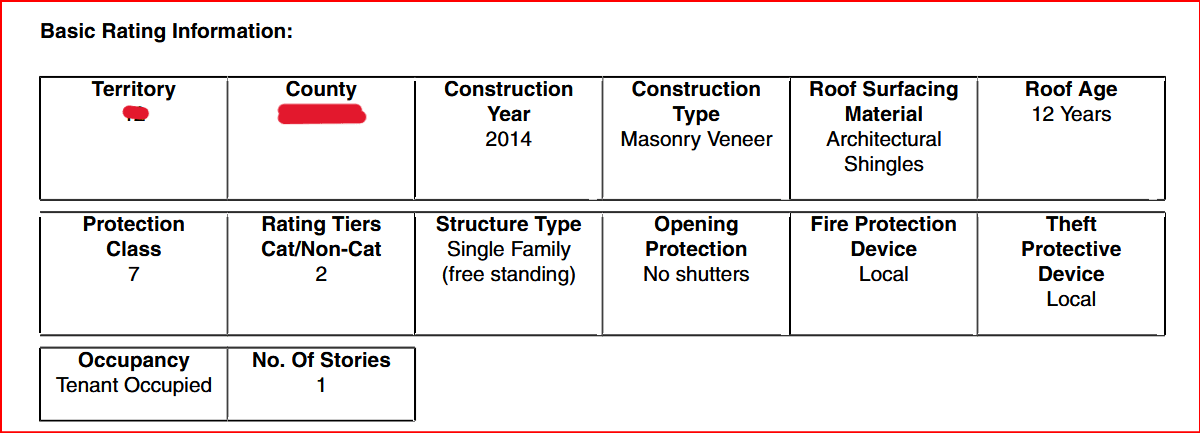
The short coverage summary—the declarations—is where the form type shows up in ordinary words. Occupancy may be on that page or on the rating grid that feeds the policy. You do not need the full policy booklet to start. You do need those pages.
If a premium is paid through escrow, changing forms can change the bill the servicer pays next year. That is how an insurance change can show up as a different monthly mortgage amount. The mechanics of that shortage math are in why an escrow shortage can raise your payment. If you want to see taxes and insurance in a monthly payment, the mortgage calculator has a slot for that. The form switch is still the occupancy issue, not the escrow spreadsheet.
Real Policy Form: Occupancy on Basic Rating Information
Swipe horizontally or scroll to the right to view the full screenshot.
What This Article Is Not
- It is not how to turn a lost-rent dollar limit into months of rent. Some dwelling policies list a line for rent you cannot collect after a covered loss. That line is a different job from whether the form matches who lives there.
- It is not "what if I cancel insurance while I still owe." Force-placed coverage is the lender buying a policy after a lapse—not a form rewrite you asked for.
- It is not a ranking of carriers, and it is not legal advice. Occupancy rules are in your contract. Wind and hail percentage deductibles are a later math topic, not this switch.
Quick Checklist
- Write down who actually lives in the house tonight.
- Find the form name on the declarations (HO-3, DP-3, or other).
- Find the occupancy wording on the declarations or the rating grid and see if it matches that.
- Check whether personal property is a dollar limit or N/A.
- Check whether a liability limit exists, or only building coverage.
- If you still have a mortgage or other loan on the house, confirm the lienholder / servicer has current proof the building is insured. The lender is checking the structure. That letter is not the same as you still having a full homeowners policy.
Summary
- HO-3 is built for a house you live in. DP-3 is the common form for a building a tenant lives in. Occupancy is the switch.
- A leftover HO-3 after you move out can still look active. That is leftover paperwork, not the insurer rewriting the form for a tenant.
- The structure can stay insured. Your stuff, your personal liability, and a hotel for you often are not included unless they show on the declarations. If you add a contents limit, that is for items you own at the rental—not the tenant's stuff.
- Lost rent is a separate limit when it exists. Canceling coverage with a mortgage is a different problem than changing forms.
- Read the form name, occupancy line, contents line, and liability line on your own declarations. Ask the carrier if those four do not match how the house is used.