In Texas, Homeowners and Landlord Insurance Usually Exclude Flood. That Is Why Flood Is Its Own Policy.
This article is about Texas, and about an ordinary house—one you live in, or one you rent to a tenant. If you live there, the usual policy is homeowners insurance. If a tenant lives there, the usual product is landlord insurance. On the standard versions of both, flood is usually excluded. Flood is its own policy, with its own limit and its own bill. A burst pipe is not a flood. That flood bill might sit in your mortgage payment, or it might be a check you write once a year.
Published on

Water in a house looks like one problem. The insurance file often is not one policy. The contract that covers the building for fire, wind, or a burst pipe is a different contract from the one that covers flood.
I rent out a house in Texas, so I keep those papers in two stacks. One stack is the policy on the house. The other stack is a flood policy with its own declarations page, its own limit, and its own bill. This guide walks through that split in plain language—what flood usually is not, how a flood premium can show up in a mortgage payment without becoming part of the house policy, and what to read on the short coverage summary.
Disclaimer: This is general education, not insurance, legal, tax, or lending advice. It is written around Texas and around an ordinary one-to-four-family house. Form names, occupancy rules, endorsements, escrow practices, and claim outcomes vary. Your declarations page and policy wording control your situation. Ask your agent or carrier before you rely on any example here.
Two Jobs, Two Contracts
If you live in the house, the usual product is homeowners insurance. If a tenant lives there, the usual product is landlord insurance. Those products are built to cover the building for a list of losses—and to leave other losses out. Flood is one of the losses that standard versions usually leave out.
"Landlord insurance" is a product name on a bill or a declarations page. The form underneath can read several different ways. The name on the product is not the same thing as the occupancy question of who lives in the house. Occupancy is a separate switch, and we already walked through that in when you rent out the house and a leftover homeowners policy is usually the wrong form.
Flood coverage, when you have it, is its own policy. It has its own limit. It has its own deductible. It has its own premium. You can buy it through the same agent who handles the house policy. That still does not merge the two contracts into one.
Analogy — two raincoats, one porch. You can hang a work coat and a storm coat on the same coat rack. Each coat still zips by itself. Rain that the work coat is not cut for does not become covered because the storm coat is hanging next to it.
Three Ways a House Gets Wet
The split is easier to see if you start with the water's path, not with the claim form. A house can get wet from inside the plumbing, from a drain that pushes water back up, or from water that gathers outside and then comes in.
A supply line that splits under a sink is the first path: a plumbing failure inside the house. Standard homeowners and landlord policies are often written to treat a sudden break like that as a different kind of water loss than flood. The wording on your form still controls the claim.
Water that backs up through a floor drain or a sewer line is the second path. That backup is often excluded unless an add-on puts it back in. It is still not the same event as a creek leaving its banks or rain pooling across a yard and walking in through a doorway.
Flood is the third path. On a standard house or landlord form in Texas, that is usually the outside story: overflow of a body of water, surface water, waves, or storm surge, whether or not the wind is blowing. Wind can open a hole in a roof, and rain that then falls through that hole is often a wind-and-rain story on the house policy. Water that was already a flood outside remains a flood story. Those two stories can happen in the same storm. They still are not the same contract.
Swipe horizontally or scroll to the right to view the full illustration.
| What happened | House or landlord policy | Flood policy |
|---|---|---|
| A pipe or appliance fails inside the house. | Often in scope on a standard form, if the wording matches a sudden indoor failure. | Not this job. Flood wording is aimed at water from outside. |
| A sewer or drain pushes water back up. | Often left out unless an add-on puts it back in. | Not this job either, unless that flood contract says otherwise. |
| A creek, bayou, or surface water comes in from outside. | Usually excluded as flood on a standard Texas house or landlord form. | This is the job that policy is written to do, within its own limit. |
That table is a map of the usual split. It is not a claim decision. The declarations page is the short coverage summary. The policy booklet behind it is the full wording. Those two documents beat a table on a website.
What the Flood Declarations Are For
If you already carry flood coverage, the flood declarations are the short coverage summary of that flood contract. They are not a chapter of the house policy. Look for a building limit, a contents limit if one exists, a deductible, and a policy period. On a rental, contents on that flood summary can be $0 because the tenant's furniture is not the landlord's property line. A real packet can run more than one page. The crop below is the top of page one, with those lines visible.
Lost rent after a covered loss on the house policy is a different line, when it exists at all. We walked through that dollar limit in Fair Rental Value: when a rental cannot be lived in. A flood policy does not automatically copy that line. If rent stops because of flood, the flood contract has to say so. If it does not say so, that gap is real.
Flood Declarations Crop: Dwelling Form, Rental Residence
Swipe horizontally or scroll to the right to view the full screenshot.
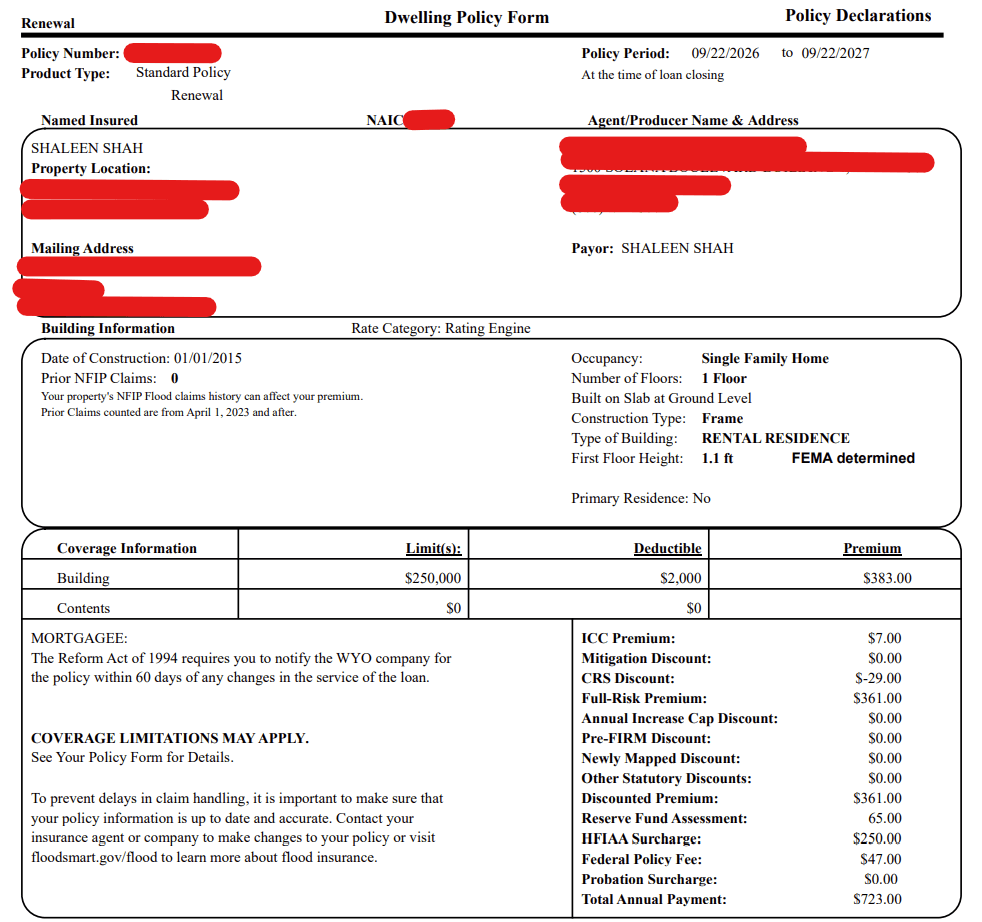
Read the header first. "Dwelling Policy Form" on this crop is the flood program's dwelling form. It is not the landlord policy on the house. Mixing those two names is how people think flood already lives inside the building contract.
Then read the coverage table. Building is $250,000 with a $2,000 deductible. Contents is $0. Occupancy is a single-family home, and Type of Building is a rental residence, with Primary Residence marked No. That matches a house a tenant lives in, not a house the named insured lives in.
The coverage-table premium for the building is $383.00. The bill at the bottom is $723.00. The gap is extra printed lines: discounts, a reserve fund assessment, an HFIAA surcharge, and a federal policy fee. The crop also prints Prior NFIP Claims: 0 and a floodsmart.gov line. It does not print a flood zone, and it is not the rest of the packet. "At the time of loan closing" under the policy period is a loan-timing note. It is not proof that flood lives inside the house policy.
Escrow Collects the Bill. It Does Not Write the Coverage.
A mortgage payment can include money for taxes and insurance. That extra slice is escrow: the servicer holds cash and pays certain bills when they come due. Escrow is a way to pay. It is not a way to combine two insurance contracts.
A flood premium might sit in that monthly slice. It might not. If a lender requires flood coverage while you still owe, the servicer may start collecting that premium with the house payment. The payment can jump even if the loan rate did not move. That jump is a new bill in the jar, which is a different event from an escrow shortage on bills that were already in the jar. We explained the shortage path in why a mortgage payment can rise when the rate did not.
If you pay the flood premium yourself once a year, the coverage can still be valid. The mailbox bill and the escrow line are two payment methods. Neither one turns flood into a chapter of homeowners or landlord insurance. While a loan is outstanding, dropping required coverage is its own problem; that path is in what happens if you cancel homeowners insurance while you have a mortgage.
If you want to see how insurance sits next to principal and interest in a monthly housing number, the mortgage calculator lets you add taxes and insurance beside the loan payment. That tool does not decide whether flood belongs in escrow. It only shows how a premium, once you know it, changes the monthly total.
If a Tenant Lives There
Landlord insurance is still a policy on the building. Standard versions usually exclude flood the same way a homeowners policy does. Switching from "I live here" to "a tenant lives here" does not secretly add flood. It changes who the house policy is written for. It does not fill the flood gap.
The tenant's clothes, TV, and couch sit on the tenant's policy, if the tenant has one. But remember the rule from the top of the page: standard policies usually exclude flood. A normal renter's policy usually will not cover a couch ruined by rising creek water. To protect their furniture from a flood, the tenant has to buy their own contents-only flood policy. The landlord's flood policy, when it exists, is aimed at the landlord's building—and only at contents the landlord actually owns, if that line is even there. The crop above prints Type of Building as a rental residence and Contents as $0. That is the building line, not the tenant's furniture.
A Short List to Check
- Open the house or landlord declarations. Confirm it is the product you think it is, and that occupancy matches who lives there.
- Look for a separate flood declarations page. If you cannot find one, ask whether flood is a second policy or is not purchased.
- Write down the flood building limit, the contents limit, and the deductible, if a flood policy exists.
- Check whether the flood premium is in escrow or paid on its own. That is a payment question, not a coverage question.
- If you collect rent, ask whether any lost-rent wording lives on the house policy, the flood policy, both, or neither.
Limits of This Guide
This guide is focused on Texas and on a regular one-to-four-family house. It is not a playbook for apartment buildings, condo associations, commercial property, or other states. Custom wording can differ. An add-on that puts flood onto a house program is still flood coverage. It is not the house policy quietly absorbing flood.
Coastal wind can be a different policy in parts of Texas. That wind policy is not flood. A storm can raise both wind questions and flood questions in the same week. Each question still has its own contract.
The declarations win. The booklet behind them wins next. An agent can walk those pages with you. This article cannot.
Summary
- In Texas, standard homeowners and landlord policies usually exclude flood. Flood is its own policy, with its own limit and its own bill.
- A burst pipe, a backed-up drain, and a flood are three different water paths. The path is the first question.
- Landlord insurance is a product name. Switching a house to a tenant does not add flood.
- Escrow can collect a flood premium, or you can pay that premium yourself. Payment method is not coverage.
- This article is about Texas and an ordinary house, not apartment buildings, condo associations, or commercial property. The declarations control.