A Mortgage Recast Reprints the Monthly Coupon. A Refinance Tears the Loan Up.
Extra cash toward a mortgage does not automatically cut the payment. A recast is the servicer redrawing the monthly bill after extra principal—original rate, original mortgage, smaller coupon. A refinance is signing a different mortgage. One is a reprint. The other is a trade-in.
Published on

You throw extra money at the mortgage. The balance drops. The monthly draft often does not. That is the trap. The required payment is a coupon the servicer already printed. Extra principal pays the loan down. It does not, by itself, reprint that coupon.
A recast is the reprint: same mortgage, same rate, same remaining years, smaller principal-and-interest bill. A refinance is a different errand: you sign a new mortgage and throw the old one away. They are not the same job.
Disclaimer: This is general education, not lending, legal, tax, or financial advice. Recast rules, fees, minimums, and eligibility vary by loan type, investor, and servicer. Some mortgages cannot be recast at all. Your note, servicing documents, and a written answer from the company that collects the payment control your situation.
Extra Cash Does Not Reprint the Coupon
Picture a used bike you are still paying off at the shop. Ten months left. They already printed a coupon book: $50 due every month. The leftover on the bike is $500.
You walk in with an extra $100. Now you owe $400. The calendar still has those ten months. The extra did one job. It shrank the leftover. It did not reprint the coupons. From here you pick one path. You do not do both in a row.
Path one: keep the $50 book. Next month is still $50. $400 ÷ $50 = eight months. You finish two months early (the extra $100 covered two of the old $50 coupons). The coupon never changed.
Path two: recast. They print a new book from the same $400 across the same ten months still on the calendar. $400 ÷ 10 = $40 each month. Last month does not move. Recast does not put months back. Those two months only disappear if you stay on path one. Same shop. Same leftover. Smaller coupon.
A mortgage still charges interest, so the servicer does not simply divide leftover by months. The fork is still the same. Extra principal with no recast: the amortization schedule still asks for the old principal-and-interest. The due date usually moves closer. A recast reprints a smaller coupon and keeps the old end date.
A recast is a cheaper monthly pass for the route you already ride. A refinance is buying a pass from a different bus company.
A Recast Keeps the Mortgage and Shrinks the P&I
Recast is also called a re-amortization. You send extra principal. Then you ask the loan servicer—the company that collects the payment, which may not be the company that first made the loan—to rebuild the remaining schedule on the smaller balance.
The math uses three leftovers: unpaid principal after the extra money, the existing interest rate, and the months still on the clock. The new required principal-and-interest is the payment that finishes those leftover months at that leftover rate. The payoff month usually stays put. The monthly bite gets smaller.
What usually stays
The mortgage itself. The interest rate. The remaining term. The loan number. You are not shopping lenders. There is usually no appraisal and no full underwrite the way a refinance runs. That is why people like it when they already like the rate they have.
What moves
The required principal-and-interest line. That is the coupon. A small processing fee is common. Servicers often want a minimum extra principal—sometimes a set dollar floor, sometimes a share of the balance. Ask before you wire money assuming a reprint will follow.
One naming trap: on some adjustable-rate mortgages, people also hear "recast" when the rate resets and the payment is rebuilt under the note. That is the contract doing its scheduled reset. It is not the same as you volunteering extra principal and asking for a smaller coupon on a fixed-rate loan. If the servicer uses the word, ask which event they mean.
Escrow Is a Different Envelope
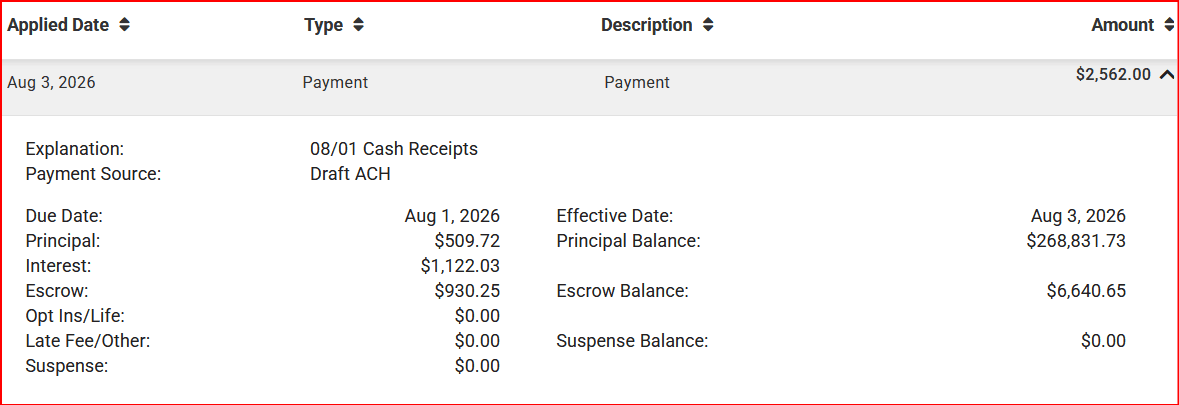
Escrow is not a second servicer. It is a second envelope the same servicer often keeps. One envelope is the loan: principal and interest. The other is a holding jar for property taxes and homeowners insurance, filled a little each month, then emptied when those bills come due.
A recast reprints the loan envelope. It does not recast the tax bill. It does not recast the insurance premium. If you have escrow, the total draft you see is usually new P&I plus the current escrow deposit. The P&I can fall while the escrow line stays put until the next annual review.
If you do not have escrow, there is no tax-and-insurance jar in the draft. The recast still works the same way on principal and interest. The whole amount the servicer collects for the loan is that P&I coupon, so the drop is easier to see. Either way: escrow is not a veto on recast, and recast is not an escrow analysis. Those two jobs can even move in opposite directions in the same year. How an escrow shortage can lift the total bill is a separate story in the escrow shortage walkthrough.
Same cafeteria worker. Two boxes. A recast only shrinks the sandwich (principal and interest). The apple (taxes and insurance in escrow) keeps its own size until the next escrow review.
Real Loan Portal: Payment Split Into Principal, Interest & Escrow
Swipe horizontally or scroll to the right to view the full screenshot.
A Refinance Is a New Mortgage
Refinance means the old note gets paid off with a new one. Rate can change. Term can change. Cash can come out. Someone can come off the loan. You usually pay closing costs. There is underwriting. The monthly number you get is whatever the new contract says—not a reprint of the old one.
That is why refinance can beat recast when the goal is a lower rate, a shorter or longer clock, or cash from equity. It is also why refinance can be a bad trade when the current rate is already cheap and the only wish is a smaller coupon after extra principal. You would be tearing up a loan you like in order to redraw a payment the servicer might have reprinted for a fee.
Side by Side
Recast versus refinance is not the whole menu. Extra principal is its own path: the $50 coupon that stays $50 after you already paid extra.
| Piece | Extra principal | Recast | Refinance |
|---|---|---|---|
| Is it still the same mortgage? | Yes | Yes | No—new note, old one paid off |
| Required P&I each month | Usually unchanged | Redrawn on the smaller balance | Set by the new contract |
| Interest rate | Unchanged | Unchanged | Can change |
| Months left on the clock | Payoff often arrives earlier | Usually the same remaining term | You pick a new term |
| Escrow / tax-and-insurance jar | Untouched by the extra principal | Untouched by the recast math | May be set up again on the new loan |
| Typical friction | A principal-only payment in the app | Servicer fee, minimum extra principal, paperwork | Closing costs, underwriting, time |
| Cash back to you | No | No | Possible (cash-out), if that is the product |
A Dollar Walk-Through
Hypothetical only. Remaining principal $320,000. Fixed rate 6%. 22 years left (264 months). You apply $50,000 extra principal. Here is the usual monthly payment on those leftover months, using a mortgage calculator:
- Required P&I before the extra money: $2,185.84
- After $50,000 extra, if the coupon is not recast: still $2,185.84 due each month. The loan simply ends sooner.
- After the same $50,000, if the servicer recasts on the leftover 264 months: required P&I becomes $1,844.30. That is about $341.54 less P&I per month. Payoff month stays on the old calendar.
Now add an escrow deposit of $450 that did not change. Total draft before: $2,635.84. Total after recast: $2,294.30. The sandwich shrank. The apple did not. If escrow later goes up at the annual review, part of that $341 P&I win can hide in the total.
Left: extra cash on the counter, same-size nightly check. Right: the cashier reprints a smaller check for the nights still on the reservation. Same stay. Different check.
Who Usually Offers a Recast
Recast is a servicing feature, not a law that every mortgage must follow. The investor behind the loan and the servicer's own menu decide.
Conventional loans
Many conventional mortgages backed by Fannie Mae or Freddie Mac can be recast if the servicer offers it and you meet their minimum extra principal and fee. "Can" is not "your app has a toggle." Call. Get the rules in writing.
FHA, VA, USDA, and many jumbo loans
Voluntary recast is usually not on the menu for FHA, VA, and USDA mortgages. Extra principal still pays those loans down. The required monthly P&I typically does not fall unless you refinance under a program that loan type allows. Many jumbo loans also skip recast. Do not assume. Ask the servicer which investor owns the loan and whether re-amortization is offered.
Which Path Fits Extra Principal
First question, before recast versus refinance: do you even want extra cash on the mortgage? A cheap fixed rate can be a bill you keep on purpose. That is a different fork, walked in why prepaying a fixed mortgage can backfire when inflation is doing work for you. The rest of this section assumes you already decided the extra money is going to principal.
Recast fits when
You like the rate. You want a smaller required P&I. You can meet the servicer's extra-principal minimum. You would rather pay a modest recast fee than closing costs. You are not trying to pull cash out or change the term.
Refinance fits when
You want a different rate, a different term, cash out, or a borrower change the current note will not allow. Recast cannot do those jobs. Also: if the loan type cannot be recast, refinance (including streamline programs some government loans offer) is often the only way to change the required payment.
Extra principal fits when
You want the loan gone sooner and you can still make the current coupon. You like the payment staying as a forced savings bit. Or the servicer will not recast, and you still want the balance down. That path saves interest. It does not reprint the coupon.
Summary
- Extra principal pays the mortgage down. It does not, by itself, lower the required monthly P&I.
- A recast reprints that P&I coupon on the original mortgage: original rate, leftover term, smaller balance.
- A refinance replaces the mortgage. New contract. New paperwork. Rate and term can change.
- Escrow is a second envelope the same servicer often holds. Recast does not recast taxes and insurance. Having escrow does not block a recast.
- Many conventional loans can recast if the servicer offers it. FHA, VA, USDA, and many jumbo loans usually cannot. Ask in writing before you count on a smaller coupon.