The First Home Insurance Check Can Be the Worn Value. A Second Check Can Come After the Repair.
Replacement cost means the policy can pay to replace covered property, up to its limit. Actual cash value means it pays what is left after age and wear. On many policies the first check is that worn value, minus the deductible. The held-back part can come later, after the work is done and you show the insurer. A policy that pays only the worn value does not pay that held-back part.
Published on

A home insurance claim can pay in two steps. The first check can be the worn value of the damaged property, after the deductible. If the policy pays to replace that property, a second check can follow for the part that was held back for age and wear. That second check waits on the work and on proof that the work was done.
The two names on the policy are replacement cost and actual cash value. Replacement cost is the price to replace covered property, up to the policy limit. Actual cash value is what is left after age and wear. The dollars below are a made-up repair, so the steps are easy to see. Your declarations page controls your claim.
Disclaimer: This is general education, not insurance, legal, or repair advice. Policies, state rules, time limits, and claim payments differ. A payment on the house can be issued to you, to you and your mortgage company together, or to the contractor. The policy and the claim papers control. Ask your insurer before you rely on an example here.
Two Prices for the Same Repair
Picture a winter coat at a shop. One tag is the price of a new coat today. The other tag is the price of that same coat after three winters of wear. Replacement cost is the new-coat price. Actual cash value is the worn-coat price. The deductible is a fee you agreed to cover before the shop pays either price.
The lining of the coat is the held-back part. The shop can hand you the shell now. The lining stays on their shelf until you bring the coat back with a tailor's receipt showing the lining was sewn in. If you bought the shell only, the lining was never part of the sale. The shelf stays closed.
How the First Check Is Counted
This post follows one example. The example is a damaged wood floor. The home policy covers that floor.
The example uses these amounts. A new floor of the same kind costs $8,000. That is the replacement cost in this example. Age and wear take $3,000 off that price. The worn value is $5,000. The deductible is $1,000. On many policies the first check is the worn value minus the deductible: $4,000. Later sections come back to these same amounts.
The deductible comes off once. It is not taken again if a second check arrives. You do not mail the deductible to the insurer as its own bill. They subtract it from what they pay.
| Piece | Amount |
|---|---|
| Price to replace the floor | $8,000 |
| Held back for age and wear | $3,000 |
| Worn value | $5,000 |
| Deductible, taken once | $1,000 |
| First check | $4,000 |
| Second check, if you replace the floor at that $8,000 price | $3,000 |
The Second Check Is the Held-Back Part
If this policy pays to replace the floor, and the new floor costs the full $8,000, the second check can be the $3,000 that was held back. The insurer has then paid $7,000. You covered the $1,000 deductible. The floor cost $8,000.
That second check is not a tip, and it is not a second deductible. It is the age-and-wear amount from the first estimate. It can arrive after the work is done and you show the insurer the receipts. That order is not a rule of one state. North Carolina's insurance department describes the same steps: a first payment of actual cash value, then a reimbursement of the extra money once the item is repaired or replaced and the receipts are in.
A thermos makes that wait easier to picture. The shop fills the cup you can drink now. That cup is the first check. The rest of the soup stays in the thermos. If your order includes a full bowl, you bring the empty cup back with the receipt and they pour the rest. If your order was the cup only, the thermos stays in the kitchen.
The second check can also be smaller than the amount that was held back. Suppose the floor is finished for $6,500, not $8,000. On many policies the insurer will not pay more than the work cost, minus the deductible, and will not pay more than the policy limit. The work cost minus the deductible is $5,500. The first check was already $4,000. The second check can be $1,500, not the full $3,000 from the estimate.
That is why the second check is not "whatever the contractor bills." It is the held-back part, trimmed to the cost of the work and to the limit on the policy. The worker's price and the claim check are related, and they are still different numbers. A repair bid is its own math, which is the subject of what a home repair costs beyond the materials.
On many policies the held-back part is paid after the work is finished, so the first check can be short of the bill while the job is still open. In the $8,000 floor, the first check is $4,000. The contractor is still owed $8,000. You are $4,000 short until the work is done. After the receipts are in, the second check can be $3,000. Your net cost is the $1,000 deductible. During the job, the other $3,000 is money you may have to put up and then get back.
When the Second Check Does Not Come
A policy that pays only the worn value does not pay the held-back part. In the floor example, $4,000 can be the only claim payment. The $3,000 stays unpaid. You can still receive another payment later if the insurer agrees the damage was larger than the first estimate. That added payment is still worn value. It is not the replacement gap.
Skipping the work can have the same result on a replacement-cost policy. The first check can stand, and the held-back part can stay with the insurer. The policy states how long you have to finish the work and ask for that part. That clock is on your forms, not in this example.
Some policies pay to replace the house and pay only the worn value on one piece of it. A roof is a common piece written that way. The rest of the house can still have a second check. That one piece does not. Belongings can be written the other way from the building: the house at replacement cost, the contents at worn value, or the reverse. Each line on the declarations page has its own answer.
If the worn value is smaller than the deductible, the first check can be $0. A worn value of $800 and a deductible of $1,000 leaves nothing for the insurer to pay until the numbers change.
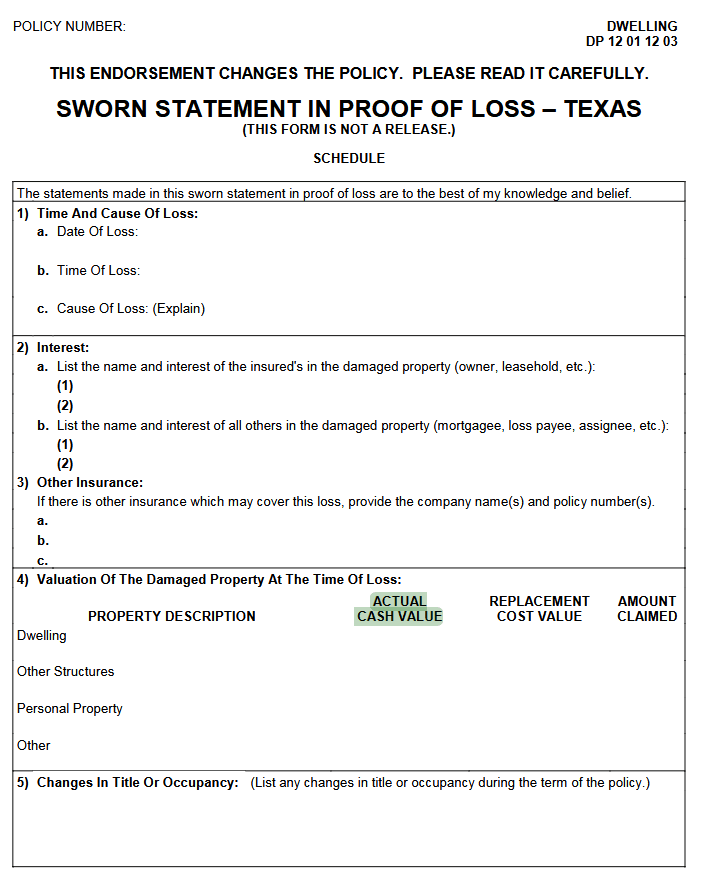
A packet can also include a blank form that asks for both prices on the same line. The form below is one Texas version from a landlord policy. An insurer may ask you to sign it. It is not a claim check, and not every claim uses it.
Blank Texas Proof of Loss: Both Prices on One Line
Swipe horizontally or scroll to the right to view the full screenshot.
What This Claim Check Is Not
This is a payment for a covered repair on the home policy. It is not a flood payment. Flood usually sits on its own policy, which is the subject of why a Texas home policy and a flood policy are separate.
It is also not the insurance premium inside a mortgage payment. That monthly bill can change when the premium changes. A claim check is a different event. For the monthly side, see why an escrow shortage can raise the mortgage payment.
The made-up floor is not a quote for your house. Limits, deductibles, and the list of what is covered change the arithmetic. A payment for the building can name you and your mortgage company on the same check. Read the claim letter before you treat either check as money you can spend on something else.
Before you cash the first check
- Find out whether the damaged property is paid at replacement cost or only at the worn value. The house and the belongings can differ. The declarations page says which, line by line.
- Treat the first check as the worn value minus the deductible, unless the claim letter shows a different split. If the deductible is larger, that check can be $0.
- The second check, when there is one, is the held-back part. It can be smaller if the finished work costs less than the estimate, and it can arrive after you have already paid the contractor.
- Ask for it after the work, with receipts, inside the time the policy allows. A worn-value policy does not pay that held-back part.