An Escrow Surplus Check in Harris County, Texas, Is Usually Not Extra Money
In Harris County, Texas, property tax is often more than one bill. School tax, county tax, and a MUD tax can all come due in the same month. Leftover is usually counted after those bills are paid, not by how full the account looks today. A small cushion usually stays. Anything above that can come back as a check. Not every Harris County house has a MUD. An escrow analysis can happen more than once a year.
Published on

A surplus check from escrow can look like extra money sitting in the account today. On many loans, the review does not work that way. It usually looks at the lowest balance expected after the next round of bills, then keeps a cushion. The check, when there is one, is the gap above that cushion. It is not a raise, and it is not a refund of the loan. Not every loan works this way.
Disclaimer: This is general education, not legal, tax, insurance, or lending advice. Escrow rules, cushions, and whether leftover is paid by check or held in the account vary by loan type, who owns the loan, and who collects the payment. Which tax offices bill you depends on the house. Your escrow letter and loan documents control your situation. If a line on your letter disagrees with this article, the letter controls.
How a Surplus Number Is Usually Calculated
Escrow is the side account that pays property tax and home insurance when those bills come due. A little extra usually goes in each month so the account can cover those bills later. A surplus review does not usually ask how full the account looks this week. It usually asks how low the account is expected to get after the next round of bills, then compares that low point with the cushion it has to keep.
If the low point is still above the cushion, the difference can be a surplus. On many loans, a surplus above a set dollar amount is returned by check, or it can be held to lower the tax-and-insurance part of the next monthly payment. Either way, the check is usually leftover after the bills, not a raise in income and not a refund of the loan itself.
Harris County Tax Is Often More Than One Bill
In Harris County, Texas, property tax is often a stack, not a single invoice. A school district can bill. The county can bill. Some neighborhoods also have a municipal utility district, often shortened to MUD, that bills on its own. Those bills can all land in the same month.
Not every Harris County house sits in a MUD. A house in a city with city services may have a different mix. A house in another school district will have a different school name. The point is the stack. When several large tax payments leave escrow in one month, the account can look healthy earlier in the year and still be set up for that one heavy month.
The account is built around those bills. The cushion is what usually stays after they are paid.
Partial Escrow Screenshot: Cushion and Table 1 Payees
Swipe horizontally or scroll to the right to view the full screenshot.
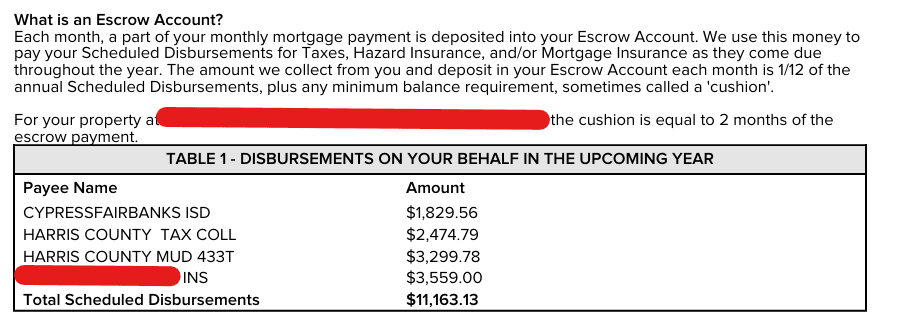
Those are the bills this account is built to pay: school tax, county tax, a MUD tax, and one insurance bill. On many loans, leftover is counted only after bills like these, not by how full the account looks before they are paid. On this letter the cushion is 2 months of the escrow payment. On many loans, that cushion usually stays. This house has a MUD. Not every Harris County house does.
The Check Is the Leftover, Not the Loan Balance
The check, when there is one, is usually what is left after those bills, above the cushion. It is not the money still sitting in the account, and it is not the loan getting smaller. Another company can keep a different cushion, or none that looks like this. A form can be off by a penny.
Partial Escrow Screenshot: Surplus Result
Swipe horizontally or scroll to the right to view the full screenshot.
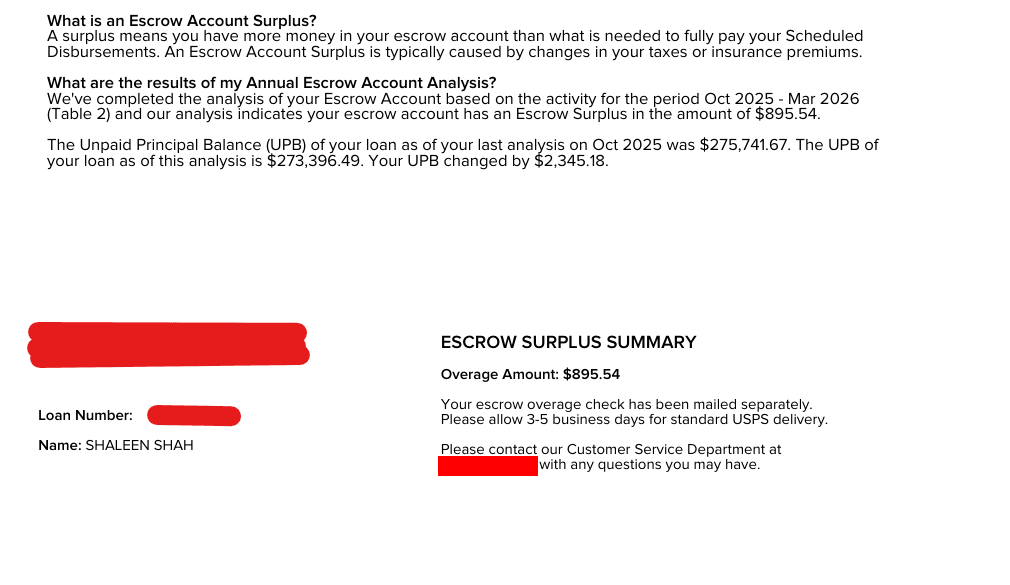
On this letter the surplus is $895.54, and it says that amount was mailed as a check. What you still owe on the loan went from $275,741.67 to $273,396.49. The loan got smaller by $2,345.18. Paying the loan down is the loan itself. It is not extra in escrow, and it is not the cushion the account keeps.
The letter comes from the company that collects the payment, which is not always the investor that owns the loan. That split is in who owns the mortgage versus who services it.
If next year's tax bills rise, the same kind of review can run the other way and create a shortage. That other path is in why a mortgage payment can jump after an escrow shortage.
The Balance Left in the Account Is Not the Check
The bills have to leave before leftover is counted. On this letter, that history runs from October 2025 through March 2026.
Escrow Table 2: Actual Account History
Swipe horizontally or scroll to the right to view the full screenshot.
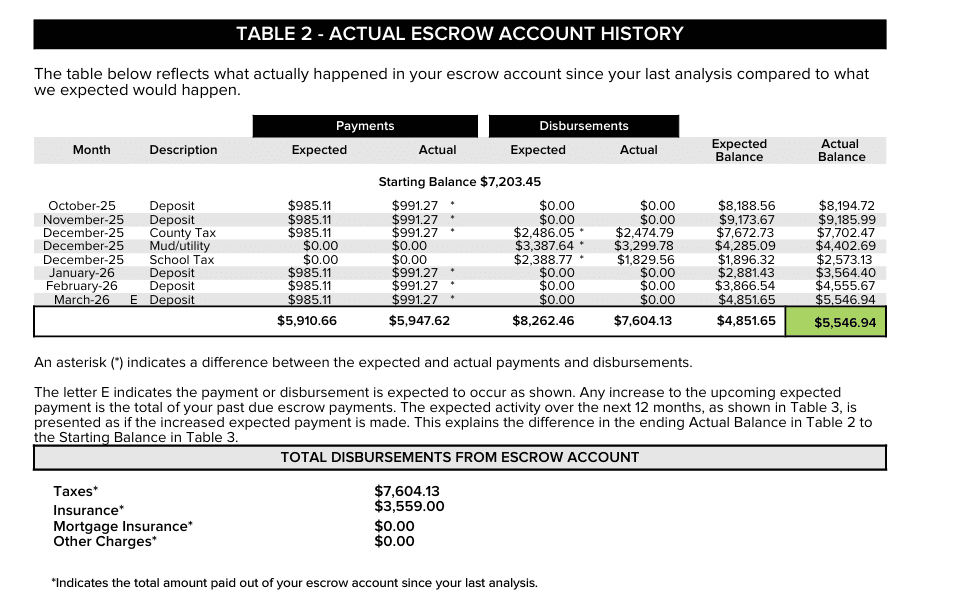
December is when those three tax bills leave together. What actually left matches the three tax lines on the bill list. Each actual bill was lower than the last estimate. That difference can leave more in the account than the estimate had planned. That difference is not the check.
| Bill | What the estimate expected | What actually left |
|---|---|---|
| County tax | $2,486.05 | $2,474.79 |
| MUD or utility | $3,387.64 | $3,299.78 |
| School tax | $2,388.77 | $1,829.56 |
| Three bills together | $8,262.46 | $7,604.13 |
After these months, $5,546.94 was still in the account. The estimate had expected $4,851.65. The account had started these months at $7,203.45. The check was $895.54. The balance still in the account is not the check. On many loans, most of what remains is still there for later bills and the cushion.
On the rows that collect a monthly deposit, the account took in $991.27. The December MUD and school rows show no deposit. That $991.27 is the escrow part of the house payment, not the loan payment by itself. A mortgage payment with taxes and insurance is where a loan payment and an escrow amount can sit side by side.
Insurance is one of those bills too. Since the last review, $3,559.00 went out for it, the same amount as on the bill list. The history does not say which month.
The next 12 months are listed as Table 3. The step that subtracts the cushion from the lowest expected balance is not included with this history.
What a MUD Is, and Why It Is Not on Every House
A municipal utility district is a local district that can levy its own property tax, often to pay for water, sewer, drainage, or similar neighborhood work. In unincorporated Harris County, a subdivision can sit in a MUD. A house inside a city can have city tax instead, or a different mix, or no MUD line at all.
So "Harris County tax" on an escrow estimate is not one bill that every house pays. It is whichever tax offices attach to that house that year. If your letter has no MUD line, that does not make the leftover math wrong. It usually means your bills are a different mix. Leftover is still counted after whatever bills that house actually has. If your letter has a MUD and a neighbor's does not, both can still be normal for Harris County.
The Insurance Line Is an Amount, Not the Policy
That insurance bill is part of what the account pays before leftover is counted. The line itself is not a description of the policy. It does not name the company, flood, or a month. The history table shows that same amount paid out, and still does not say which month. The kind of policy can be on a page that is not shown here. The sentence above the bill list says escrow can pay taxes, hazard insurance, and/or mortgage insurance. That sentence is general. It does not say what the insurance line is. Flood coverage, when someone buys it, is usually its own policy. That difference is explained in does homeowners insurance cover flood in Texas. Some loans escrow flood. Some do not. This letter does not show whether flood is in the account.
The history table shows $0.00 paid out for mortgage insurance. A letter can still include standard mortgage-insurance wording when nothing was paid. Standard wording is not the same as money leaving the account. Whether mortgage insurance still belongs on the loan is a separate question. That question is covered in how much you still owe, and mortgage insurance, not by this check.
An Escrow Review Can Happen More Than Once a Year
Escrow is sometimes described as a once-a-year checkup. For many home loans, federal rules call for a review at least once a year. A new one can also follow a tax change, an insurance change, or a shortage or surplus from the last one. This letter calls the review annual. The months it covers are October 2025 through March 2026, and it also refers to a last review in October 2025. Those dates are closer together than a year. That is what this letter says. It is not a rule that every loan uses that same stretch of months. Use the dates on your letter, not a once-a-year rule of thumb.
Tax rates and appraised values also move. Harris County bills are not frozen. A surplus this year does not lock in a smaller payment from now on. Next year's bills can be higher, and the review can ask for more. The full monthly housing cost still has to include tax. That picture is in true home affordability.
A Short List to Check
- Find the bills the account expects to pay. Note the months, not only the yearly total. In Harris County, school, county, and sometimes a MUD can hit the same month.
- Find the lowest balance the letter expects, and the cushion it keeps. The surplus is usually the gap between those two, not the balance as of today.
- See whether the leftover comes back as a check, stays in the account, or both. The letter should say which.
- A MUD line, a mortgage-insurance paragraph, or an insurance company name is not proof of a policy you have not checked elsewhere.
Limits of This Guide
This guide uses one Harris County letter: the bill list, the surplus result, and the account history. It does not include the step that subtracts the cushion. The dollar amounts are this letter's amounts. They are not a promise that every Harris County surplus check matches them, or that leftover always comes back as a check. Some loans leave it in the account instead.
This is not a Texas-only rule. On many mortgages, comparing leftover with the cushion follows federal escrow rules. Local tax offices still set the bills. A MUD is not on every Harris County house.
The letter your mortgage company mailed you is the one that counts. This article cannot replace it.
What to take from this
- If a check shows up, treat it as leftover after the bills, not as spending money the account can spare today. Most of what is in the account is usually still reserved for bills and the cushion.
- On the letter, keep three amounts apart: the check, the money still in escrow, and what you still owe on the loan. Only the check is the surplus.
- Match the bills to your own tax offices. A neighbor in Harris County can have a different mix, including no MUD, and both letters can be normal.
- Do not treat this year's check as a smaller payment from now on. If the bills rise, the next review can ask for more instead.