How the Interest Rate and the APR Differ on a Home Loan, a Car Loan, and a Credit Card
On a home loan, a car loan, and a credit card, the interest rate and the APR are not the same pair of numbers. On a home loan, the APR can be higher than the interest rate, and paying the loan off early can make the lower APR cost more. On a car loan, the two numbers are often the same, and extra items can raise the amount you borrow. On a credit card, the APR is the interest rate, and cash can use a higher one than a purchase. Each one is explained below.
Published on

A home loan, a car loan, and a credit card can all show an interest rate and an APR. The interest rate is the percent charged on what you still owe. The APR is a yearly percent too, but it is not always that same percent, and it is not doing the same job on each of those three.
The monthly payment on a home loan or a car loan is built from the interest rate. How that payment splits between interest and the amount you owe is covered in how amortization works on a mortgage and a car loan. The APR is a different number from that split.
A Home Loan Uses the Interest Rate for the Payment
The monthly payment uses the interest rate
On a home loan, the interest rate is the percent in the monthly payment. That payment is the part that pays the loan. Taxes and insurance can be billed with it, but they are not the interest rate, and they are not the APR. A mortgage calculator uses the interest rate, the amount borrowed, and the number of years to build that loan payment. You do not pay the APR on top of that. The APR is not a second monthly bill. It is a yearly percent you can use to compare one home loan with another.
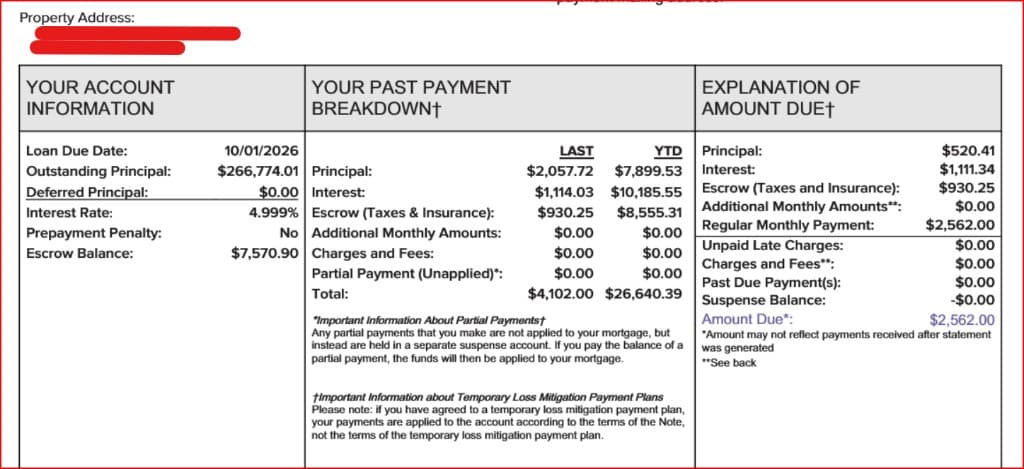
A Home Loan Statement Shows the Interest Rate, Not the APR
Swipe horizontally or scroll to the right to view the rest of this crop.
Some fees at the start can raise the APR
A home loan offer shows an interest rate and an APR. The interest rate is the percent that builds the monthly payment, together with the amount you borrow and the number of years on the loan. You do not pay the APR as a second charge on that bill.
The APR starts from the interest rate. It is that rate restated as one yearly percent that also includes some fees you pay the lender once, at the start. Annual means per year. Percentage rate means a percent, so the restated percent can be read next to the interest rate and one offer can be compared with another. The fee stays a one-time payment. It is not added to the amount you borrow, and it is not added to the monthly payment. The APR is only the percent that shows the interest and that fee together.
The full term is used so every offer is measured on the schedule written on the loan, not on a guess about when you might sell or refinance. On a 30-year loan, the APR counts the one-time fee across all 30 years of that schedule. The counting happens inside the percent. It does not add the fee to your balance. Sell, refinance, or pay the loan off after a few years, and the fee is still paid in full, while the lower interest rate lasted for fewer years. The APR does not shrink to match those years. It was calculated for the whole term. The offer with the lower APR can still be the one that costs more dollars, if the fee paid at the start is bigger than the interest the lower rate has saved. That comparison is not a reason to avoid paying a loan down. Extra payments still cut the interest on the balance you have.
One common fee included in the APR is money you pay the lender so the interest rate will be lower. You pay it once, up front, and it does go into the APR. Taxes and insurance can be due at closing too, and those do not go into the APR. Two loans can share one interest rate and the same monthly payment. Each loan has one APR. The APR on the loan that included this fee can be higher than the APR on the loan that did not.
A bus pass for a full year is the same idea. You pay for the pass once. That price is not added to the fare for each ride. Blend the pass into a daily cost by using every day of the year, and you can compare the pass with paying for each ride on its own. That blended daily cost is not a new fare. Ride all year, and it fits what you paid. Stop after a few months, and the pass is still paid for, so the blended cost made those months look cheaper than they were. The APR is that kind of yearly percent. The interest rate is still what builds the monthly payment.
Leaving early can make the lower APR cost more
Here is that comparison with two made-up loans, not a loan offer. Both borrow $200,000 for 30 years. Loan A has a 7% interest rate and no fee of the kind that goes into the APR, so the APR is also 7% and the loan payment is about $1,331 a month. Loan B has a 6.5% interest rate, so the loan payment is about $1,264 a month. Getting that lower rate means paying the lender $4,000 in cash at the start, and the $4,000 is not added to the $200,000. The APR includes that one-time $4,000 by using all 30 years of payments, and loan B's APR is about 6.7%. The balance and the monthly payment stay on the 6.5% interest rate. That 6.7% is higher than loan B's interest rate, and lower than loan A's 7% APR.
If you sell, refinance, or pay the loan off after 3 years, loan B costs more than loan A in this example, even though loan B's APR is lower. Loan A has cost about $41,356 in interest. Loan B has cost about $38,343 in interest, and the $4,000 fee is already paid, which brings loan B to about $42,343. The lower interest rate saved about $3,013, which is less than the $4,000 fee. Keep both loans for all 30 years, and loan B costs less than loan A. Interest on loan B plus the $4,000 comes to about $259,089. Interest on loan A comes to about $279,018. The lower APR is the cheaper offer here only when the lower interest rate has enough years to cover the fee. Once you already have the loan, paying the balance down faster still reduces the interest from that point on.
| Loan | Interest rate | Fee at the start | Monthly payment | APR | Cost after 3 years |
|---|---|---|---|---|---|
| A | 7% | $0 | about $1,331 | 7% | about $41,356 |
| B | 6.5% | $4,000 | about $1,264 | about 6.7% | about $42,343 |
A Car Loan Often Shows the Same Number Twice
The interest rate and the APR are often the same
On a car loan, the interest rate and the APR are often the same number. The monthly payment uses that interest rate, the amount you borrow, and how many months you have to pay it back. If the only charge counted in the APR is that interest, the APR does not sit above the interest rate the way a home-loan APR can. A separate fee paid to the lender at the start can still lift the APR a little. That is the home-loan pattern, and it is less common on a car loan. If the interest rate itself is raised, the APR usually rises with it, because the two are often the same number. A gap between the interest rate and the APR is the wrong place to look for that raise. The raise is already in both lines.
Extra items can raise the amount you borrow
The cost can rise because extra items were added to the amount you borrow. A warranty is one example. The interest rate can stay put. The APR can stay the same number as that interest rate. You still pay that interest rate on a bigger amount, so the payment and the interest can both go up. The APR did not have to change for the loan to cost more.
Picture apples sold by the pound. The price per pound is the interest rate, and on this kind of loan the APR is often that same price. Adding a melon to the bag does not change the price per pound. The bag costs more because it weighs more. Extra items on a car loan are the melon. The APR can look unchanged while the amount you owe got bigger.
A Credit Card APR Is the Interest Rate
A credit card does not split these into two percents
On a credit card, the APR is the interest rate. A home loan can show 6.5% in the payment and about 6.7% as the APR. A credit card does not make that split. The APR for a purchase is the rate those purchases are charged. A yearly card fee, if the card has one, is usually its own charge. It is not mixed into the purchase APR the way a home-loan fee can be mixed into the home-loan APR.
Taking out cash can use a higher APR
Buying something with the card uses one APR. That is the interest rate on those purchases. Taking out cash often uses a higher APR, so the interest on that cash can cost more than the interest on a purchase. Cash can also start costing interest right away, and the card can add a fee on the cash itself. A purchase can still have a stretch of time before interest starts. Cash often does not get that stretch. If you pay the full statement by the due date, and the card gives that stretch on purchases, the purchase APR may not be charged on those purchases. The cash can still cost its own higher APR from the day you took it.
Picture one drink stand. A cup of lemonade has one price. Asking the stand to hand you cash from the till has a higher price. It is the same stand. The cash is not the lemonade, so it does not have to use the lemonade price. A card can work that way. The purchase APR is the lemonade price. The cash APR can be higher.
A different mix-up is taking the card's monthly percent and multiplying by 12. That one is about the year, and it is explained in why 1.5% a month is not 18% a year. The cash APR is a different interest rate on the same card, not that multiplication.
The Same APR Is Not the Same Deal
One percent cannot rank all three
A home loan, a car loan, and a credit card can each show the same APR, and that still does not make them the same offer. On the home loan, that APR can already include some fees paid at the start, counted for every year, while the monthly payment uses a lower interest rate. On the car loan, that APR is often the interest rate itself, and the amount you borrowed can be the part that changed. On the card, that APR is the interest rate for one use. Cash can be a higher APR, and purchases may not be charged the purchase APR if you pay the statement in full and the card gives that stretch of time.
The comparison stays inside one kind of loan. A home-loan APR is for comparing home loans. A car-loan APR is for comparing car loans, next to the amount borrowed. A card APR is for comparing that use of the card, purchase or cash, with the interest rate that use actually charges.
What to remember
- On a home loan, the interest rate is the percent in the monthly payment. The APR can be higher because a fee you pay the lender once, at the start, is turned into a yearly percent spread over the full term. A lower APR can still be the costlier offer if that fee is larger than the interest saved before you sell, refinance, or pay the loan off. In the made-up example, keeping loan B for all 30 years gave the lower rate enough time to cover the fee. Paying the balance down faster still reduces interest.
- On a car loan, the interest rate and the APR are often the same number. Extra items added to the amount you borrow can raise the cost even when the APR does not change.
- On a credit card, the APR is the interest rate. Taking out cash often uses a higher APR than buying something with the card. Paying the statement in full can leave the purchase APR uncharged, while the cash can still cost interest from the day you took it.