Hedge Funds Trade, Private Equity Buys Companies, and a Pension Is the Customer
Hedge funds, private equity, and pensions get named in the same breath, so they sound like three products on one shelf. They're not. Hedge funds buy and sell things that already have a price. Private equity buys companies and holds them for years. A pension is a retirement pool that already has money and has to pay checks. When a large plan — including many union plans — puts money into those funds, the plan is the customer. The manager runs the fund. A regular brokerage account usually cannot buy that same fund.
Published on

A hedge fund and a private equity fund are two kinds of private investment pools. Think of them as vehicles: they take in money, lock it for a while, and put it to work. A pension is a different thing. It is a retirement trust that already has money — from employers, workers, or both — and has to invest that pool so it can pay checks for decades. Those three names get said together. They are not three products on one shelf.
When that trust puts a slice into a hedge fund or a private equity fund, the plan trust is the customer. On the paperwork that customer seat is called the limited partner (LP). That is true of many large public plans. CalPERS is an LP in pooled private equity funds. It is also true of many large union plans that cover several employers. The union as a labor organization is not the LP. The electrician or teacher whose dues or paycheck helped fill the trust is not the LP either. Those members are beneficiaries of the pension: they get a retirement check if the plan stays healthy.
This piece stays on that stack — who sits in which chair, how the manager gets paid (including carry), why a regular brokerage account cannot buy the same fund (including sections 3(c)(1) and 3(c)(7)), and what a union member actually is. It is U.S.-focused and educational. Nearby math lives in other pieces: IRR, EBITDA, and NAV.
Two seats: who runs the fund, and who puts up the money
In the usual U.S. setup, the fund has two seats. The general partner (GP) is the manager: the firm that picks trades or buys companies, hires staff, and lives with the results. The limited partner (LP) is the customer who promised the money and then mostly sits still — an endowment, a family office, an insurer, a wealthy person, or a pension trust that signed up for the fund. The restaurant version: the GP cooks; the LP paid to build the kitchen and reserved the table.
"Limited" is doing real work. An LP can lose what they promised to that fund. They typically do not owe the restaurant their house if the kitchen fails. The GP runs the operation and takes the reputation hit if the food is bad.
A giant public plan like CalPERS, a large union plan, and a university endowment are different organizations with different boards. When they put money into the same private equity or hedge fund, they occupy the same chair: customer (LP). They are not LPs when they simply hold listed stocks and bonds — that is ordinary investing, not signing up for a private fund. And the electrician or teacher whose dues or paycheck funded the plan is never that chair. They are a beneficiary. They receive a retirement check if the plan stays healthy. They do not pick the hedge fund.
What the money actually does
GP and LP name the chairs. They do not name the job. A hedge fund and a private equity fund can share the same legal wrapper — a partnership, a management fee, a slice of profits — and still spend the decade doing different work.
Hedge funds: a stall that can buy and sell all day
A hedge fund typically trades things that already have a price: stocks, bonds, currencies, derivatives. The classic extra tool is going short — borrowing something, selling it, and hoping to buy it back cheaper later. The name comes from pairing buys with shorts. It is not a promise that the fund is safer than the market.
Holdings are often securities you could sell on a screen. That is why hedge funds sometimes offer a path back to cash after a waiting period: a monthly or quarterly window, some notice, maybe a gate if too many customers head for the door at once. The fund still calculates a NAV on those dates so new money, withdrawals, and fees have a number. That is not a 4:00 p.m. mutual-fund price you can tap from a brokerage app.
Private equity: buying the orchard, not a crate of apples
Private equity (buyouts, in the usual headline sense) buys companies, or controlling stakes in companies, that are not sitting on the public stock exchange as the main event. The fund may use loan money at the company — a leveraged buyout — then try to change how the business runs, and sell or list it years later. The scoreboard is often IRR and a multiple of money in vs. money out, not a daily ticker. Operating conversations lean on metrics such as EBITDA.
You cannot send the manager a letter and get cash next week. The asset is a chain of clinics or a software firm, not a basket of listed shares. Selling your seat to someone else (a secondary) is a different, often discounted side door — not a mutual-fund undo button. A classic fund asks for a ten-year life, often with a couple of one-year extensions. Money does not all leave the customer's account on day one. You commit a total; the manager sends capital calls when it actually buys something — like a contractor draw on a house, not a one-shot checkout.
| Compared | Hedge fund | Private equity |
|---|---|---|
| What they do | Buy and sell things that already have a price. Can also bet that a price will fall (short). | Buy companies (or large stakes), try to improve them, sell years later. |
| Can you cash out? | After a waiting period, maybe on set dates. If too many people leave at once, the fund can slow the line (a gate). | Almost never on demand. The asset is a business, not a ticker you can sell by 4:00 p.m. |
| When the money leaves | Once you are in, the money stays until a withdrawal window. | You promise a total. The manager asks for pieces when it buys something (capital calls). Typical life is about 10 years, plus extensions. |
| Borrowed money | Often inside the fund (for example through a prime broker). | Often at the company — the deal uses debt. Not a day-trading account. |
| How they keep score | Return vs. a benchmark. Extra bonus only after beating the last peak (high-water mark). | IRR and “how many times your money came back” after sales. Often a minimum return (hurdle) before the manager’s bonus. |
How the manager gets paid: a fee, then a bonus
The manager does not work for free. Two pay streams show up in almost every pitch, even when the percentages have drifted.
The management fee is rent for showing up. Hedge funds have historically charged about 2% a year of the money in the fund. Private equity often charges about 2% a year of the money customers promised during the first years (often years 1–5). After that buying window ends, that fee usually steps down to a percentage of the money still sitting in companies as those companies are sold. It pays salaries, research, and the lights. It is not a law — big customers often negotiate less.
The bonus is called carry (carried interest). It is a cut of profits, not of the rent. The folklore number is 20% of gains.
In private equity, that bonus usually does not start on the first dollar of profit. The paperwork often runs in this order:
- Customers get their original money back.
- Customers get a minimum return first — classically around 8% a year. That minimum is the hurdle (also called a preferred return).
- Then the manager gets the next profit checks until they have their 20% cut of the whole profit. That step is called GP catch-up. It exists because customers just took the first 8% alone.
- After that, any leftover profit is split the usual way: 80 cents to customers, 20 cents to the manager.
Hedge funds usually skip that PE waterfall. Their extra bonus often waits behind a high-water mark instead: no second bonus until the fund has climbed back above its last peak. The manager is not paid twice for recovering the same hole.
"2 and 20" is a nickname for that rent-plus-bonus shape. It is not a law, and it is not universal. Treat it as folklore with a real idea underneath: the manager gets paid to operate, and then gets a cut if the customer actually makes money.
Why you cannot cash out tomorrow
A mutual fund is built around daily cash-out. These funds are built around the opposite: the manager needs time with the money.
In private equity, the customer signs a commitment — a promise of up to $X. The manager calls pieces of that promise when a deal closes. Until then, the uncalled amount is still a legal obligation, like a construction budget you have not drawn yet. Trying to yank the whole promise because markets got noisy is not how the contract works.
In a hedge fund, a lockup is the period when withdrawals are off the table. After that, you may still only exit on certain dates, and a gate can slow the line if too many customers leave together. That is the paint-is-wet rule: the manager agreed to a strategy that breaks if everyone sprints for the door on the same Tuesday.
Where pensions sit — including union plans
A pension is not a third flavor of hedge fund. It is a pool with a job: pay retirees. The common U.S. design here is a defined-benefit plan. The plan promises a paycheck in retirement (a formula, not a brokerage login). That is a different contract from a 401(k), where the worker owns an account and picks funds inside it.
Trustees and staff — often with consultants — decide how that pool is invested. A large slice still sits in public stocks and bonds, where the plan is just another big holder, not an LP. Another sleeve, labeled alternatives on the slide, can include private equity, hedge funds, private credit, real estate, and infrastructure. There the plan trust is shopping as a customer (or as a co-investor next to the manager). It is not competing as a product on the same shelf.
Many union pensions are not one company's plan. They cover workers at many employers in the same trade — construction, trucking, groceries — so an electrician can move from contractor to contractor and stay in the same pension. The 1947 Taft-Hartley Act is why that structure is legal: employers can pay into a shared trust, but the board that runs it has to be split — half union trustees, half employer trustees. Neither side runs it alone. That jointly trusteed, multiemployer setup is the Taft-Hartley pattern. Public plans covering teachers, firefighters, or city workers sit in a sibling role, often with bigger checks. In both cases, when the trust puts money into a private equity or hedge fund, the trust is the LP on the papers. The member paying dues or contributing through payroll is a beneficiary of that trust, not an LP in the private fund. Not every local's plan writes those checks — size, how well funded the plan is, and how fast it needs cash all matter — but the large ones that do sit in the same customer chair as endowments.
University endowments and sovereign wealth funds sit in that same customer chair, usually with even longer horizons. They are not this chapter's thesis. They are proof that "who writes the check" is a role, not a brand name.
Why a regular brokerage account cannot buy the same fund
Retail here means a person buying through a brokerage app, with a prospectus and a sell button. The door is not closed because someone failed a personality test. It is closed because these private funds do not work like a mutual fund, and U.S. law treats a fund sold to the public more strictly.
An ordinary mutual fund you can buy in a brokerage account (an open-end fund under the Investment Company Act of 1940) has extra rules. It has to spread its bets, limit borrowed money, and usually let you cash out the same day. You cannot honestly promise daily cash-out if the money is locked inside a company for seven years. So classic private equity and hedge funds stay private. They do not sell to the public at large. They only take investors the rules treat as able to wait and able to lose the money. Other products under that same 1940 Act — closed-end funds, interval funds, and business development companies (BDCs) — are cousins. They are not the private partnership a pension signed.
Two ways a private fund skips the public-fund rules — and a third law people mix in
A classic private equity or hedge fund stays private by using an exemption from those 1940 Act public-fund rules. Two exemptions show up over and over. They are different clubs. A third rule comes from a different law entirely. People mash all three together. The table is the un-mash.
| What it means in English | The legal name |
|---|---|
| Small club: as a rule, no more than 100 owners. A qualifying venture capital fund can go to 250 owners if it also stays under a small size cap, currently $12 million promised. | Investment Company Act section 3(c)(1) |
| Bigger club: the 100-person cap does not apply under the 1940 Act. The tradeoff is that every owner has to pass a harder wealth test (qualified purchaser). | Investment Company Act section 3(c)(7) |
| A separate trigger from a different law: around 2,000 holders and $10 million of assets can force public reporting. That is why giant funds do not invite infinite people. Easy to mash into the 100-person rule. Not the same law. | Exchange Act section 12(g) |
Skipping the 1940 Act is only half the job. The fund still has to follow a second law about how it sells itself (the Securities Act). The usual path is Regulation D. That is a different door from 3(c)(1) and 3(c)(7). Regulation D is where accredited investor status appears. Passing that test means a seller may legally offer you the deal. It does not mean you have a seat. Minimum checks are often hundreds of thousands to millions of dollars. Pensions clear that. A regular IRA usually does not.
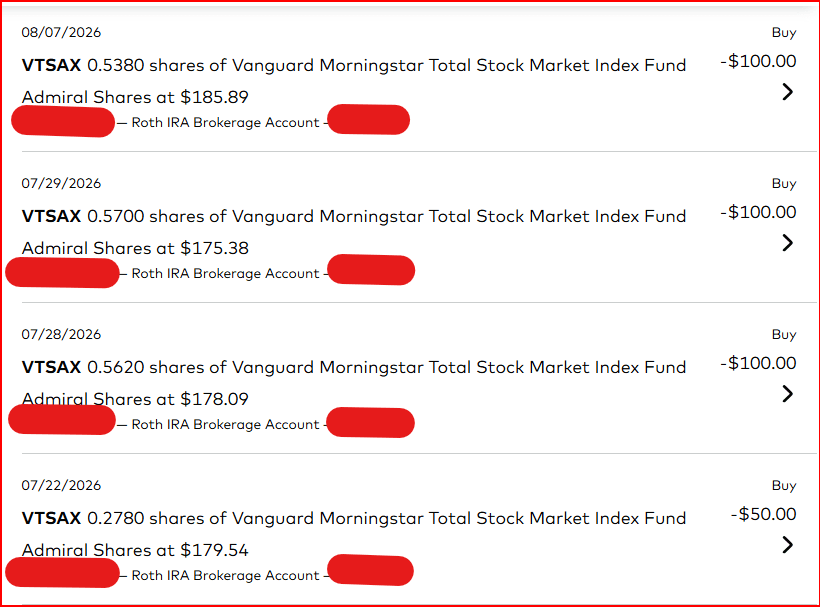
The screenshot below is a sample of buys in a real Roth IRA: an everyday listed index fund, in $50 and $100 clips. That is a normal retirement account buying a mutual fund. It is not signing up for the private fund a pension buys.
Real Roth IRA: Sample VTSAX Buys
Swipe horizontally or scroll to the right to view the full screenshot.
Three wealth tests that are not the same thing
Marketing blurbs flatten this into "you have to be rich." The forms ask three different questions. Mixing them is how explainers go wrong.
- Accredited investor is the Regulation D test: may a seller legally offer you the private deal?
- Qualified client is a different test: may a registered manager take a bonus cut of profits (not just a flat fee), often on smaller 3(c)(1) funds?
- Qualified purchaser is the 3(c)(7) test: may you own a piece of the big private fund?
Passing a test is a wristband. It is not a seat.
| The test | What passing it lets you do | The dollar bar in 2026 (as of August 2026) |
|---|---|---|
| Accredited investor | A seller may legally offer you many private deals (Regulation D). | Income over $200k a year ($300k with a spouse or spousal equivalent) for each of the last two years, and you expect the same this year, or $1M net worth leaving out your primary residence, or certain licenses (Series 7, 65, or 82). A rental or a second home still counts. The home you live in does not. |
| Qualified client | A registered manager may charge a bonus on profits, not just a flat fee, on many smaller private funds (often 3(c)(1) funds). | As of June 29, 2026: $1.4M with that manager, or $2.7M net worth leaving out your primary residence. A rental or a second home still counts. Qualified purchasers count automatically. Older contracts can be grandfathered. |
| Qualified purchaser | You may own a piece of the big private funds that use section 3(c)(7). | About $5M in investments for a person (not net worth). The home you live in does not count. Real estate you hold as an investment, like a rental, can count. Institutions often need about $25M in investments. This is the pension-sized door. |
Those dollar numbers change on a schedule, and they are not investment advice. The point of listing them is the ladder. A six-figure salary can pass accredited and still be nowhere near the big-fund test (3(c)(7)). A large pension trust that already holds tens of millions in investments often meets the institution-sized qualified-purchaser test (about $25M in investments). The people who run the plan make that call — not each teacher or electrician. A small local plan may never write that check, or it may buy a slice through a fund of funds (a fund that buys other funds).
Other private funds pensions also buy
The same customer chair shows up in nearby products. Pensions write those checks too. Naming them keeps the map honest without turning this into an encyclopedia.
| Name | What it does |
|---|---|
| Venture capital | Bets on young companies. Same wait-years shape: promise money, get called, wait. |
| Growth equity | Buys companies that are already growing. Usually uses less borrowed money than a classic buyout. |
| Private credit | Lends to companies instead of owning them. |
| Real estate / infrastructure PE | Same long wait as private equity, but the assets are buildings, roads, or similar. Public REITs are the version you can trade like a stock. |
| Fund of funds | A fund that buys other funds. It is a customer of those funds, and its own investors are customers of it. |
A public REIT you can buy like a stock is a different animal. It has its own cash-flow language (AFFO and REIT payouts). You can trade it the same day. It is not a ten-year promise-and-wait fund.
What a brokerage account can actually buy
You are not locked out of every business that smells like private markets. The honest line is: you are usually not sitting in the pension's seat in the private fund the pension bought.
You can buy stock in a listed alternatives firm (the management company). You can buy shares of a listed business development company (BDC) — a registered vehicle that can lend to or take stakes in smaller companies, often with a ticker you can trade. Some interval funds are registered products that offer scheduled buybacks of a slice of shares, not daily cash-out. A few 401(k) target-date products now add a thin private-markets sleeve. Those are real products with their own fees, discounts, and cash-out rules. They are not the pension trust's seat in the private partnership, not the side-by-side co-invests, and not the fee break the giant check negotiated.
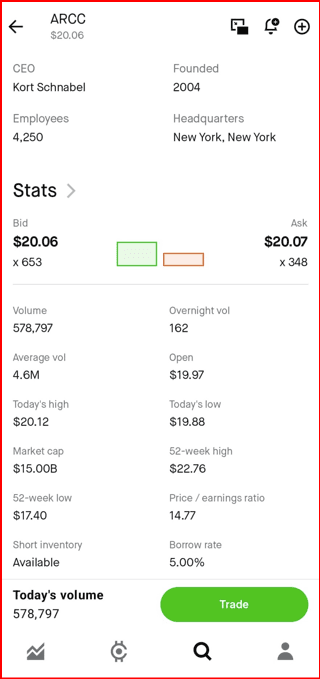
The screenshot below is a real Robinhood quote page for a listed BDC. The green Trade button is the sidewalk window: you can buy a ticker. That button does not sign you up for the manager's private fund.
Real Broker Screen: ARCC Quote & Trade Button
If you want the math the big customers still run
Private equity sends cash in lumps, not a smooth line. That is why IRR shows up on every big-customer report — and why the True Annualized Return calculator is the public-markets cousin of that question. Everyday compounding still uses CAGR and the Compound Interest calculator. When someone is talking about a buyout company's operations, they still run through EBITDA. None of that replaces the seating chart. It is what the people in those chairs argue about after the money is already in.
Definitive Summary: Who Writes the Check
- Hedge funds and private equity are vehicles. A pension is a retirement trust. When that trust puts money into a PE or hedge fund, the plan is the customer (the LP) — including many large union and public plans. The union member is a beneficiary, not an LP.
- The GP (manager) runs the fund. The LP (customer) puts up the money. Carry is a cut of profits after the manager has already collected a management fee. In PE, carry often waits behind a hurdle, then a GP catch-up, then an 80/20 split. Hedge funds often use a high-water mark instead. "2 and 20" is folklore, not a law.
- Hedge funds trade (and can short). Private equity buys companies and calls capital over a long fund life you cannot cash out of tomorrow.
- A union member is a beneficiary of the trust. Trustees allocate. Not every local plan writes PE or hedge-fund checks — size, how well funded it is, and how fast it needs cash all matter.
- A regular brokerage account is usually out because daily cash-out, 1940 Act limits, and check size cannot survive a long hold — for example, owning a company for seven years. Section 3(c)(1) is the small club. Section 3(c)(7) is the rich club. Section 12(g) is a different reporting trigger. Accredited, qualified client, and qualified purchaser are three different tickets — and a ticket is still not an invitation.