The “Per” Trap: Why $/lb, $/oz, and Monthly Fees Don’t Compare
A lower number on the shelf means nothing if one tag is per ounce and the other is per pound—or if one bill is monthly and the other is yearly. Match the base, then decide.
Published on

A small word can quietly skew a shopping or billing decision: per. A tag that says $0.39 per ounce can look "cheaper" than a tag that says $5.99 per pound—until you notice those two tags are not measuring the same slice of the product. The same trap shows up when one plan lists $29 per month and another lists $299 per year. The smaller digit wins the glance. The matched base wins the decision.
This post is about that mismatch. It is not about hunting for the deepest discount, and it is not the same problem as converting inches to centimeters. The conversion may be fine. The comparison base is still wrong.
What "Per" Actually Does to a Price
A sticker price answers "how much for this package?" A per price answers "how much for one chunk of a shared measuring stick?" That stick might be an ounce, a pound, a square foot, a liter, a week, or a year. Change the stick, and the dollars-per-stick number moves—even when the package cost stays the same.
So the rule is blunt: only compare per-prices that share the same stick. If they do not, rewrite both onto one stick first. Then compare.
Analogy — Two Runners, Two Clocks
Imagine a race finish board. Runner A shows 4.2. Runner B shows 252. Without labels, A looks faster. Then you learn A's clock counts minutes and B's clock counts seconds. Same finish. Different dials. The "smaller number wins" rule collapses the moment the dials disagree.
Unit prices work the same way. "Per ounce" and "per pound" are two dials. "Per month" and "per year" are two dials. Pick a winner only after both clocks speak the same language.
Grocery Shelf: $/oz vs. $/lb
One jar lists $0.40 per ounce. Another lists $5.60 per pound. Your eye grabs 0.40 because it is tiny. But a pound is sixteen ounces, so $5.60 per pound is $5.60 ÷ 16 = $0.35 per ounce. The "expensive-looking" pound price was the better buy—once both stickers share the ounce stick.
Flip it the other way when you need pounds: multiply the ounce rate by 16. $0.40 × 16 = $6.40 per pound. Now both tags sit on the pound stick, and the comparison is honest.
Some retailers print that stick under the big price. The Costco listing below is one example: package total and a per pound line on the same screen—so you can check whether the unit rate matches the bag weight.
Real Product Page: Package Price vs. Per-Pound Stick
Swipe horizontally or scroll to the right to view the full screenshot.
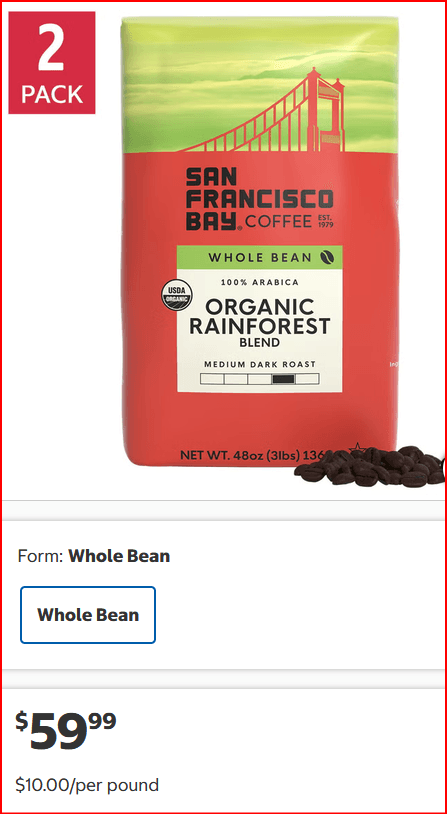
The 16-Ounce Trap
People skip the rewrite because sixteen feels "close enough to ignore." It is not. Skipping that step is how a shelf tag steals the decision. If you need help moving ounces, pounds, grams, or kilograms onto one line before you shop, use the Universal Weight Calculator. For liquids sold by fluid ounce, cup, or liter, use the Universal Volume Calculator the same way—match the measuring stick, then compare dollars.
Warehouse clubs add another layer (club packs, membership fees). That is a separate decision from base-matching. When the pack size itself is the question, see when bulk buys actually save money. Fix the per-unit base first; then ask whether the giant pack is worth it.
Floors and Fabric: $/sq ft vs. a Lump Sum
Flooring and fabric love the word "per." One quote is $4.50 per square foot. Another is $1,800 for the whole room. Those are not rivals until you know the room size. A 12 × 15 foot room is 180 square feet. At $4.50 per square foot, the room costs 180 × $4.50 = $810 for material alone—before waste, underlayment, or labor. The lump sum might still win after extras. Or it might not. You cannot tell from the sticker shapes alone.
Build the area (or linear feet) first, then force both quotes onto the same stick—dollars for the whole job, or dollars per square foot. The Universal Length Calculator helps when one plan uses feet and another uses meters or inches. Unit mix-ups compound this trap; for that failure mode, see unit conversion mistakes.
Bills: Monthly vs. Yearly (and Weekly)
Analogy — one pizza slice vs. the whole pie: A café chalks "$3 a slice" next to "$28 for the pie." Calling the slice "cheaper food" because 3 is smaller than 28 skips the question of how many slices you need. Twelve slices at $3 is $36—more than the pie. Monthly fees play that game with calendars instead of crust.
Take Plan M at $29 per month and Plan Y at $299 per year. Twelve months of M cost 12 × $29 = $348. Plan Y is cheaper on a one-year stick—if you will keep the service that long. Weekly trial prices need the same rewrite: multiply by 52 for a year stick, or divide the yearly price by 52 for a week stick.
When the choice is subscribe forever vs. buy once, you also need a break-even in months. That is a cousin of this trap, not a twin. Use the Subscription vs. Ownership Calculator and the walkthrough in subscriptions vs. one-time purchases. Match the time stick first; then ask how long you will keep paying.
A 30-Second Base-Match Habit
You do not need a spreadsheet. You need a short habit that interrupts the glance.
Step 1 — Name the stick on each offer
Say it out loud: ounce, pound, square foot, liter, week, month, year. If two offers name different sticks, stop comparing digits.
Step 2 — Rewrite both onto one stick
Multiply or divide until both prices answer the same question. Weight and volume calculators help when the package sizes are messy. Time sticks are usually ×12, ×52, or ÷12, ÷52.
Step 3 — Compare, then decide what else matters
After the bases match, the cheaper rate is clear. Then fold in quality, waste, shipping, membership fees, or how long you will keep a subscription. If you want to measure how much one matched rate beats another, the Percentage Change Calculator is for that second step—not for comparing mismatched sticks. For which percent formula fits your claim, see percent change vs. percentage difference.
Shopping across currencies adds a third dial. Match the measuring stick, then convert money with the Currency Converter so mid-market rates do not hide a second gap—covered in the currency conversion gap.
| You see | Hidden mismatch | Rewrite |
|---|---|---|
| $0.45/oz vs. $6.99/lb | Ounce stick vs. pound stick | Divide $/lb by 16 (or ×16 the other way) |
| $3.20/sq ft vs. $2,400 job | Per-area vs. whole-room | Multiply area × rate, or divide job ÷ area |
| $25/mo vs. $240/yr | Month stick vs. year stick | ×12 the monthly (or ÷12 the yearly) |
| $9/week vs. $35/mo | Week stick vs. month stick | Use ~4.3 weeks/month, or put both on a year stick |
Definitive Summary: Match the Stick, Then Trust the Digit
- "Per" attaches dollars to a measuring stick. Different sticks make smaller digits look like better deals.
- Grocery: ounces and pounds need a ×16 / ÷16 rewrite before you crown a winner—use the Universal Weight Calculator when sizes get messy.
- Projects: turn $/sq ft and lump sums into the same question with area (and the Universal Length Calculator when units mix).
- Bills: monthly and yearly are calendar sticks—×12 or ÷12 before you compare; then use the Subscription vs. Ownership Calculator if the real question is subscribe vs. buy once.
- Habit: name the stick, rewrite both offers, compare, then layer extras. Skip that, and the shelf tag picks for you.