You Can Borrow From a 401(k) to Buy a House, but You Can't Take All of It
A 401(k) is money your job sets aside for retirement, and some jobs let you borrow from it when you buy a house. You have to pay that money back, and you can't borrow the whole account. The most is usually half of the 401(k) money that already belongs to you, and it cannot be more than $50,000. Because the loan is for the house you live in, you might get more than five years to pay it back.
Published on

A 401(k) is money your job sets aside for retirement, and some jobs let you borrow from it when you buy a house. You have to pay that money back, and you can't borrow the whole account. That is the part that gets lost when a down payment feels short and the retirement account looks like cash you can spend. The most is usually half of the 401(k) money that already belongs to you, and it cannot be more than $50,000. Because the loan is for the house you live in, you might get more than five years to pay it back.
Borrowing the money and paying it back on time is different from cashing the account out. Cashing it out can be taxed. A loan that follows the rules is the version you pay back into the account, and the house you live in changes how long that payback can last, not how much of the account you can take.
A note before the numbers: This is general information, not a plan for one person or one job. A regular 401(k) and a Roth 401(k) use the same borrowing amount here. Your job can refuse loans, choose a lower amount, or charge a fee, and the loan rules from your plan are the ones that apply to you. The tax if you do not pay the loan back can differ when some of the money is Roth, and that is the only place the two accounts part ways in this post.
The most is the smaller of two numbers
The money that already belongs to you—what plan administrators call your vested balance—is the part you would keep if you left the job today. Money the employer added, which you would give up by leaving before you have stayed long enough, does not count toward the loan. Take half of the part that belongs to you, and then look at $50,000. The most you can borrow is the smaller of those two numbers, and your job can choose a number lower than that, or decide not to offer a loan at all.
If $80,000 already belongs to you, half is $40,000. That is under $50,000, so $40,000 is the most. If $200,000 already belongs to you, half is $100,000, but $50,000 is smaller, so you stop at $50,000. A larger balance still stops there. These two amounts are an example, not a promise of what your account will show.
There is a small opening in the tax rules for a modest account. If half of what belongs to you is under $10,000, a plan is allowed to lend up to $10,000, but not more than the amount that belongs to you. A plan does not have to offer that opening, so the number to expect is still half of what belongs to you, and not more than $50,000, unless the plan tells you otherwise.
A loan you already paid off can still count
Paying an old loan off does not give you a fresh $50,000 the next time you borrow. The 12 months before the day the new loan is made still count. Look through those 12 months and find the highest amount you still owed at any point. That high point is what comes off the $50,000. If the old loan is already paid down to nothing, the whole high point comes off. If you still owe part of it on the day the new loan is made, only the part you have paid down comes off, because the part you still owe is already a loan. If that sounds complicated, the example below shows the paid-off case.
Say the highest amount you still owed in the 12 months before the day the new loan is made was $30,000, and you have paid it off, so you owe nothing on that day. The whole $30,000 comes off the $50,000, and $20,000 is what is left of that $50,000. That $20,000 is about how much you are allowed to borrow after the old loan. It does not look at how big the account is. The half is a different limit. It is half of the money that already belongs to you, and you usually cannot borrow more than that half, no matter what is left of the $50,000. You do not cut the $20,000 in half, and you do not add the two numbers. The loan has to fit under both, so you use whichever is smaller.
If half of the money that already belongs to you is $12,000, the account limit is $12,000. That is smaller than the $20,000 left of the $50,000, so you stop at $12,000. If half of the money that already belongs to you is $40,000, the account would allow $40,000, but only $20,000 is left of the $50,000, so you stop at $20,000.
Some jobs have more than one retirement plan, such as two 401(k) plans or a 401(k) and another plan. For this limit, those plans are counted together, so you do not get a separate $50,000 from each one.
You pay it back, and the house can add years
You pay the loan back into your own account. The payments have to be spread out in amounts that stay about the same size, and you have to pay at least every three months. Many jobs take the payment out of the paycheck so the schedule does not depend on you remembering a due date. A loan that is not for the house you live in has to be paid off within five years.
Paying the money back is not the same as putting new retirement savings in for the year. The payback does not raise the amount you are allowed to contribute. The interest you pay goes back into the account, which can make the loan feel free, but the borrowed money is out of the investments while you repay it, and that interest is usually not a tax write-off the way interest on a bank mortgage can be.
The home you live in can lengthen the payback
If the loan is used to buy the home you will live in, the five-year limit can come off, and the plan can give you longer to pay it back. The plan decides how much longer. That extra time is for buying that home. It is not for a vacation home, and it is not for refinancing a home you already own. Replacing the mortgage on a home you already have is a different loan, which is the choice described in how a refinance replaces a mortgage, while a recast only redraws the payment. Borrowing from the 401(k) does not do either of those jobs.
The extra years do not increase the dollars. An example loan of $40,000 is still $40,000 if the reason is the house you live in. What can change is the number of years those same dollars are spread across, and only when the plan allows the longer payback.
One employer's 401(k), kept at Vanguard, shows both parts of that rule. The first capture puts the two loans side by side. The amount available matches, so the home loan does not add dollars. It limits the purchase to the main home, and this plan adds paperwork the other loan does not ask for. The second capture opens that home loan and shows the years this employer allows.
Employer 401(k) at Vanguard: two loan choices
Swipe horizontally or scroll to the right to view the full capture.
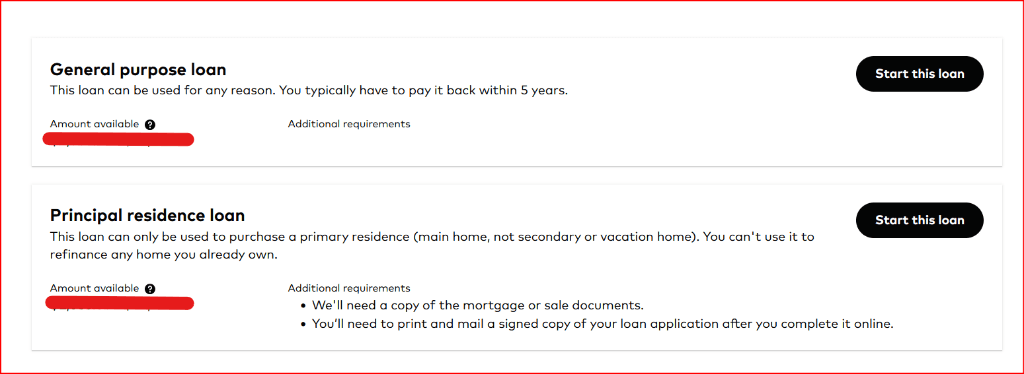
Same plan: the home loan runs from 1 to 10 years
Swipe horizontally or scroll to the right to view the full capture.
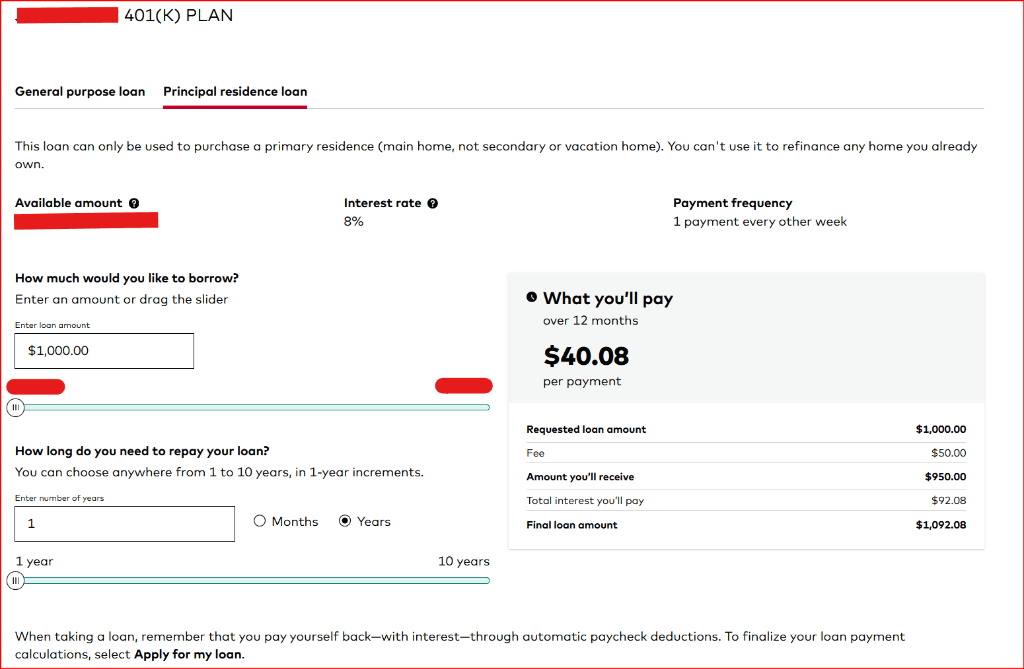
The figure below keeps an example at $40,000 either way. The years are the part that can change, and only when the plan allows the longer payback.
The bank's mortgage is a separate loan
The mortgage from a bank is built from the price of the house, the interest rate, and the number of years, which you can sketch with a mortgage calculator. That loan can include taxes, insurance, and other pieces of the monthly bill. The 401(k) loan does not replace it. You are borrowing retirement money and paying it back into the same account, while the bank loan is a debt against the house.
A bank mortgage also splits each payment between interest and the amount you still owe, which is explained in how amortization works on a mortgage and a car loan. A 401(k) loan has its own payback schedule. It is not that mortgage split, and it is not a second monthly bill added on top of the interest rate the bank already quoted.
If the payback stops, the unpaid part can be taxed
If a payment is missed, the plan can give you time to catch up, often through the end of the following quarter. After that window, the unpaid amount can be treated as money you took out of the account, and then it can be taxed as income. If you are under 59 and a half, an extra 10 percent tax can apply on top of the income tax, unless a tax exception fits your situation. The loan can also remain something you still owe the plan, so the tax and the debt are not always a swap.
Leaving the job can move the due date up. The plan can ask you to pay the rest back when you leave, instead of letting the old paycheck deduction continue. If the plan then pulls the unpaid loan out of the account, you may have until the deadline for that year's tax return, including an extension, to move that amount into another retirement account and avoid the tax. A default while you still work is harder to repair, because that unpaid amount is generally taxed, and moving the money to another retirement account later does not undo the tax.
A Roth 401(k) uses the same amount
A Roth 401(k) and a regular 401(k) let you borrow the same amount. You take half of the money that already belongs to you, and that amount cannot be more than $50,000. Roth money does not add a second $50,000 on top of that.
Roth and a regular 401(k) differ here only if you do not pay the loan back. Say $5,000 is never paid back. If that $5,000 came from a regular 401(k), the income tax on it was put off when the money went in, so it can be taxed now. If that $5,000 is money you contributed to a Roth 401(k), the income tax was already taken from your pay in the year you contributed, so it is not taxed again.
Your job can be stricter than the tax rules
The tax rules set a top, and that top is the most you can borrow: half of the money that already belongs to you, and not more than $50,000. Your job can stay under that. It can decline to offer loans, require a minimum amount, charge a fee to open the loan or to keep it open, ask a spouse to sign, or skip the longer payback even when you are buying the home you live in. Those choices are not the same at every job. Two people with the same account balance can be offered different loans because they work for different employers.
Before you count on a number for a down payment, read the loan rules your job actually uses. The half and the $50,000 are that top, the most the tax rules allow. The plan explains whether you can borrow at all, what it will cost to set the loan up, and how many years you get if the money is for the house you live in.
Before you borrow
- You can't borrow the whole 401(k) to buy a house, and you have to pay the money back.
- The most is usually half of the money that already belongs to you (your vested balance), and not more than $50,000. A job can set a lower amount.
- A loan from the 12 months before the new loan is made can shrink the next one, even after you pay it off.
- Buying the home you live in can give you more years to pay the loan back. Those extra years do not increase the amount you can borrow, and they are not for refinancing a home you already own.
- If you don't pay the loan back as the plan requires, the unpaid amount can be taxed. A Roth 401(k) uses the same borrowing amount, and the tax is the only part that can differ.